An App That Helps You Not Text Your Ex: $58K in Seven Months, Every Dollar Third-Party Verified — Then Listed for Sale at $160K
The hardest moment after a breakup is often 3 a.m., when you want to text your ex. The popular 'no contact rule' says to cut off all contact after a breakup, but it's hard to follow. In March 2026, Yasir Mohiuddin and his app studio Reframes launched Zero Contact: a pink monster helps you track how many days you've gone without contact, and when the urge hits you can type into a chat that never sends, do breathing exercises, journal, or vent to an in-app 'bestie.' It grows almost entirely through content on TikTok and Instagram. Third-party revenue verification platform TrustMRR reads its RevenueCat subscription data directly: $65 in March, about $2,000 in April, growth almost every month after, and about $14,000 in September; as of mid-October 2026, $57,910 all-time, $8,374 MRR, 1,288 active subscriptions and a 40% profit margin over the last 30 days. Pricing is $3.99 a week or $39.99 a year. Since July it has been listed for sale on TrustMRR at an asking price of $160,000.
Process
After a breakup, the hardest part often isn't the daytime. It's late at night.
At 3 a.m., you scroll back through your chats, type out a long message, and your finger hovers over send. Reason says don't; emotion pushes you to do it anyway. The next morning, you'll probably regret it.
There's a popular idea online called the "no contact rule": after a breakup, cut off all contact — no messages, no checking their posts — and give yourself time to move on. Everyone understands it; actually doing it is hard.
In March 2026, an app called Zero Contact launched to tackle exactly that moment: not by forbidding the urge, but by giving you somewhere to put it when you can't hold back.
Unlike many indie stories, this case's revenue figures don't come from a founder interview. They come from the third-party revenue verification platform TrustMRR, which reads the app's subscription back end (RevenueCat) directly, so the month-by-month numbers can be checked publicly. As of mid-October 2026, seven months after launch, Zero Contact had made $57,910 in total revenue.
A caveat up front: there is very little first-hand public information about the founder or how the app was built, and no formal interview could be found. So this piece sticks to verifiable facts: TrustMRR's verified data, public App Store information, and the developer studio's own website.
Phase 1 · A studio that makes "viral apps"
Zero Contact's developer is Reframes Group, LLC, founded by Yasir Mohiuddin. His X profile places him in Hong Kong, and his bio says he's "building the most viral + tastiest apps ever."
Reframes isn't one person quietly writing code. It's a studio focused on consumer apps. Its website describes "a studio system for products that need to feel considered, move quickly, and reach culture through organic distribution," and claims:
- 15+ products released;
- 2M+ users served;
- 750M+ organic impressions on social media;
- an ambassador network of 220+ creators who move products into culture;
- and a "We're hiring" link.
Among the featured work on the site, Zero Contact is described as the "pink monster" app with 62,400+ downloads, which "had its trademark 'pink monster' storm through social media, sparking conversations in the consumer mental health space." On the App Store, Reframes also publishes the dating app Crossi, the couples app Spicey and the sleep app Sleepy, among others.
So this isn't a "one person, one laptop, starting from zero" story. It's one product from a small studio with a playbook and a creator network. That matters: it shapes how Zero Contact grew, and how hard it is for an ordinary person to copy.
Phase 2 · A pink monster and four features
On the App Store, Zero Contact's full name is "Zero Contact: Heal Faster." It launched on March 12, 2026, in the Lifestyle category.
Its description is blunt: "Heartbreak sucks. That 3 AM urge to text? We've all been there."
According to the App Store listing, its core features are:
- A no-contact streak: timers, a fiery tracker and badges show how many days and hours you've gone without contact — "celebrate every hour you stay strong";
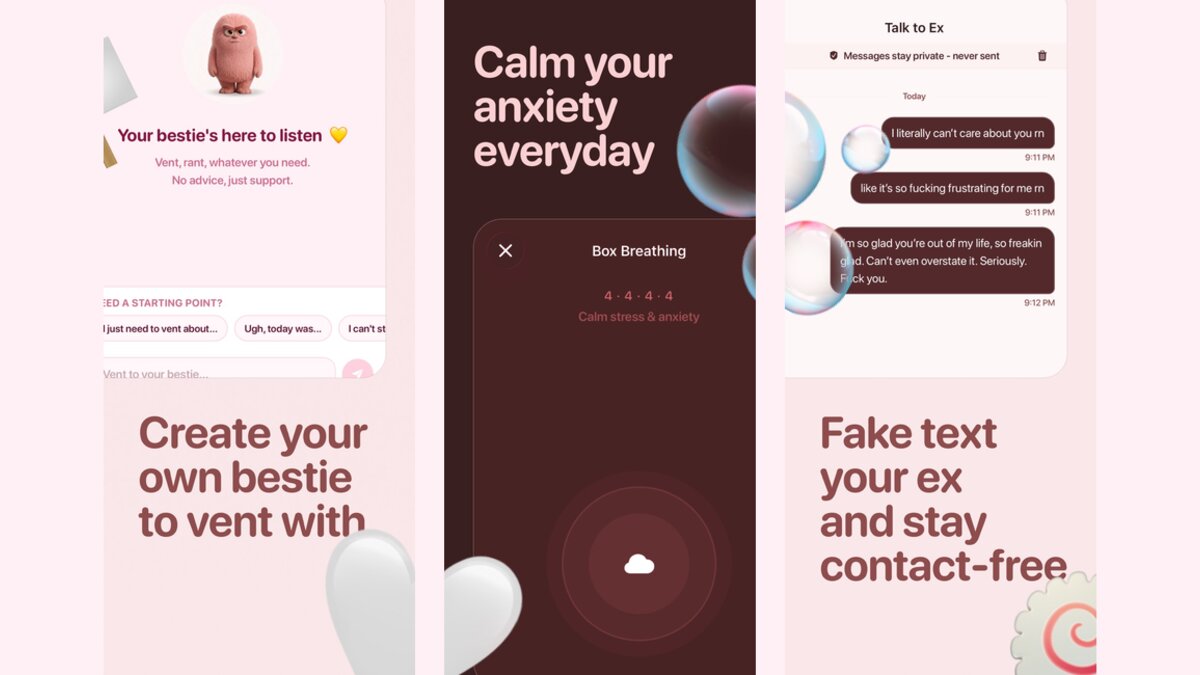
- Fake-texting your ex: write whatever you want, but it never sends — "pure catharsis in a private bubble";
- Calming down: guided box and 4-7-8 breathing, quick coping tips, and healing quotes when temptation hits;
- A daily journal: log feelings and track moods, "reflect without judgment."
The App Store screenshots also show a "bestie" feature: "Your bestie's here to listen. Vent, rant, whatever you need. No advice, just support."
The whole app is built around a fuzzy pink monster. On the first screen it stands with arms crossed and a frown next to "#1 no contact app"; on the streak screen it stands amid confetti above "Day 39, one month of healing."
It's a smart design. Wanting to text an ex is a very private, even slightly embarrassing impulse. Zero Contact doesn't try to suppress it; it gives you a safe place to write it all out, get the feelings out, and then not send it.
Phase 3 · Seven months of revenue
TrustMRR's data shows every month of Zero Contact's growth from zero:
| Month | Verified revenue |
|---|---|
| March 2026 (launch month) | $65 |
| April 2026 | $1,965 |
| May 2026 | $6,644 |
| June 2026 | $8,800 |
| July 2026 | $9,086 |
| August 2026 | $11,744 |
| September 2026 | $13,996 |
From $65 in its launch month to nearly $14,000 in a single month six months later, revenue grew almost every month. Revenue over the last 30 days was $13,438, up about 9% on the previous 30 days.
Other verified figures (as of October 14, 2026):
- MRR (monthly recurring revenue): $8,374;
- Active subscriptions: 1,288;
- Profit margin over the last 30 days: 40%.
There are just two price points: $3.99 a week or $39.99 a year, with possible free trials for new users.
One detail worth noting: revenue over the last 30 days ($13,438) is clearly higher than MRR ($8,374). That usually means some users buy yearly plans: the annual fee counts as revenue in the month it's paid, but is spread across 12 months when calculating MRR.
Another detail is the 40% profit margin, which isn't high for a software product. Given Apple's cut and the studio's creator-driven acquisition model, a good share of revenue likely goes to acquiring users — though the actual cost breakdown isn't public.
On the tech side, TrustMRR lists Expo and React Native (cross-platform development), Next.js and Tailwind CSS (website), Supabase (back end), Sentry (error monitoring) and RevenueCat (subscriptions). It lists just two marketing channels: TikTok and Instagram.
By October 2026, Zero Contact had 392 ratings on the US App Store, averaging 4.75.
Phase 4 · Listed for sale four months after launch
The most surprising part of this story is how it ends.
According to its TrustMRR page, Zero Contact has been listed for sale since July 8, 2026 — less than four months after launch.
The listing:
- Asking price: $160,000;
- a revenue multiple of about 1.0x (roughly one year of revenue);
- nine offers received so far, with 2,000+ potential buyers having viewed it recently.
Why sell a product that's still growing? Public sources don't say. But given Reframes' model, one reasonable guess is that for a studio constantly launching new products and testing fast through a creator network, cashing out a product that has proven itself and reinvesting in the next one is a business model in itself.
For a buyer, 1x revenue isn't expensive, but there are risks: demand for emotional apps like this is temporary — users leave once they've moved on — and growth depends heavily on organic short-video traffic. Whether growth would continue under a team less skilled at content is a big question mark.
Thinking
1. Good products catch the impulse instead of forbidding it
Most no-contact advice says "don't reach out." Zero Contact lets you write — it just never sends. It acknowledges the emotion and gives it a safe outlet.
For emotional products, design with users' instincts instead of fighting them.
2. A distinctive character is a growth asset in the short-video era
A frowning, arms-crossed pink monster is more memorable and shareable than any feature list. The studio's own site calls Zero Contact the "pink monster" app.
In categories that grow through short videos, a recognizable visual character is marketing in itself.
3. Third-party verified data beats any interview
This case has no long founder interview, but it does have month-by-month revenue anyone can check. A curve from $65 to nearly $14,000 is more convincing than any "I make X a month" claim.
When reading revenue stories, trust numbers that can be verified first.
4. The studio model: building products — and selling them
Reframes has released more than a dozen products, and Zero Contact was listed for sale less than four months after launch. That points to a different path from "build one product for life": build fast, prove growth, then sell.
Marketplaces like TrustMRR mean even a small app making a few thousand to ten-plus thousand dollars a month can find a buyer.
5. Understand the risks
A 40% profit margin suggests acquisition isn't cheap; heartbreak is a temporary need, and users leave once they're better; growth depends on short-video platform traffic. All of this means it's a business that needs ongoing investment in content and acquisition, not something you build once and coast on.
Action
Step 1: Find a "strong but private" emotional moment (1 week) Breakups, quitting smoking or drinking, controlling impulse spending. Ask: what do people most want to do — but most shouldn't — in that moment?
Step 2: Design a safe outlet, not a ban Like "a message to your ex that never sends," let users release the impulse instead of suppressing it.
Step 3: Create a recognizable character Give your product a cute, expressive mascot and put it on every screen and in every video.
Step 4: Launch with as few features as possible Tracking, venting, calming down and journaling — four features are enough. Build fast with off-the-shelf tools like Expo, Supabase and RevenueCat.
Step 5: Tell users' stories on TikTok and Instagram Make content around relatable moments like "the 3 a.m. urge to text." If you don't have a creator network, start by appearing yourself or working with small creators.
Step 6: Connect your revenue to a third-party verification platform Verifying revenue publicly on a platform like TrustMRR builds trust and prepares you for a possible sale later.
Step 7: Decide whether to run it long term or sell it once it works If you're good at building fast and driving growth, consider doing what a studio does: list proven products for sale and reinvest in the next one.
Not for you if:
- You can't make short-video content and have no creator resources;
- You want long-term retention — emotional needs are often temporary;
- You can't accept high acquisition costs and margins below half;
- You don't respect the limits of mental-health products: apps like this can offer emotional support, but they're no substitute for professional counseling.