A College Dropout Who Couldn't Code Built an App Just for Abs: $50K a Month in Five Months — Then Put It Up for Sale
Lino is 19, dropped out after one semester of college and had never written a line of code. In February 2026, at the gym with friends who kept comparing abs, he realized there was no app dedicated to helping people get visible abs. He spent two months fumbling with the AI site builder Lovable, decided it was too poor to launch, rebuilt it in a month with the AI app builder Rork, and made just over $7,000 in the first month. Early on he paid big fitness influencers thousands of dollars per video, leaving margins of only 5–10%; he then gave equity to one fitness creator in exchange for content, cut every other influencer deal and focused on Meta and TikTok ads, where the same videos earned several times more on TikTok. According to what he told Starter Story in October 2026, the month was tracking at about $55,000 and heading toward $60,000, with 3,000+ paying users. Third-party platform TrustMRR, verified via RevenueCat, shows about $49,000 in revenue over the last 30 days and $154,000 all-time. But he has also listed the app for sale on TrustMRR, saying he's stretched thin across too many projects.
Process
Twenty or thirty years ago on American television, late-night infomercials were inescapable: a chiselled fitness model holding some miraculous gadget, promising that "just five minutes a day will get you washboard abs by summer."
Those infomercials ran for decades because they were never truly selling fitness equipment. They were selling a timeless, evergreen human desire: everyone wants visible abs. Summer rolls around every single year, and every year people want to look their best at the beach.
In 2026, a 19-year-old took that age-old commercial desire and packaged it into a mobile app.
His name is Lino. He dropped out of college after just one semester and had never written a single line of code in his life. His app is called AbMaxx, and it does exactly one thing: help you build visible abs.
According to his interview on the entrepreneurial channel Starter Story in October 2026, AbMaxx had been live for about five months and was tracking at roughly $55,000 per month, on pace to hit $60,000. Independent revenue verification platform TrustMRR, connected directly to his RevenueCat backend, showed $49,414 over the trailing 30 days and $154,337 in all-time revenue.
Yet this story comes with an unexpected twist: Lino has already put the app up for sale.
Stage 1: An "Abs Contest" at the Gym
In February 2026, Lino went to the gym with a group of friends.
Throughout their workout, everyone was comparing physiques: "My abs look sharper than yours." "No way, mine are way more defined."
A sudden realization struck Lino: "Literally everyone cares about their abs."
He went home and conducted market research, uncovering a massive gap: if someone in 2026 wanted to train specifically for visible abs, there was not a single dedicated destination on the market. There was no shortage of fitness apps, but they were all all-in-one generic trackers; not one focused purely and solely on abs.
He asked himself: why not build an app dedicated exclusively to helping people get six-pack abs?
Starter Story host Pat Walls praised the positioning: "If you build an all-in-one workout logger, sure, people have succeeded there, but drilling down into an ultra-specific niche works infinitely better."
Stage 2: Fumbling for Two Months with Lovable, Then Scrapping Everything
The immediate hurdle was that Lino didn't know how to code.
Reflecting on that phase, he admitted: "Back then, I didn't even know what vibe coding was. I didn't know how to write effective prompts, I had no idea what RevenueCat was, and I didn't even understand what an onboarding flow meant."
He started with an AI website builder called Lovable, writing prompts sentence by sentence. That process consumed two full months.
When the app was finally ready to launch, he stared at the finished build and thought: "There is no way I can ship this. It's absolute garbage."
He decided to scrap the entire project and restart from scratch using another AI app builder, Rork. Around this time, he immersed himself in the indie app developer community on X (Twitter), following successful solo founders. From them, he absorbed the principles of vibe coding and gleaned invaluable operational playbooks: how to design onboarding screens, how to run performance marketing, and what tactics actually converted in real-world apps.
He created his X account in November 2025; by October 2026, he had amassed over 6,000 followers. To him, that community was the most valuable free resource imaginable: "These founders share immense amounts of tactical advice completely free." His number one piece of advice to beginners became: "Join the app ecosystem on X first and follow the top founders."
Applying these hard-earned insights to his second attempt, he rebuilt the launch-ready V2 in just one month.
In its first month post-launch, AbMaxx generated over $7,000.
Stage 3: Burning Cash on Big Influencers with Just 5% Margins
Next came user acquisition—and Lino's first major misstep proved expensive.
He began hiring top-tier fitness influencers to produce promotional videos, spending thousands of dollars per post. He later admitted: "That was probably one of the biggest mistakes I made. We rushed in blindly before validating which creative formats actually worked, throwing thousands of dollars at single videos without proven scripts."
At the same time, he manually ran several faceless TikTok image-carousel accounts.
While the combination of mega-influencers and organic TikTok carousels lifted monthly revenue to $3,000–$4,000, there was a glaring flaw: net profit margins sat at just 5% to 10%. Despite all the hustle, he was taking virtually no profit home.
Stage 4: Trading Equity for Content, Then Betting Everything on Paid Ads
That was when Lino devised a far smarter strategy: he partnered with an influential fitness creator, granting them equity in the app in exchange for long-term content creation for AbMaxx.
Pat Walls lauded the move: "Instead of scrambling after a dozen micro-creators, negotiating micro-deals and praying one or two hit, partnering with an equity-aligned collaborator is brilliant. Your creative production costs drop to near zero, and your partner is genuinely invested in making the app win."
Fueled by this steady stream of high-quality creator assets, AbMaxx surged to roughly $10,000 a month.
Next, Lino made a bold call: he terminated all other influencer and UGC contracts, kept only the equity-partnered creator, and doubled down on what had proven most predictable: paid performance advertising.
He discovered that Meta ads delivered a Return on Ad Spend (ROAS) of 2x to 2.5x, making campaigns instantly profitable. He scaled his Meta ad spend aggressively.
Soon after, he ported the exact same Meta video creatives directly into TikTok Ads. The results were astonishing: the identical creatives generated a 4x to 5x ROAS on TikTok.
The reasoning was straightforward: AbMaxx targets men and women aged 15 to 30. TikTok’s audience skews significantly younger, whereas Meta trends older. "On TikTok, we were able to reach and resonate with that core demographic with pinpoint precision."
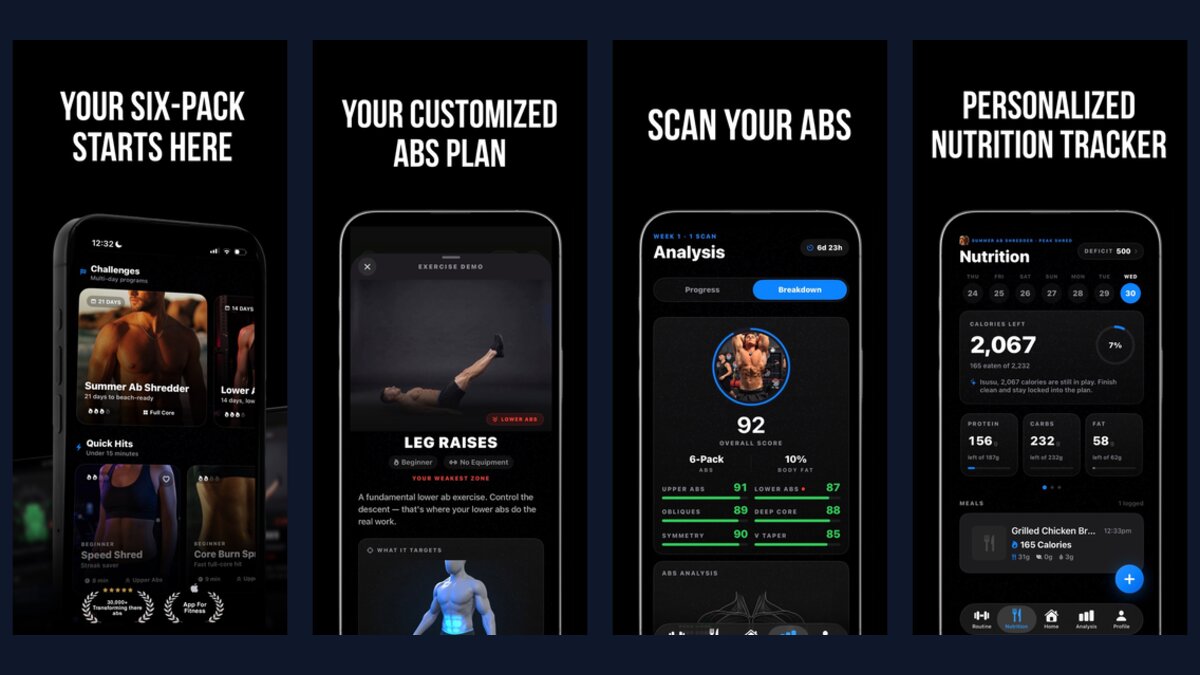
Stage 5: A "Photo-Scoring" Abs App
AbMaxx’s user experience is friction-free:
- Snap a photo, and the AI analyzes your abdominal development in seconds, issuing an overall aesthetic score and estimating body fat percentage;
- It breaks down what is holding your abs back: whether your body fat is too high or your core muscle mass is insufficient;
- It generates a hyper-personalized abs workout routine tailored to your physique.
The app also features curated training programs, such as Lino’s personal favorite "Summer Abs Fast-Track"—a structured 30-day challenge. Its App Store listing also showcases fitness streaks and calorie/nutrition logging.
Lino's tech stack is remarkably lean: Rork for front-to-back app generation, Supabase for authentication and database management, PostHog for product analytics, Sensor Tower for competitor intelligence and inspiration, and an electronic signature tool for executing creator contracts.
He maintains he was the first to execute on this specific angle: "There was practically zero direct competition in this niche." However, Pat Walls offered a candid reality check to viewers: anyone can build a similar app. "Building the software isn't the barrier; the real competitive moat is marketing and distribution."
Stage 6: Five Months In, $50K a Month
By October 2026, Lino revealed his figures on Starter Story: monthly run-rate hovering around $55,000, tracking toward $60,000; over 16,000 downloads in the past 28 days; and more than 3,000 paying subscribers.
TrustMRR’s verified metrics largely corroborated the scale: $49,414 in 30-day revenue, $154,337 in cumulative revenue, and 4,905 active subscriptions, accompanied by roughly 1,700 App Store ratings in the US store with an average score of 4.7.
Intriguingly, TrustMRR reported a Monthly Recurring Revenue (MRR) of just $18,860, considerably lower than the headline $50,000 monthly cash intake. This discrepancy indicates that a substantial portion of sales stems from annual subscriptions or upfront non-recurring purchases: annual fees hit top-line cash in the month of purchase, but are normalized across 12 months when computing MRR. "Monthly cash collection" and "MRR" are two distinct financial metrics, and discerning founders must always separate the two.
Regarding unit economics, while Lino did not disclose exact ad spend, he stated campaigns were comfortably profitable. A back-of-the-envelope calculation reveals: with ROAS between 2x and 5x, every $10,000 in revenue requires $2,000 to $5,000 in ad spend. After factoring in Apple’s 15–30% platform cut, the creator’s equity distributions, and SaaS tooling overhead, the net profit landing in his pocket is significantly smaller than gross top-line revenue. This is the universal reality of ad-driven apps: top-line revenue scales at lightning speed, but every single dollar of revenue carries customer acquisition costs.
Stage 7: Listed for Sale
As of October 9, 2026, AbMaxx displayed an active badge on TrustMRR: For Sale. Right around the broadcast of his Starter Story feature, the asset was listed on the open marketplace.
Lino left a public note on the listing: "Everything is dialed in and primed for further scaling. I simply have too many other projects ongoing and cannot give this the focus it deserves. We are the #1 ranked app in the abs category with virtually no direct competitors."
His X bio now reads: "19 y/o building mobile apps," accompanied by a link booking 1-on-1 advisory calls.
For a 19-year-old college dropout who couldn't write code six months earlier, bootstrapping an app from scratch to tens of thousands in monthly revenue and exiting via sale represents a complete, textbook entrepreneurial lifecycle.
His advice to aspiring founders: never quit, and stop comparing your beginning to people flashing seven-figure exits on social media. "You will hit rough patches where you genuinely feel like life is ruined. I lived through those moments where I thought everything was over. Looking back now, it was nothing. As long as you never quit, show up every day, and make incremental progress, it is mathematically impossible to lose."
Thinking
1. The narrower the niche, the easier it is to be discovered
AbMaxx avoids building a generic fitness tracker and zeroes in on getting visible abs. Users grasp the value proposition in one second, ad copywriting writes itself, and direct competitors are scarce. Carving out an ultra-narrow entry point with intense emotional demand inside a massive market is far easier than fighting entrenched giants head-on.
2. AI tools eliminate coding barriers, but they don't build great products automatically
Lino spent two months on Lovable and ended up with a build he was ashamed to publish. Only after switching to Rork and copying proven onboarding and paywall architectures from top indie hackers on X did he craft a high-converting product. AI writes code, but it cannot judge product-market fit. Learning directly from established operators is infinitely faster than stumbling in isolation.
3. Validate creative formats with pocket change before spending big
His costliest blunder was dropping thousands of dollars on mega-influencers before validating creative angles, collapsing margins to 5%. His revised playbook: spend $100 across micro-creators to test 10 different hooks and formats, and only pour capital into winners. Validate with pocket change before scaling with real cash.
4. The same creative asset can yield completely different returns across platforms
The identical video ad returned 2–2.5x on Meta but achieved 4–5x on TikTok, driven entirely by audience demographic alignment. Deploy ad dollars where your actual target demographic spends their attention.
5. Distinguish cash revenue from MRR, and understand founder incentives
A $50,000 monthly cash collection versus an $18,860 MRR reveals that revenue is heavily weighted toward upfront annual billings. Furthermore, when a founder lists an ad-driven app for sale at peak momentum, remember: apps with modest technical moats rely perpetually on marketing arbitrage. Whenever you see glamorous top-line revenue, ask: how is it calculated, and can it endure?
Action
Step 1: Immerse yourself in the indie app community on X (Week 1)
Follow bootstrapped app founders who transparently share metrics and playbooks. Dissect their onboarding flows, paywalls, and ad creatives.
Step 2: Identify lucrative niches using Sensor Tower
If multiple apps in a sub-category consistently generate over $10,000 monthly, proven consumer demand exists. Pinpoint an ultra-focused wedge inside that demand.
Step 3: Validate demand with content before writing code
Launch a faceless TikTok carousel account. Publish 3–4 daily posts tailored to your concept, closing with: "Comment 'App' and I'll DM you the link." Assess comment volume after 7 days to validate organic pull.
Step 4: Ship V1 within 7 days
Leverage AI builders like Rork or Lovable to construct only core functionality. Launch immediately rather than getting trapped in multi-month perfectionism.
Step 5: Test creatives with micro-creators
Partner with micro-influencers (500–1,000 followers) who post daily. Spend ~$100 across 10 sample videos testing various hooks, pacing, and calls-to-action.
Step 6: Scale validated winners
Expand to 10–15 creator collaborations or negotiate equity with a high-profile creator for continuous content. Funnel winning creatives into Meta and TikTok ad campaigns, measuring platform-specific ROAS.
Step 7: Refine the product only after distribution stabilizes
Once monthly revenues sustain at $5,000–$10,000, consider hiring professional engineers to refactor the codebase and expand feature depth.
This is NOT for you if:
- You lack testing capital for paid performance ads or cannot tolerate negative testing ROAS;
- You seek to build defensible, long-term enterprise moats—lightweight consumer apps are easily replicated;
- You are unwilling to spend significant time analyzing campaign data and optimizing ad funnels;
- You fixate purely on gross revenue while ignoring ad acquisition costs, net margins, and churn rates.