College Dropouts Built $13M Turbo AI: How Two 20-Year-Olds Scaled to 10M Users via Free Cookies and Bathroom Fliers
Rudy Arora and Sarthak Dhawan have been friends since sixth grade; in high school they built a Christmas-light installation app that made about $60,000. In 2023 they started at Northwestern and Duke, and in January 2024 launched Turbolearn (later Turbo AI), which turns lecture recordings, PDFs and YouTube videos into notes, flashcards and quizzes. They bootstrapped with cookies in dining halls and posters in bathroom stalls, won Northwestern's $100,000 VentureCat grand prize in May 2024, then scaled through a TikTok creator program. They raised only about $750K, stayed profitable, and dropped out after sophomore year in 2025. Per TechCrunch and Business Insider: 5M users and eight-figure ARR in October 2025; $13M lifetime revenue with a 10-person team by June 2026.
Process
One line from Sarthak Dhawan sums up where Turbo AI started:
"I could never take notes and pay attention to the teacher at the same time."
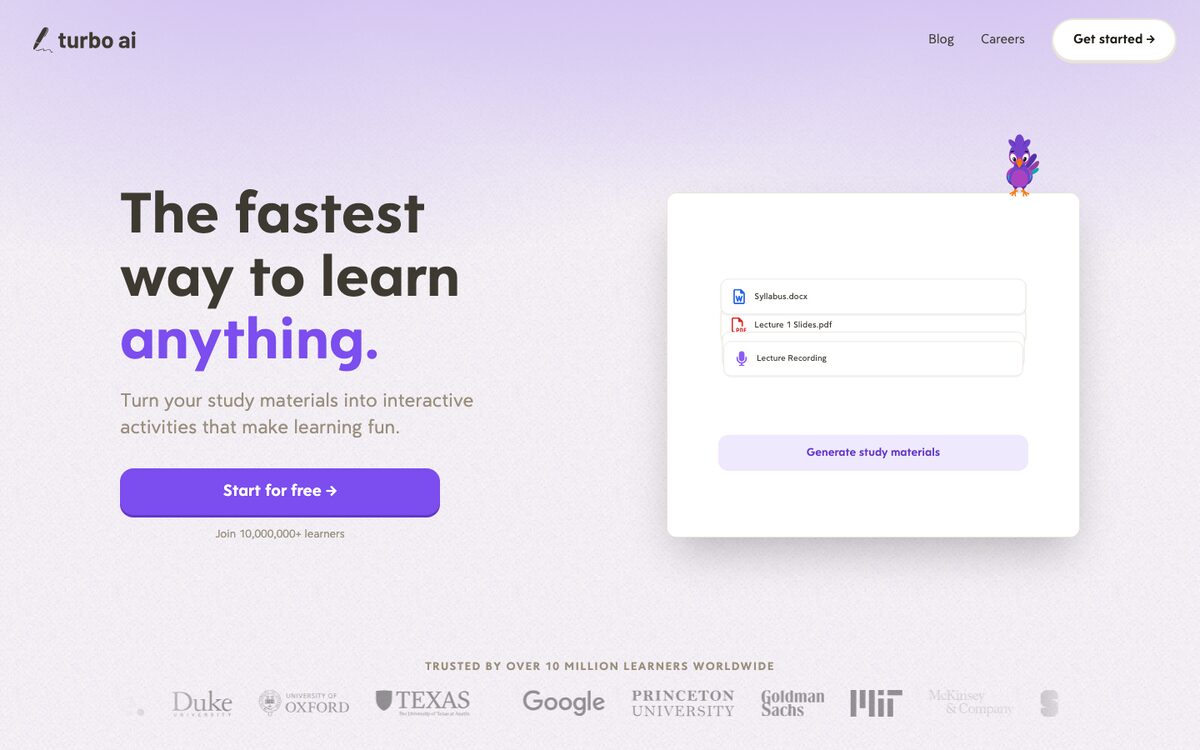
Almost every student has that problem. The difference is that Dhawan and Rudy Arora, his friend since sixth grade, turned it into a business. Turbolearn (later renamed Turbo AI) launched in January 2024 and automatically turns lecture recordings, PDF slides and YouTube videos into notes, flashcards and quizzes.
The numbers, all from public reporting:
- March 2025: about $500K in monthly revenue;
- October 2025 (TechCrunch): 5 million users, up from 1 million in six months, about 20,000 new users a day, eight-figure ARR, a 15-person team;
- June 2026 (Business Insider): $13M in lifetime revenue with a 10-person team;
- Website claim: 10 million+ learners (company figure, not independently verified).
Outside funding totals only about $750K, and the founders say the company has been profitable from day one.
A note up front: Turbo AI has a 10–15 person team, so it isn't a solo business. But it barely relied on funding, and its growth path is one ordinary founders can understand and borrow from.
Phase 1 · Doing business in high school (before 2023)
Rudy and Sarthak met in sixth grade. Both were high achievers in high school — Arora took 16 AP courses and scored 1560 on the SAT; Dhawan was salutatorian, took 21 APs and got a perfect ACT.
More important than grades, they were already building products together: an app for booking Christmas-light installation that made about $60,000.
According to TechCrunch, Dhawan had also worked on UMax, an advice app that reached #1 on the App Store. In other words, before Turbo AI they already had hands-on experience building consumer apps and acquiring users. This wasn't two students' lucky flash of inspiration; it was an experienced pair finding a new direction.
Arora focuses on social media growth; Dhawan handles product and engineering.
Phase 2 · Freshman year: turning their own pain into a product (2023–early 2024)
In fall 2023, Arora started at Northwestern and Dhawan at Duke.
College lectures are fast and dense. Take notes and you stop listening; listen and your notes are incomplete; before exams you face hundreds of slides and hours of audio and pull all-nighters.
Speech-to-text and large language models were good enough by then. Their idea was simple: record the lecture, or drop in a PDF or a YouTube link, and walk out with notes, flashcards and quiz questions ready to study.
Turbolearn launched in January 2024.
Phase 3 · Cookies, bathroom posters and the VentureCat prize (spring 2024)
With no ad budget, they started on their own campuses:
- Free cookies in dining halls in exchange for scanning a QR code and trying the app;
- Posters inside bathroom stalls — where students are most likely to pull out their phones with nothing else to do.
These tactics cost almost nothing and suited saturating two campuses first: classmates talk, and word spreads fast.
On May 22, 2024, Rudy Arora presented Turbolearn at VentureCat, Northwestern's startup competition, and won the $100,000 grand prize. The non-dilutive money also raised the project's profile on campus.
Phase 4 · The real growth engine: a TikTok creator program (2024–2025)
Offline hustle got them from zero to one. Going from hundreds of thousands to millions of users came from TikTok.
Their approach was industrial:
- Pay lots of creators to post: about $5 per video, plus bonuses when a video goes viral;
- Trade volume for hits: one of their videos reached 20 million views, but only after roughly 40–50 attempts.
The point is not to bet on any single piece of content but to test cheaply at volume until something breaks out. Students already live on TikTok, and "save me before the exam" content spreads naturally.
Around this time they raised about $750K from investors who approached them. They say they have no plans to raise more.
Phase 5 · Dropping out, rebranding, reaching professionals (2025)
In 2025, after sophomore year, both dropped out to work on Turbo AI full time. The company is based in Los Angeles.
The product was renamed from Turbolearn to Turbo AI because its users were no longer just students: consultants, lawyers, doctors and analysts at Goldman Sachs and McKinsey were using it to digest large volumes of material.
Pricing is $20/month or $120/year — the annual plan is half price, which fits students' habit of buying once at the start of the year.
In October 2025, TechCrunch reported 5 million users, up from 1 million in six months, about 20,000 new users a day, eight-figure ARR and continued profitability. Dhawan said: "What's cool now is that when students think of an AI notetaker or AI study tool, we're the first ones that come to mind."
Phase 6 · A 10-person team, $13M lifetime revenue and Claude Code (2026)
In June 2026, Business Insider reported that Turbo AI had reached $13M in lifetime revenue with just 10 people, six of them engineers.
One reason such a small team ships fast is AI coding. The founders say they now write little code by hand and rely heavily on Claude Code. Dhawan admits he can feel his "coding skills atrophying," but the small team ships at the pace of a much larger one.
Thinking
1. A pain point that is essential, frequent and deadline-driven
Most learning products die because users quit after three days. Turbo AI targets a different kind of need: every lecture, and urgently before every exam. Exams have deadlines, and anxiety drives purchase decisions; daily classes drive frequent use. The founders were the users, so they understood the scenario exactly.
2. Cold start and scale need different playbooks
- 0 → 1: cookies and bathroom posters — nearly free, saturating a closed community (a campus) first;
- 1 → 100: a TikTok creator program — turning content marketing into a pipeline you can buy and test at volume.
Many people only remember the fun cookie story and miss that the second playbook brought in millions of users. 40–50 attempts for one hit means it's a probability game: the key is a low cost per attempt and many attempts.
3. Watch for survivorship bias: they didn't start from zero
The founders built a $60K app in high school, and Dhawan reportedly worked on an app that topped the App Store. They knew how consumer apps acquire and monetize users. Add the VentureCat stage and media attention that come with elite universities, and you have advantages most people copying them won't have. What you can copy is the method (your own pain point + cheap testing + creator distribution), not the starting point.
4. Little funding kept their options open
Raising only about $750K and staying profitable meant no pressure to burn cash for a valuation, and freedom to expand on their own schedule (from students to professionals). A 10-person team plus Claude Code keeps leverage high and margins healthy.
5. Risks and criticism
- Free alternatives from big tech: ChatGPT, Gemini and Google's NotebookLM (which now offers flashcards and quizzes) can do similar things. Turbo AI's moat is its complete workflow and brand recognition, not the technology itself;
- Seasonality: student demand follows semesters and exam weeks, with clear dips over summer;
- Lecture-recording rules: some schools and professors ban recording, which limits the core feature;
- Inconsistent figures: the website claims 10M+ learners, while media report 5M users (October 2025) and $13M lifetime revenue (June 2026); none of it is audited.
Action
Step 1: Find a frequent, deadline-driven pain in your own community (1 week) List tasks you or people around you repeat weekly that have clear deadlines: exam review, weekly reports, meeting notes, tax paperwork. Prefer the one where you are a heavy user yourself.
Step 2: Build an MVP that delivers the end result (2–4 weeks) Don't build "yet another chat box." Like Turbo AI, wrap the whole flow from input (recording/PDF/link) to output (notes/flashcards/quiz) so one click gets the result. Use Claude Code or Cursor to move fast.
Step 3: Saturate one closed community first A school, a company, an industry group, a local club — pick a community you can physically reach and use cheap offline tactics (small gifts for trying it, posters where people's attention is idle) to get your first few hundred users and feedback.
Step 4: Price for "free habit + annual discount" Let the free tier fit into everyday use; the paid tier unlocks unlimited use. Set annual pricing around half of monthly (e.g., $20/month vs $120/year) and push annual plans at peak-demand moments (start of term, before exams).
Step 5: Run a small creator program Find 20–50 small creators in your target audience and pay per post (a few dollars each) plus viral bonuses. Give them a few proven script angles (e.g., "6 hours before the exam"), and expect 40–50 posts before one breaks out. Track signups and payments from each video.
Step 6: Follow your users into new segments Look for unexpected groups among paying users (Turbo AI found consultants, lawyers and doctors), then adjust copy — even the brand name — to widen the market.
Step 7: Stay small and raise cautiously As long as you're profitable, grow from profits. Only take small amounts of funding that let you keep control.
Not for you if:
- Your community lacks a strong, frequent shared pain point;
- You won't grind through lots of content tests and expect one video to go viral;
- Your product is just a thin wrapper around an LLM with no full workflow — one big-tech feature update and you're gone;
- Your target users can barely pay, and you have no path to higher-value segments.