A 21-Year-Old Student Built a Guitar Tone App With AI Over Thanksgiving Break: Zero Lines of Code Written by Hand, $25K a Month in Five Months
Kyan Santiago-Calling is a computer science student at San Diego State University who plays guitar almost every day. His biggest frustration was 'tone chasing': teachers in online lessons play guitars and amps worth thousands of dollars, so copying their knob settings sounds nothing like the original on a cheap amp, and ChatGPT's suggestions weren't accurate either. Over Thanksgiving break in 2025, he 'vibe coded' the web version of ToneAdapt in a week with Cursor and Claude Code: pick a song, enter your own guitar and amp, and AI tells you where to set every knob. Tens of thousands of visitors poured in within days, but he forgot to charge at first and missed his first 3,000 users. He then posted three videos a day on TikTok, Instagram, YouTube and Facebook; his first video went viral overnight, and he remade the same format 50 times. The iOS app launched in April 2026 and had about 400 paying subscribers in its first month. According to what he told Starter Story in June 2026: more than 100,000 registered users and about $25,000 in revenue over the last four weeks (about $11,000 web, $14,000 app), run by himself.
Process
Almost every electric guitar player has tasted this exact brand of frustration.
You want to learn a rock anthem — say, Metallica's "Master of Puppets." You pull up an online lesson where the instructor plays with blistering authority, their tone hitting like a solid wall of brick. You copy their settings to the millimeter, turning your gain, bass, mid, and treble knobs to the exact same positions. Then you strike a chord — and the sound coming out of your practice amp is thin, muddy, and completely lifeless.
The reason is brutally simple: the teacher is probably playing a $3,000 guitar through a boutique vintage tube amplifier; you are playing a $200 entry-level axe through a tiny bedroom practice amp. The identical knob position on two different rigs produces two completely unrecognizable sounds.
In the guitar community, this endless struggle is known as "tone chasing." Plenty of players spend more hours tweaking knobs than actually playing music.
Twenty-one-year-old student Kyan Santiago-Calling was one of them. Over his 2025 Thanksgiving break, he used AI coding tools to spend a single week building a utility to fix this exact headache for himself: ToneAdapt.
According to his June 2026 interview on Starter Story: in under five months, this little tool accumulated over 100,000 registered users, generating roughly $25,000 in revenue across the trailing four weeks. And as he put it himself: "Every single line of code was vibe coded."
What makes this journey compelling is that it checks every classic box of modern indie hacking in 2026: AI-assisted coding, monetizing an authentic passion, and short-form video customer acquisition. A college kid with zero prior entrepreneurial pedigree shipped a functioning tool over a single school recess and sold it using nothing more than a smartphone camera. The barrier to entry looks deceptively low, yet very few actually pull it off. Where is the real differentiator? The answer is hidden in the specific decisions he made at every juncture.
Note: All financial figures originate from self-reported statements by the founder and have not undergone third-party auditing.
Phase 1 · A Guitarist's Niche Frustration
Kyan is a computer science undergraduate at San Diego State University. Prior to building ToneAdapt, he had never shipped a single digital product.
What he did have, however, was a daily habit: playing guitar. Before this idea struck, he had been practicing consistently almost every single day for well over a year.
"Tone chasing" was a persistent splinter in his mind. He had tried asking ChatGPT: "I'm using this guitar and this amp, how do I dial in the tone for this specific song?" But the answers arrived agonizingly slow, or were completely tone-deaf and musically inaccurate.
He scrolled through the comment sections of Reddit guitar forums and Instagram reels, only to discover that thousands of guitarists wrestled with this exact same pain point, with zero dedicated tools available to solve it.
He later distilled a remarkably grounded insight: "If you are dealing with a nagging frustration, there are at least thousands, if not tens of thousands, of people out there suffering from that exact same problem."
At the beginning, his ambition was refreshingly modest: construct a polished side project to pad his résumé so he could secure a software engineering internship. He never imagined for a second that it would evolve into a full-scale business.
Phase 2 · Thanksgiving Break, Built in a Week
When Thanksgiving break arrived in 2025, Kyan got to work.
He relied on Cursor and Claude Code as his primary AI coding companions. In his own words, he never wrote a single line of code by hand; instead, he communicated in natural language, describing what he wanted to achieve, then inspecting, testing, and refining the output — the quintessential manifestation of "vibe coding."
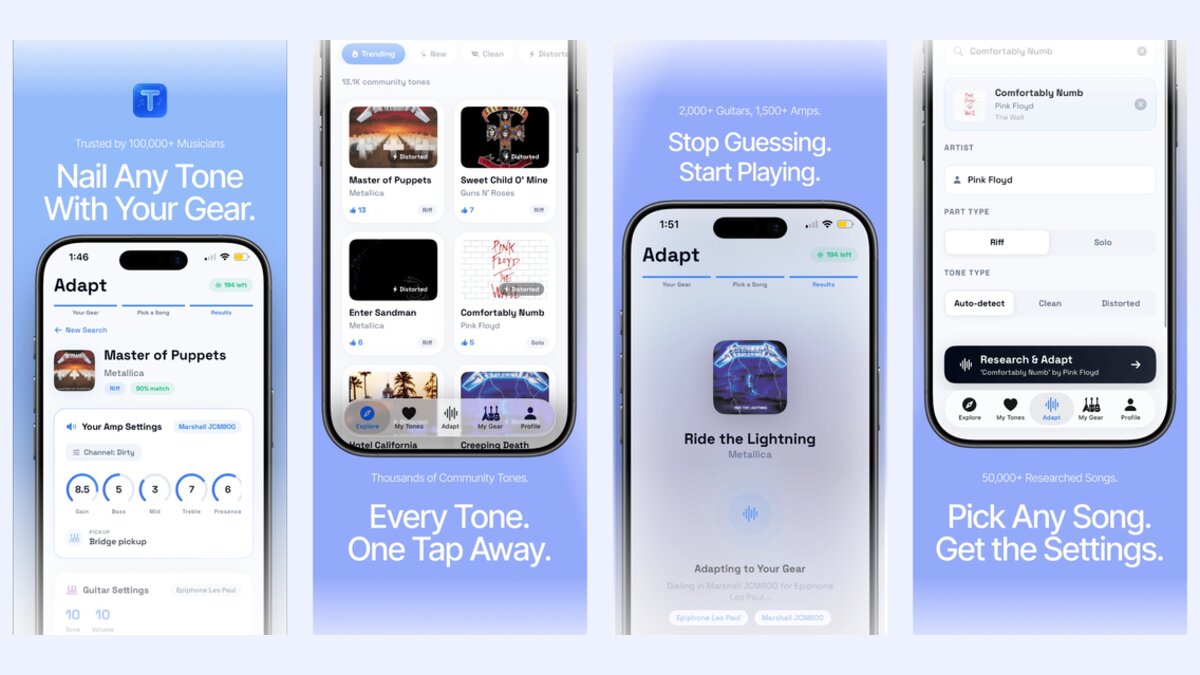
In about one week, the web version of ToneAdapt was up and running. The workflow was streamlined and intuitive:
- Input your own specific guitar, amplifier, and effect pedals;
- Search for any song title;
- The AI pulls up the original track's rig and settings, then translates and recalculates those values into the exact knob positions for your specific gear, even detailing the optimal pedal signal chain.
The entire calculation took less than 30 seconds.
The hardest part was not the software logic, but the underlying dataset. He gathered publicly available information from guitar forums, artist rig rundowns, gear teardown videos, musician interviews, and equipment reviews, gradually building a proprietary database that now encompasses over 3,600 guitars, amps, and effects pedals. The AI then computes adjusted parameter configurations based on pickup types, EQ curves, and gain stages across distinct gear profiles.
From an infrastructure perspective, he wired Supabase for database storage and user authentication, Vercel for web hosting, Stripe for payments, OpenAI APIs for inference, and an integrated web-scraping search utility to fetch supplementary reference data.
Phase 3 · Tens of Thousands of Visitors, but Forgot to Charge
The moment the web app went live, Kyan shared it on guitar subreddits as a free community utility.
The response blew past his wildest expectations. He later authored a post on Reddit's entrepreneur community titled: "Accidentally built a product that got 10K visitors in 3 days."
Yet he made a classic rookie blunder: he completely forgot to implement a payment gateway. The first wave of roughly 3,000 visitors entered, used the tool, and walked away without paying a dime. By the time he scrambled to integrate Stripe in December 2025, he managed to retain only 6 paid subscribers, netting roughly $50 in MRR.
That costly oversight led to a principle he now preaches relentlessly: "Charge from day one. You generate revenue immediately, and more importantly, you collect high-signal product feedback from people who have actual skin in the game."
His subsequent tactical advice was even blunter: "Don't spend hours picking a logo. Don't polish anything prematurely. Build something functional, put it on the web, and ask for money. You can ship a web app today and have someone pay you for it tonight."
Phase 4 · Three Videos a Day, One Hit Re-shot 50 Times
What transformed ToneAdapt into an unstoppable growth machine was short-form video.
Kyan's organic marketing engine was simple to the point of seeming brutish: publish 3 videos every single day, distributed simultaneously across Instagram, TikTok, YouTube Shorts, and Facebook Reels. His governing philosophy: "Any content is better than zero content."
He also showed his face on camera from the very first video. He admitted that his inaugural clip was "honestly super awkward," but once you hit publish and it's out in the open, you quickly realize "it really doesn't matter." He wanted prospective users to see an authentic person behind the screen, "feeling like they were embarking on this journey alongside me."
His video architecture was meticulously calibrated. It opened with an irresistible hook: "Want to get the Metallica tone using your own gear?" Next came a brisk screen demonstration of ToneAdapt generating custom settings, concluded by him personally ripping a riff on guitar to prove the settings worked.
Against all odds, his very first video went viral overnight.
Instead of chasing a brand-new gimmick for his next post, he executed a masterclass in marketing discipline: he re-shot that exact winning video 50 times, introducing micro-variations each time to pinpoint the precise hook and narrative rhythm that converted casual viewers into active users.
Once he isolated the repeatable, high-converting format, he scaled aggressively:
- Hired UGC creators (everyday user-style video makers) to churn out 60 videos a month strictly adhering to his formula;
- Poured paid advertising dollars into Meta and TikTok ads behind top-performing organic clips.
The strategic brilliance here is unmistakable: a single viral post might be pure serendipity, but a repeatable viral creative blueprint is an enterprise. Once you determine which opening frame, which cadence, and which riff reliably convert, you can pay other creators to replicate it at scale — trading capital for reach rather than praying for lightning to strike twice.
He summarized this operating rhythm in one punchy maxim: "Post like crazy until you uncover a winner; take that winner, pour gasoline on it until it burns out, and then repeat."
He also engineered native viral loops into the app: every calculated tone came with a one-click share card for social media, turning active users into free promotional evangelists. In tandem, he nurtured an active Discord community where guitarists swapped custom tone presets.
Phase 5 · Launching the iOS App and Climbing the Charts
Having validated undeniable consumer demand on the web, Kyan turned his attention to mobile.
He noted that with modern AI coding assistants, recreating the core logic of the web app natively was something he could "knock out in a matter of hours." The iOS application was authored in native Swift, leveraging RevenueCat for in-app subscription infrastructure and Superwall for paywall pay-screen A/B testing.
On April 10, 2026, ToneAdapt debuted on the App Store. In its inaugural month, the mobile app secured 397 active paying subscribers.
His monetization structure was deliberately unconventional. As shared during his Starter Story interview, ToneAdapt bypassed monthly plans altogether, offering solely a weekly pass ($10/week) and an annual pass ($60/year). The underlying reasoning: a huge cohort of guitarists only want to master a specific set of tracks for a brief window, making a weekly pass optimal; whereas dedicated daily players naturally gravitated toward the far more economical annual membership.
Phase 6 · Five Months, $25,000 a Month
In June 2026, Kyan sat down with Starter Story to publicly reveal his milestone metrics:
| Metric | Performance |
|---|---|
| Trailing 4-week Web Revenue (Stripe) | ~$11,000 |
| Trailing 4-week iOS Revenue (RevenueCat) | ~$14,000 |
| Cumulative Web Revenue (First 3 Months) | ~$45,000 |
| New Web Subscribers (First 3 Months) | ~1,400 |
| iOS Active Subscribers (Month 1) | 397 |
| Registered User Base | 100,000+ |
From December 2025's meager 6 subscribers and $50 monthly recurring revenue to approximately $25,000 a month just six months later, the trajectory was astronomical. Starter Story featured the video with a bold headline proclaiming "$300,000 a year" — an annualized projection based on multiplying monthly revenue by 12, rather than cumulative historical earnings.
On the expenditure front, exact figures remain private. Known operational costs encompass AI API inference bills, UGC creator compensation, paid acquisition budgets, and Apple's 15–30% platform take on in-app subscriptions. Running a lean solo operation with zero payroll means a substantial portion drops directly to the bottom line, though precise net margins are undisclosed. By October 2026, ToneAdapt had amassed nearly 3,000 reviews on the US App Store with a 4.8-star average rating.
Inevitably, rapid triumph invited fierce competition. Searching "guitar tone match" on the App Store yields multiple copycat apps mimicking its branding and feature set. Host Pat Walls offered an incisive verdict: "AI programming will only get easier, and identical apps will proliferate. How do you stand out? You build media and master distribution."
Kyan's roadmap involves continuous horizontal expansion: launching a desktop plugin that interfaces directly with digital audio workstations (DAWs), adding support for bass guitars and keyboards, and introducing an in-app marketplace where guitarists can buy and sell custom preset tone packs.
Thinking
1. The most lucrative ideas hide in your daily routines
ToneAdapt was not conceived through boardroom market research; it was born out of an avid guitarist solving his own daily friction. Because he lived and breathed the problem, he recognized that guitarists didn't crave generic preset libraries — they demanded to know how to nail that tone using their own physical gear.
Pick an activity you practice daily or weekly. Your domain intuition will automatically surpass that of any outside observer.
2. AI coding permanently eliminates the "building" barrier
A college undergraduate with zero product history shipped a web MVP in one week, and later rebuilt the entire mobile architecture in hours. Writing software is transitioning from an elite moat into a commoditized utility.
However, this reality cuts both ways: whatever you can build in a week, a competitor can duplicate in a week. The durable moat no longer resides in lines of code, but in proprietary data assets, distribution velocity, and intimate user empathy.
3. Monetize from day one — the earlier, the better
Surrendering his first 3,000 users without charging was Kyan's most painful early mistake. Free tools generate vanity traffic, but only monetary transactions validate authentic demand and bankroll sustainable iteration.
Introduce a checkout flow on day one, even at a modest price point. Feedback from a single paying subscriber outweighs praise from a hundred free freeloaders.
4. Content scale is not luck — it is brute-force consistency
Three videos every single day, one winning format remade 50 times, 60 monthly UGC assets — behind these figures lies mechanical, unglamorous persistence. Virality looks like lottery luck from afar, but up close, it is the mathematical inevitability of unrelenting volume.
Kyan's challenge remains potent: "Post three videos a day without fail for at least 30 days. I guarantee you will generate revenue and acquire users."
5. Great consumer products are instantly understandable
"Get the Metallica tone with YOUR gear" — that single sentence, paired with a quick demonstration and a blistering riff, communicates the entire value proposition in under five seconds. Sound and visuals are inherently cinematic, making the offering tailor-made for viral short video.
Before writing a single line of software, ask yourself: Can this product's core value be demonstrated and understood in a 15-second clip?
Action
Step 1: Uncover a persistent friction in your authentic hobby (Week 1) List tools and activities you engage with daily or weekly. Identify what annoys you most. Dive into Reddit, TikTok, or niche forums to verify if others vocalize the exact same frustration.
Step 2: Build a stripped-down MVP in one week using AI coding tools Harness Cursor or Claude Code alongside turnkey backends like Supabase, Vercel, and Stripe. Focus strictly on the single core utility. Discard aesthetic perfectionism.
Step 3: Integrate payments prior to public launch Implement free trial parameters alongside recurring billing. Determine whether your audience benefits from short-term bursts (weekly pass) or long-term retention (annual pass), and price accordingly.
Step 4: Seed the utility across relevant niche communities Share your MVP across targeted subreddits, Discord servers, and specialist discussion boards. Observe unfiltered user behavior and bug reports.
Step 5: Publish three short videos daily for at least 30 consecutive days Show your face, open with a high-stakes hook, and rapidly demonstrate the outcome. Syndicate across TikTok, Instagram Reels, and YouTube Shorts.
Step 6: Identify your first outlier hit, iterate, and pour fuel on it Produce dozens of micro-variations of your top-converting video to dissect its viral mechanics. Contract freelance UGC creators to replicate the format, and back it with targeted paid ads.
Step 7: Bake native sharing mechanisms into the product Empower users to publish their generated achievements with one click, transforming your customer base into an automated word-of-mouth marketing fleet.
Not for you if:
- You harbor no genuine personal connection to the niche and are merely chasing an opportunistic AI gimmick;
- You refuse to get on camera or lack the discipline to maintain an aggressive daily publishing schedule;
- Your value proposition is complex and cannot be demonstrated visually or audibly in a few seconds;
- You cannot tolerate operating in a cutthroat landscape where low build barriers invite swift copycats.