Crochet Kits Started With $200: How an Ex-Google Designer Used UX Thinking to Teach 500,000 People to Crochet and Sold $5.3M in Two Years
Justine Tiu was a UX designer at Google (Google Classroom) who burned out after being promoted to manager; her husband, Adrian Zhang, was a director at Deutsche Bank. Both quit in 2018. Justine learned to crochet to make a penguin for a friend and found it far too hard for beginners; coworkers who saw her work said, 'That's cute, but I could never make that.' During the 2020 pandemic, the couple spent $200 on yarn and a domain, started selling on Etsy and packed orders in her in-laws' garage. They designed the kits the way you'd design software: the hardest starting stitches come pre-done, regular yarn is replaced with a custom yarn that doesn't fray, and step-by-step videos guide you through. For the first two years it was just the two of them. When they appeared on Shark Tank in September 2022, they had sold $5.3M in two years, selling a kit that costs $3 for $30, at 86% gross and 32% net margins. The $450K deal struck on the show never closed, and the company has never raised money. By 2024 it had taught 500,000 people to crochet.
Process
Crochet is a craft that is remarkably easy to give up on.
You spot an adorable, round yarn penguin online and think, "I want to make one of those." You buy some yarn and a hook, pull up a tutorial, and get stuck on step one: making a "magic loop" to start. The yarn frays and unravels as soon as you pull it. After struggling through a few rounds, the yarn splits, the stitches turn crooked, and the whole thing dissolves into an unreadable mess. Half an hour later, you stuff the yarn into a drawer, never to take it out again.
Justine Tiu was once exactly that frustrated beginner.
The difference was that she was a user experience (UX) designer at Google — someone whose professional training was studying "why users get stuck, and how to keep them from getting stuck." Later, teaming up with her husband Adrian Zhang, she re-engineered learning crochet using the principles of software design, building the beginner crochet kit brand The Woobles.
They started with just $200. For the first two years, the company was just the two of them, hand-packing orders in her in-laws' garage. When they appeared on Shark Tank in September 2022, they revealed astonishing numbers: $5.3 million in cumulative sales over two years; a kit costing $3 to manufacture retailed for $30, delivering an 86% gross margin and 32% net margin. By 2024, they had taught over 500,000 people how to crochet.
The most fascinating aspect of this story is that crochet is not a new invention, nor is yarn a scarce resource; the market is flooded with countless tutorials and craft bundles. Why did a designer who had never touched physical manufacturing and a Wall Street banker turn it into a multi-million-dollar empire? The answer lies not in the yarn itself, but in the lens through which Justine approached the problem.
Note: The Woobles now employs over 25 people and is no longer a mom-and-pop shop. Yet its inception — $200, two people, a suburban garage, and zero venture capital — represents a playbook that any aspiring creator can study.
Phase 1 · A "Terrible Manager" and a Wall Street Director
Justine and Adrian are both alumni of Duke University.
Justine joined Google, working on UX design for the Google Classroom team. She excelled and was promoted to manager. But she quickly discovered that managing people did not suit her. As she later joked self-deprecatingly: "They promoted me to manager, and it turns out I sucked at being a manager."
She plunged into severe burnout and self-doubt, enduring a dark period of mental exhaustion.
Adrian, on the other hand, worked on Wall Street as a director at Deutsche Bank.
In 2018, both decided to leave their corporate jobs. Over the ensuing months, they tested several startup ideas, but none gained meaningful traction.
Walking away from prestigious salaries at Google and Wall Street is unthinkable to many. But for Justine at the time, remaining in a role that constantly eroded her self-confidence carried an even higher toll. They had savings and they had time; what they needed was a direction truly worth committing their lives to.
Phase 2 · A Penguin, and "I Could Never Make That"
The breakthrough came from an unassuming gesture.
Justine wanted to give a close friend a thoughtful, personalized gift. She thought: "What is more personal than something made by hand?" So she set out to learn crochet, aiming to craft a small penguin. Her mother, an experienced crocheter, offered guidance.
Yet the learning curve was far steeper than she anticipated. Looking back, she realized that overcoming that steep curve reignited something burnout had snuffed out: "Hey, I am still capable of learning new things."
She brought the finished penguin to a company photoshoot. Colleagues gathered around, admiring the little toy, and almost everyone uttered the exact same phrase: "That is so cute, but I could never make that."
Hearing those words ignited the UX designer inside her. When people believe they cannot accomplish something, it is rarely due to a lack of intelligence; rather, it is because the onboarding experience is fundamentally flawed. Her immediate reaction was: "Challenge accepted."
This is textbook UX thinking. At Google, if users consistently abandon a workflow on a web page, designers do not blame the users for being incompetent; they investigate: Which step is overly complex? Which label is confusing? Justine applied that exact diagnostic framework to crochet: Where do beginners give up? Why? And can that stumbling block be designed out of existence?
Phase 3 · $200, an Etsy Store, and Yarn Wound Around a Sharpie
In early 2020, the COVID-19 pandemic struck. Confined to their homes, millions sought comfort in new hobbies, sparking a massive renaissance in craft hobbies.
Justine and Adrian seized the moment. They invested roughly $200 to buy yarn and register a domain name.
Instead of overbuilding an elaborate custom website, they launched a storefront on Etsy, selling crochet patterns and basic starter kits to test market demand. Driven by the crafting boom and organic word of mouth, sales surged.
In July 2020, The Woobles officially launched its own standalone website. They initially ran on WordPress and WooCommerce, which crashed frequently under traffic spikes; they subsequently migrated to Shopify. Adrian noted that setting up Shopify took just a single afternoon using a free default theme. His assessment was candid: "The vast majority of e-commerce is straightforward. You do not need overly sophisticated custom features."
Everything in the early days was assembled by hand. Justine recalled literally winding yarn skeins around Sharpie markers to fit them into boxes. Orders were packed and shipped out of Adrian's parents' garage, and the founders handled every customer service inquiry personally.
For their first two years, the company operated without a single employee — just the husband-and-wife duo. According to Business Insider, they generated approximately $1 million in revenue during their very first year.
Phase 4 · "The User Should Never Enter a Bad State"
The core breakthrough of The Woobles was Justine's application of digital UX principles to a physical craft kit.
In software design, an inviolable rule is: A user should never be allowed to enter a bad state. In other words, the interface must be engineered so that users can hardly make a fatal error, become hopelessly confused, or abandon the process.
She applied this principle systematically to crochet, methodically dismantling every point of failure for beginners:
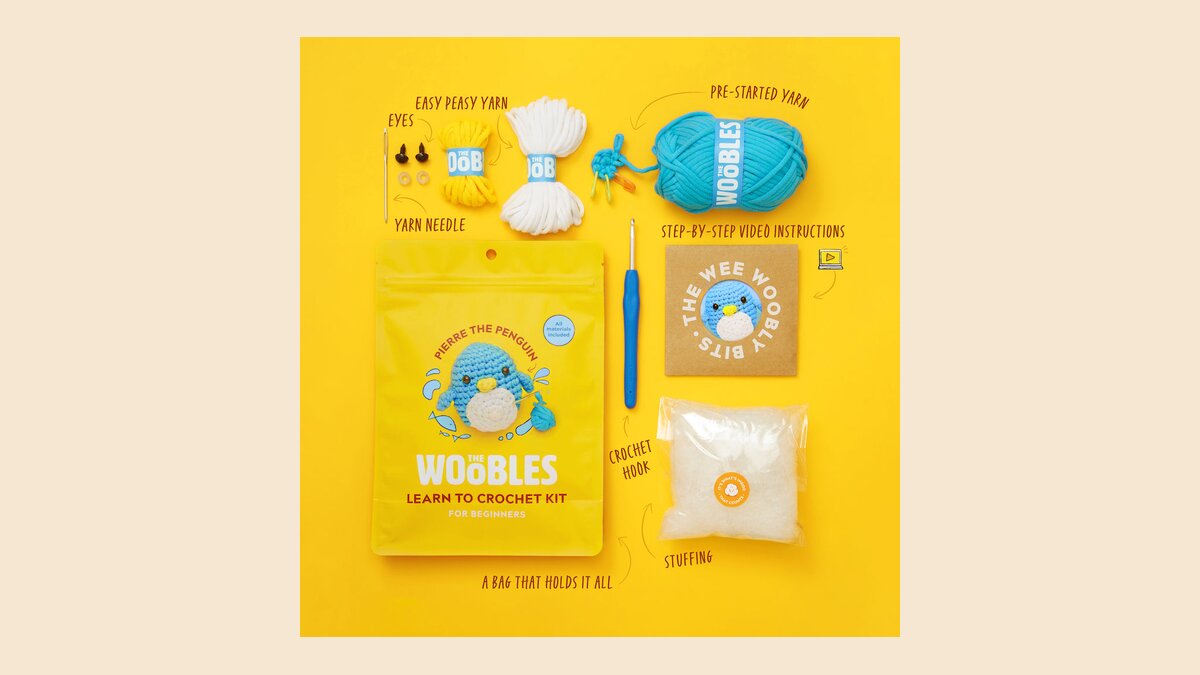
- Pre-started Pieces: The absolute hardest part of crochet is creating the initial stitches and founding rounds. In every Woobles kit, the first round is already crocheted by hand at the factory, complete with stitch markers locked in place. Beginners pick up the piece and start immediately.
- Custom Yarn: Standard spun yarn frays, splits, and pills easily, making it nearly impossible for beginners to see individual stitch loops. They engineered a proprietary nylon-polyester blend dubbed Easy Peasy Yarn, which never splits, snags, or unravels.
- Step-by-Step Video Modules: Flat paper crochet charts resemble incomprehensible hieroglyphics to beginners. Every kit includes a QR code linking to comprehensive, bite-sized video tutorials walking users through every stitch and loop.
Together, these three innovations converted "I could never make that" into "Wow, I can actually do this."
Phase 5 · Shark Tank: Four Sharks Bidding, but No Deal Closed
On September 30, 2022, the founders appeared on Season 14 of ABC's Shark Tank.
They sought $250,000 for a 5% equity stake, implying a $5 million pre-money valuation. They then unveiled a financial profile that stunned the panel of investors:
| Metric | Performance Data |
|---|---|
| Cumulative sales in first 2 years | $5.3 million |
| Projected 2022 full-year revenue | $7.0 million |
| Landed unit manufacturing cost | $3.00 |
| Wholesale / retail price | $15.00 / $30.00 |
| Gross margin / net margin | 86% / 32% |
| Customer acquisition cost (CAC) / average order value (AOV) | $16.00 / $57.00 |
| Percentage of sales through direct-to-consumer (DTC) site | 90% |
Selling a physical product costing $3 for $30 does not depend on the raw cost of yarn, but on the proprietary design and instructional system that guarantees success. That is the wellspring of their pricing power.
The unit economics tell a compelling story: With an average order value of $57 and an 86% gross margin, each transaction yields roughly $49 in gross profit. Against a customer acquisition cost of just $16, the company recoups its ad spend and nets over $30 in profit on the very first purchase. As disclosed on the show, they reinvested roughly 20% of topline revenue into paid media. When unit economics are this healthy, a bootstrapped business never needs external venture capital to fuel its growth.
Multiple Sharks entered a bidding war. Ultimately, Justine and Adrian shook hands on a joint offer from Mark Cuban and Lori Greiner: $450,000 for 6% equity, valuing the company at $7.5 million.
However, the deal never actually closed after the broadcast. The founders never publicly detailed the reasons; Mark Cuban remarked simply: "I think they got what they wanted from Shark Tank."
Indeed, they did. On the night the episode aired, their commemorative shark-themed kit, "Tank," sold out almost instantly.
Looking back, declining the deal was entirely rational. The broadcast agreement gave away 6% equity for $450,000. Yet for a company generating a 32% net margin on $7 million in projected annual sales, annual net earnings exceeded $2 million. For The Woobles, the true value of Shark Tank was not cash, but prime-time exposure before tens of millions of American households.
Phase 6 · From a Suburban Garage to a 25-Person Enterprise
Following Shark Tank, The Woobles initiated an aggressive multi-channel expansion:
- In March 2022, having outgrown the garage, they moved into their first dedicated fulfillment warehouse, eventually scaling across four hubs before consolidating into a 15,000-square-foot logistics facility.
- In October 2022, they published an official crochet book, which rapidly claimed the #1 Best Seller rank in Amazon's Toy Making category.
- Retail Distribution: They secured wholesale placement across major national chains, including Michaels, Joann, Walmart, Barnes & Noble, and Blick Art Materials, while expanding Amazon sales via FBA.
- Licensed Collaborations: They launched officially licensed, limited-edition kits partnering with global entertainment franchises including Sanrio (Hello Kitty), Peanuts (Snoopy), PAC-MAN, Miffy, and BT21.
- In 2023, Justine was named to Inc. magazine's Female Founders 200 list.
By August 2024, they had taught over 500,000 beginners how to crochet. Their website amassed over 17,000 verified customer reviews with an average rating of 4.7 stars. As of 2026, the company is headquartered in Durham, North Carolina, with an in-house team of over 25 employees, and has still never accepted outside investment.
Scaling introduced a new caliber of operational complexity. Justine discussed in interviews how they had to master physical supply chains from scratch: sourcing reliable manufacturing partners, instituting rigorous QA protocols, and perfecting packaging engineering. A subtle color dye shift in the yarn or a misplaced pre-started loop breaks the onboarding magic for a total novice. For a brand whose brand promise is "guaranteed to learn," quality control is not an afterthought — it is the product.
Justine reflects on the journey as "both exciting but also exhausting." Yet her foundational thesis has never wavered: "If you can turn a skein of yarn into an adorable penguin, what else might you be capable of achieving?"
Thinking
1. You Are Not Selling Raw Materials — You Are Selling the Feeling of Mastery
The physical raw materials in a Woobles kit cost just $3, yet the box commands $30 at retail. Where does that 10x premium originate? It comes from the pre-started loop, the custom snag-free yarn, and the modular video lessons — the entire system that guarantees the user will not fail.
In traditional commodity sectors, raw supplies are abundant and cheap. The transformative opportunity lies in holding the user's hand across the highest initial hurdle. Whoever turns "I want to do this but can't" into "Look, I made this myself" captures outsized pricing power.
2. Cross-Disciplinary Professional Skills Are an Entrepreneur's Greatest Unfair Advantage
The crafting industry was never lacking in master crocheters; it was starved of digital product designers. Justine exported Google's user-centered software design methodologies into an offline domestic craft, instantly rendering all legacy craft competitors obsolete.
A standard, everyday skill in your current industry can be a game-changing superpower when transplanted into an adjacent field.
3. Validate at the Absolute Lowest Cost Before Scaling Infrastructure
$200 in initial capital, an Etsy storefront, yarn wrapped around a pen, and an in-laws' garage — The Woobles incurred virtually zero fixed overhead in its formative months. Only once customer pull was indisputable did they invest in a custom domain, enterprise software, warehouse leases, and full-time payroll.
This disciplined cadence meant they never needed outside capital from day one, and it gave them ultimate negotiating leverage in the Shark Tank: if the deal walked away, the company remained completely secure.
4. Exemplary Unit Economics Grant You Ultimate Autonomy
An 86% gross margin, a 32% net margin, and an acquisition cost of $16 against a $57 basket size — these financial metrics prove that The Woobles generated substantial, immediate cash profit on every single transaction.
Because the core engine generated abundant organic cash flow, the founders possessed the luxury of walking away from a $450,000 investor check. Having the leverage to say "no" to institutional money is infinitely more valuable than raising it.
5. Customer Insecurity and Frustration Are the Ultimate Product Specifications
When colleagues gasped, "That is so cute, but I could never make that," Justine recognized the most genuine user feedback imaginable. Rather than taking it as polite flattery, she interpreted it as an unsolved user experience problem.
Whenever ordinary people remark "I could never do that," there is almost certainly a massive business waiting to be created by designing the friction away.
Action
Step 1: Identify a hobby that people crave to learn but frequently abandon (1 week) Explore hobbies like sourdough baking, watercolor painting, acoustic guitar, knitting, or bonsai cultivation. Browse social forums and TikTok comments to isolate the single most demoralizing friction point that causes beginners to quit.
Step 2: Experience the beginner onboarding personally and catalog every friction point Attempt to learn the discipline completely from scratch as an amateur. Write down every moment of frustration, confusion, and temptation to quit. That friction log forms your core product requirements document.
Step 3: Systematically engineer out the most difficult initial obstacles Emulate The Woobles' pre-started loops: Which tedious preliminary step can you pre-fabricate for the user? Which tricky materials can be replaced with beginner-forgiving alternatives? Which dense text guides can be converted into interactive micro-videos?
Step 4: Produce an initial test batch for a few hundred dollars on an established marketplace Do not waste months building custom web platforms or stocking heavy inventory. Assemble a modest batch of kits and test demand on Etsy, eBay, or creator marketplaces to validate conversions, customer satisfaction, and organic referral rates.
Step 5: Leverage instructional media to flatten the learning curve Pair physical goods with frictionless video tutorials accessible via QR codes. Instructional video is simultaneously the core utility of the product and your most viral top-of-funnel marketing asset.
Step 6: Master your unit economic model before scaling marketing Accurately calculate your landed cost of goods, wholesale allowance, paid CAC, and blended average order value. Confirm that customer acquisition is profitable on transaction one before scaling paid ad spend.
Step 7: Scale physical distribution only after product-market fit is proven Once predictable sales velocity is demonstrated, migrate to custom e-commerce infrastructure, lease fulfillment hubs, pursue national retail placement, and license mainstream pop-culture intellectual property. Maintain a growth trajectory where cash flow remains under your full control.
This model is not suitable for you if:
- You have no authentic curiosity about the hobby itself and are merely seeking quick transactional profits;
- You are unwilling to pack physical shipments, answer customer tickets, and navigate the messy logistics of physical inventory;
- Your offering is merely an uncurated bundle of raw goods that fails to fundamentally reduce beginner difficulty;
- You are unwilling or unable to manage supply chain lead times, working capital requirements, and inventory risk.