Ex-Optician Built 3 Micro-SaaS to $35K/Month: How Samuel Rondot Out-Earned Full Teams by Copying Smarter
French indie hacker Samuel Rondot spent about three years as an optician, then taught himself to code around 2017 from a single 15-hour YouTube course. His rule: 'I never build something unless it already exists and is successful.' He enters niches with proven paying customers and builds a slightly better version. His portfolio — UseArtemis (LinkedIn lead generation), StoryShort.ai (AI short-video generator) and Capacity.so (AI app builder) — reached a self-reported ~$35,000/month in 2025, with StoryShort's $22,309 MRR and 391 paying subscribers verified by TrustMRR via Stripe. Solo, no funding.
Process
Samuel Rondot's whole method fits in one unglamorous sentence:
"I never build something unless it already exists and is successful."
The French indie hacker has no computer science degree and worked as an optician for about three years. His entire formal coding education was one 15-hour course on YouTube. Since then he has built three SaaS products on his own: UseArtemis (LinkedIn lead generation), StoryShort.ai (AI short-video generator) and Capacity.so (AI app builder). In 2025 he said the three together brought in about $35,000 a month.
First, which numbers are solid. The portfolio total is his own claim; the Indie Hackers interview headline says $28,000/month, and figures vary by date and source. Only StoryShort.ai is independently verified: TrustMRR, connected directly to its Stripe account, showed $22,309 MRR, 391 paying subscribers and $513,973 in lifetime revenue as of July 2026.
Phase 1 · An optician and a 15-hour course (around 2017)
Samuel lived in France, right next to the Swiss border. After school he became an optician and worked in a glasses shop for about three years.
He had tinkered with websites since college but never studied programming properly. The turning point was a 15-hour full-stack course on YouTube. His approach was blunt: no exercises — watch a section, then use it on a real project. He repeats this in interviews: the goal isn't "learn to code," it's "build something people pay for."
During his optician years he worked on side projects every morning before work and every evening after.
Phase 2 · A first business with zero code (2017)
His first "business" wasn't even software. It was an Instagram growth automation service: a WordPress landing page took orders and payments, and behind it there was no automation at all — he hired people in India and Bangladesh to do the likes and follows by hand.
It taught him two things:
- Sell first, build later. Customers buy outcomes; they don't care whether code or humans deliver them.
- Demand before technology. He couldn't yet build the system, but he had proven people would pay for it.
(Secondhand summaries of the Indie Hackers interview say this early business reached about $30K/month at one point. We could not confirm this from the original, so treat it with caution.)
Phase 3 · UseArtemis: $15K/month — and what he calls a mistake
Once he could code, he built UseArtemis, a tool that scrapes LinkedIn profiles so B2B sales teams can find leads in bulk. By his August 2025 account it had about 10,000 users, roughly $15,000/month in revenue and about $4,000/month in costs.
Samuel uses it as a cautionary tale. Scraping products break whenever the target platform changes its pages or tightens anti-scraping measures, and you have to fix them immediately. They look profitable, but they chain you to your laptop. That is where the "simple maintenance" filter in his idea checklist comes from.
Phase 4 · StoryShort.ai: copying a niche that was already making money (from August 2024)
In 2024, "faceless" accounts were booming on TikTok and YouTube Shorts: no face on camera, just AI voiceovers and stock footage telling stories. Tools in this space were already posting their revenue publicly.
Under Samuel's rule, that was exactly the signal he wanted: someone is already making money, so the demand is real. He ran it through his filters:
- Would he use it himself? Yes.
- Proven paid traction? Competitors were publicly sharing MRR.
- Could it grow without heavy ad spend? There was room for SEO and content.
- Simple to maintain? The core chains existing AI APIs into a pipeline, with no scraping involved.
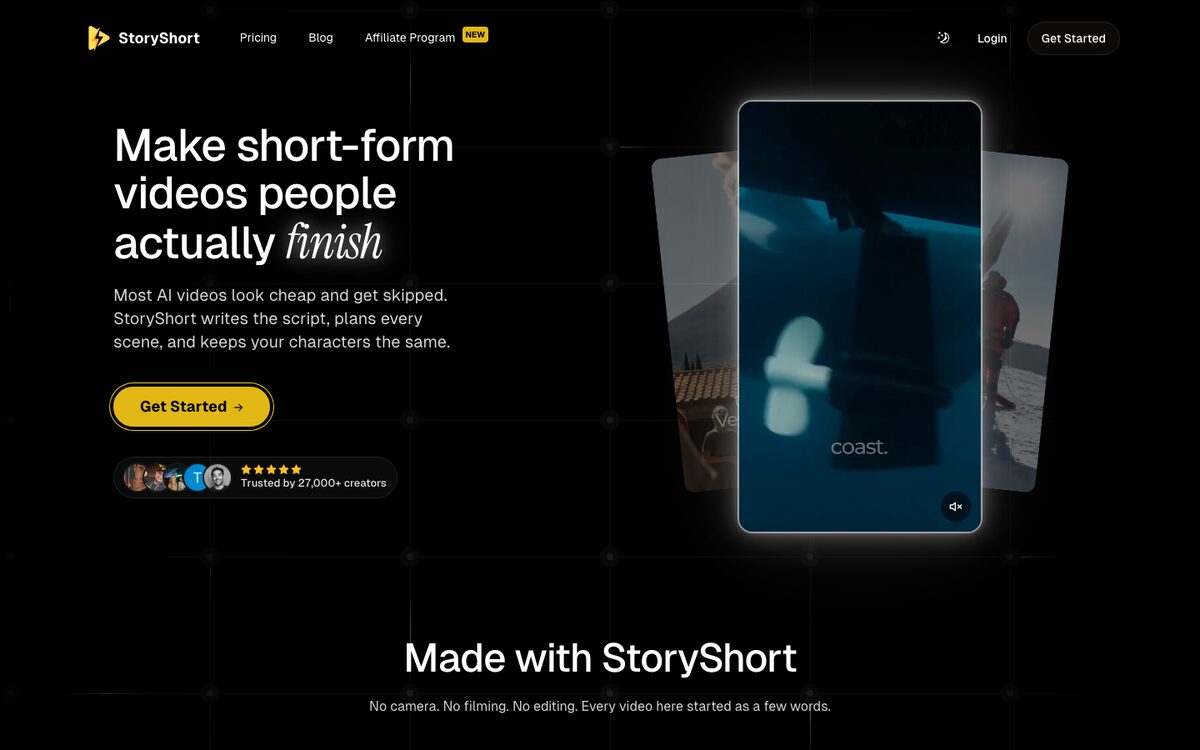
StoryShort.ai launched in August 2024. You enter a topic; it writes the script, adds a voiceover, generates visuals and captions, and outputs a ready-to-post short video.
Growth started entirely with paid ads. He says all early traffic came from Facebook ads. That is his standard playbook: buy a few weeks of traffic and see if people pay. Once validated, add the slow channels — SEO articles (he bulk-publishes with the automated writing tool Outrank), faceless YouTube channels made with StoryShort itself, and an affiliate program (still in the site's top navigation).
In August 2025 he reported StoryShort at about $20,000/month, roughly 4,000 users and about $5,000/month in costs, mostly AI API fees. By July 2026, TrustMRR verified $22,309 MRR.
Phase 5 · Capacity.so: using AI to code, then selling "AI that codes" (2025)
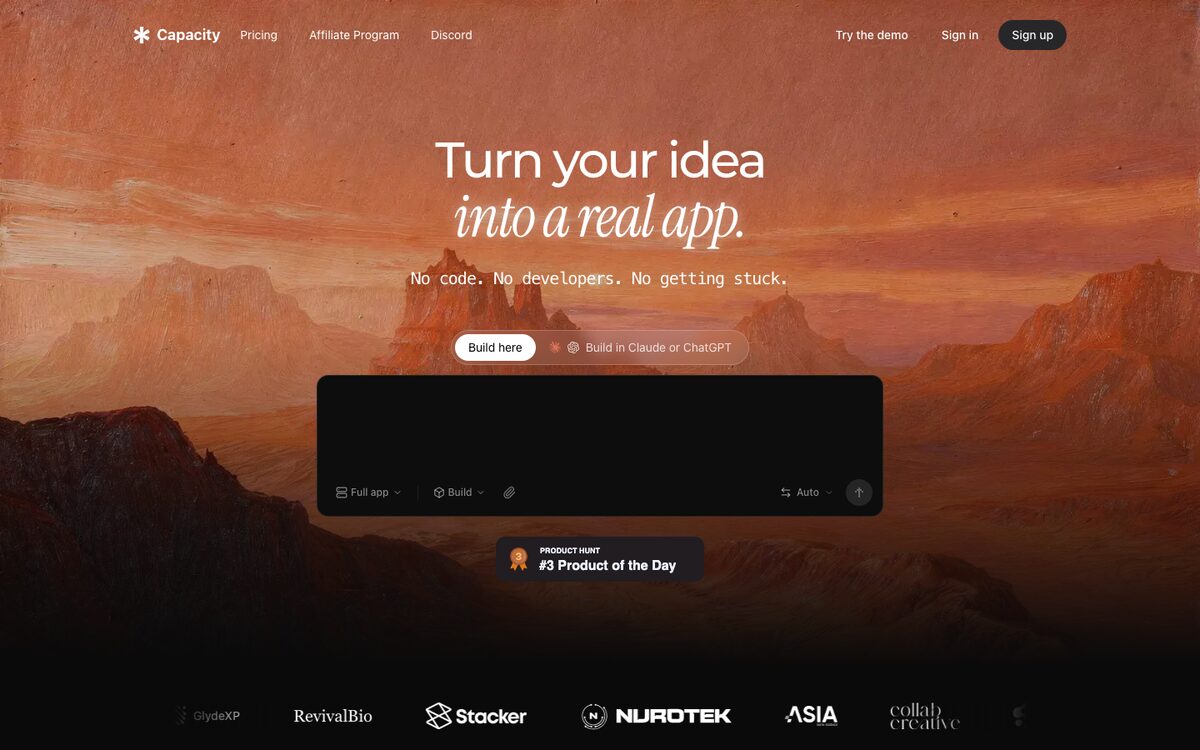
In 2025, prompt-to-app tools like Lovable and Bolt.new were growing explosively — another niche where someone was clearly making money. Samuel built Capacity.so. In August 2025 it was very early: about 50 users and roughly $900/month. Later reports put it at around $3,000/month.
His own way of building changed too. He says Claude Code now does about 90% of the work. His stack is Next.js + Node.js, deployed on Vercel, with Stripe for payments. He has even said: "If I were 18 now, I wouldn't learn coding. I'd use AI tools." He adds, though, that understanding code still matters, and he keeps learning.
The ledger: what the real numbers look like
A rough tally of his self-reported August 2025 figures:
| Product | Monthly revenue | Monthly cost | Users |
|---|---|---|---|
| StoryShort.ai | ~$20,000 | ~$5,000 | ~4,000 |
| UseArtemis | ~$15,000 | ~$4,000 | ~10,000 |
| Capacity.so | ~$900 | — | ~50 |
| Total | ~$35,900 | ≥$9,000 |
After known costs that is a margin of roughly 70–75%, lower once ad spend is included. Still excellent, but not the "85% net profit" figure that circulates online.
Thinking
1. What "copying" really means: outsourcing validation to the market
Samuel's "copying" isn't pixel-for-pixel cloning. It's skipping the most expensive step in a startup: proving someone will pay. Most indie developers die from "built it, nobody wanted it." He only enters niches where someone has already posted MRR screenshots or Stripe revenue. Other people's revenue screenshots are his free market research.
He also uses Ahrefs to check a competitor's traffic mix. The best targets have both paid ads and organic search traffic — ads mean the customer value can cover acquisition costs, and SEO means the demand is durable.
2. He wins on growth sequence, not product
StoryShort has plenty of competitors with similar features. His edge is a fixed growth sequence:
- Ads first: real money tests demand and conversion within weeks.
- SEO next: automated articles at scale for long-term free traffic.
- Product-made content: faceless YouTube channels built with StoryShort itself.
- Affiliates: creators distribute it for him.
Fast before slow, buy before grow. Many founders do it backwards — six months of SEO before finding out anyone wants the product — and waste half a year in the wrong niche.
3. Maintenance is the hidden cost of a portfolio
"Spread risk across products" sounds great, but every extra product adds upkeep. UseArtemis makes $15K/month and he still calls it a mistake: LinkedIn scraping is inherently fragile and carries terms-of-service risk (LinkedIn has long fought scrapers in court). At equal revenue, the product with lower maintenance is worth more — the most overlooked of his four filters.
4. AI changed the value of coding, not the value of picking niches
Someone who watched one 15-hour course now runs three SaaS products alone; AI coding tools deserve much of the credit. But the barrier is disappearing for everyone: if you can build StoryShort in a week with Claude Code, so can others. What's scarce is judgment about what to build and the ability to acquire customers — which is why he can say an 18-year-old needn't learn to code.
5. Read this case with a cool head
- Discount the numbers: $28K, $35K and $36K all appear in different sources; only StoryShort's $22,309 is verified. Using his own cost figures, margins are about 70–75%, not 85%.
- Platform policy risk: AI short-video users monetize on YouTube and TikTok. YouTube tightened monetization rules for mass-produced, repetitive content in July 2025, and shifts like that hit StoryShort's demand directly.
- "Copying" has limits: he copies categories and demand, not code, brands or designs. Copying those brings legal risk and gives you no edge.
Action
Step 1: Build a "validated niches" list (1 week) Spend 30 minutes a day on X's #buildinpublic, Indie Hackers and TrustMRR. Log small tools that publicly share revenue: name, MRR, pricing, launch date. Aim for 20 candidates.
Step 2: Cut to 3 with the four filters For each: would I use it? Is there proof of payment? Can it grow without heavy ad spend? Is it simple to maintain? Cross off anything that depends on scraping third-party platforms or needs heavy manual support.
Step 3: Check the traffic mix Use Ahrefs or the free tier of Similarweb to see where each candidate's traffic comes from. Prefer those with both paid and organic search traffic. Then search Reddit and Trustpilot for "[competitor] alternative / sucks" and write down the 2–3 most common complaints — that's your "1% better."
Step 4: Ship a paid MVP in 1–2 weeks Build only the core feature plus a fix for the competitor's top complaint. Copy his stack: Next.js + Vercel + Stripe, with Claude Code or Cursor writing the code. Take payments from day one.
Step 5: Validate with a small ad budget for 2–4 weeks Run small Google or Meta campaigns and watch one metric: do strangers pay? If not, move to the next candidate. Don't linger.
Step 6: Add slow channels only after validation SEO articles, accounts posting content made with your own product, an affiliate program — in fast-to-slow order.
Step 7: Do the maintenance math before product #2 Start a second product only once the first is stable and its weekly upkeep is under control. Favor new products that share your stack and carry little maintenance.
Not for you if:
- You don't have a few hundred to a thousand dollars for ad tests, or you strongly dislike running ads;
- You want to build an original "change the world" product and can't accept entering a crowded niche;
- You expect "build once, relax forever" passive income — SaaS means ongoing bug fixes, support and platform changes;
- Your category depends heavily on one platform's policies (monetization rules or API access) and you have no fallback.