One Lonely Solo Trip Led to a $140K-a-Month App: An Ex-Amazon Engineer Built a Travel Meetup App With 2 Million Users, Alone
Jay Raavi spent three years as a software engineer at Amazon and used all his time off for solo trips. He noticed that young travelers in hostels make friends easily, but travelers who want a bit more comfort struggle to find company in a new city. He talked to about 20 friends from past trips, ran small Meta ads to test demand, quit two weeks later and built nomadtable from his San Francisco apartment: open the map to see nearby travelers and create or join activities like dinners, dancing or sightseeing. After launching on the App Store in March 2025, he filmed a TikTok himself every day, reaching 200,000–500,000 downloads from his own videos before building a team of about 60 UGC creators paid by views, now driving about 44 million views a month with almost no ad spend. Per his public numbers: about 75,000 monthly actives and $18,000 MRR around six months in; 1 million downloads in under a year; 2 million users and a $2 million annual run rate in July 2026; about $140,000 MRR in September 2026. He has no employees, co-founders or funding, and runs it while traveling the world.
Process
Anyone who has ever traveled alone knows that exact feeling.
You arrive in an unfamiliar city by yourself, drop your bags off at your accommodation, and step out onto the streets. Dinner time rolls around. Restaurants are packed with lively groups of friends and families, while you sit alone staring at the menu. You know there must be dozens of other solo travelers just like you scattered across the city at that very moment, but you have no idea where they are, and no natural way to introduce yourself.
Staying at a youth hostel is one way out — hostels are built specifically for making quick friends. But if you have outgrown dorm rooms and bunk beds and prefer a little more comfort and privacy, crossing paths with fellow travelers suddenly becomes an uphill battle.
Jay Raavi felt that stinging isolation firsthand during a solo trip abroad. He jotted down an idea in his smartphone's notes app: build an app where solo travelers can instantly find nearby companions to grab a bite, explore the town, or hit a local bar together.
Two years later, that very app — named nomadtable — boasts 2 million users and has facilitated over 100,000 real-world meetups. As he shared on the founder podcast Starter Story in September 2026, the app generates approximately $140,000 in monthly recurring revenue (MRR).
And remarkably, he built and scales the entire operation completely on his own: zero employees, zero co-founders, and zero venture capital. He even operates this million-user platform while traveling non-stop around the globe.
Note: All metrics and revenue figures are self-reported by the founder on podcasts and social channels, and have not been audited by an independent third party.
Phase 1 · An Engineer Spending Every Vacation on the Road
Jay spent three years as a software engineer at Amazon. In his mid-twenties, he loved exploring the world and poured every single accrued vacation day into solo travel.
He openly admits he was never a "born entrepreneur" obsessed with launching startups. But throughout his journeys, he encountered the exact same friction time and again: wanting to meet people, but having no viable way to find them.
He observed that youth hostels made socializing almost effortless for backpackers. Yet many travelers preferred private hotel rooms while still craving genuine social connections. Meanwhile, most existing travel social apps on the market forced users to plan elaborate itineraries weeks in advance and lock in dates early.
Jay describes himself as having a "Type B personality" — spontaneous and averse to rigid planning. "I much prefer showing up somewhere first, and then spontaneously hitting up someone to hang out." That distinction would become nomadtable's defining edge: connect on the spot, meet anytime.
Phase 2 · Two Weeks of Validation, Then Quitting
When struck by an idea, most developers immediately jump into writing code. Jay took a disciplined detour.
He first took two deliberate steps:
- User Interviews: He reached out to roughly 20 friends he had met on past solo journeys and interviewed them using The Mom Test framework — never asking "Would you like this idea?", but instead digging into their genuine past frustrations and real behaviors;
- "Ghost Marketing": Before writing a single line of code, he ran small Meta ad campaigns with landing pages to observe actual click-through rates and email sign-ups, validating raw market appetite with real behavioral data.
After just two weeks, his mind was made up: he handed in his resignation.
To outsiders, walking away from a lucrative engineering role at Amazon seemed reckless. But Jay had his own internal calculus: "I had already landed a top tech job once, which meant I could land another one if needed. So I convinced myself this wasn't actually that risky. What felt truly dangerous was never trying at all, because that meant living with lifelong regret."
He reflected: "The torment of 'what if' was far more terrifying to me than failing."
Phase 3 · Coding and Filming Daily in a San Francisco Apartment
After leaving Amazon, Jay began full-time development from his San Francisco apartment. He went through three distinct MVP iterations, each focused squarely on one objective: getting solo travelers to meet in person as quickly and frictionlessly as possible.
In March 2025, nomadtable went live on the App Store.
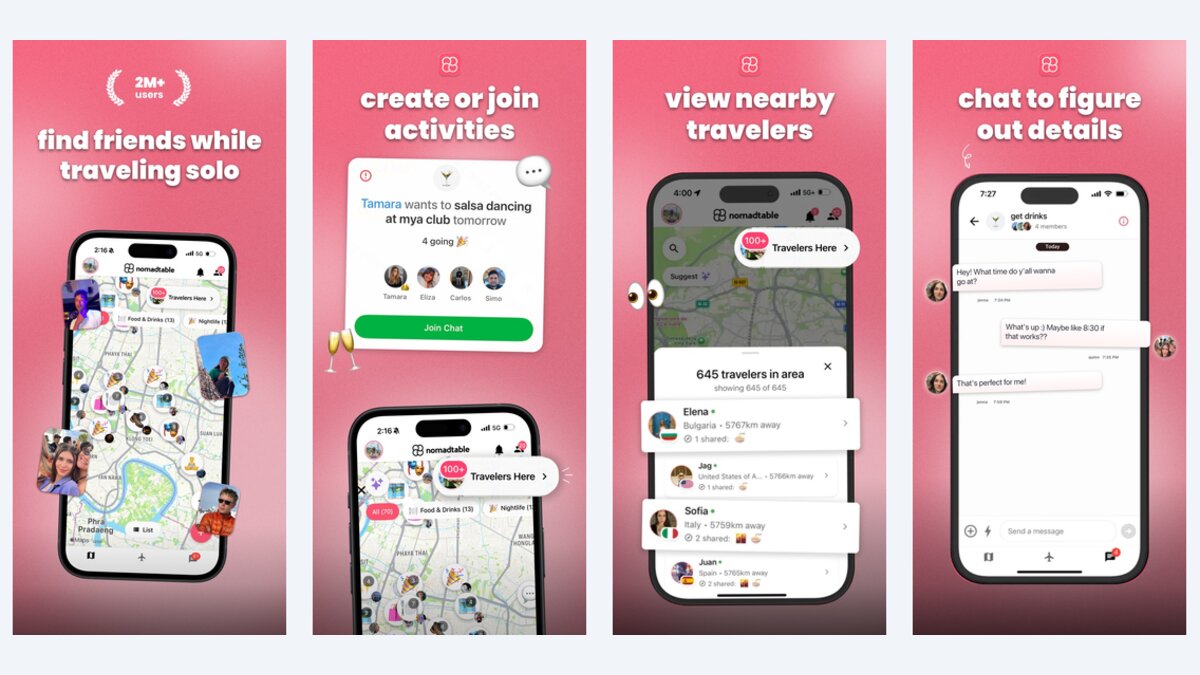
The core user experience is dead simple: open the map interface to immediately see how many travelers, expats, and digital nomads are nearby. You can create an impromptu plan — like "Going to a salsa club tomorrow night" — or tap into someone else's activity to join a dedicated group chat and finalize logistics. The app also features an AI recommendation engine to suggest trending local activities to do together.
Its underlying philosophy is "plans first, chat second." Unlike typical social apps that trap users in endless, dead-end texting loops without ever meeting, nomadtable nudges everyone toward a concrete real-world activity. Jay repeatedly stresses that it is not a dating app, nor is it a passive digital social network; it is an action-driven tool designed solely to bring people together offline.
Alongside engineering the product, he assigned himself a relentless marketing habit: shoot and publish one short video every single day.
Phase 4 · The Founder Becomes a Creator First
nomadtable's explosive user acquisition stems almost entirely from short-form video. But Jay did not start out hiring agencies or paying creators.
His first move was becoming the primary content creator himself. He studied what competing apps were posting, followed top creators in the travel space on X to dissect viral mechanics, and personally shot one video every day. His content documented raw, relatable travel moments: landing solo in a new city and meeting an amazing crew of fellow travelers through the app that very evening.
That authentic experience was the best possible ad.
As he revealed on the Superwall podcast, his own organic videos alone generated between 200,000 and 500,000 downloads. He spent several months running rapid experiments until he systematically unlocked the exact hook and storytelling formats that triggered viral distribution.
He also identified the golden metric that separated viral hits from duds: the percentage of viewers who watched past the first 3 seconds. "If that retention rate sits between 75% and 80%, you generally have a winner," he explained, noting it is far more predictive of total reach than early view counts.
Around three months post-launch, nomadtable reached roughly $10,000 in monthly revenue with 100,000 downloads; by month six, it surged to 75,000 monthly active users (MAU), 15,000 daily active users (DAU), and $18,000 MRR, breaking into the top 50 travel apps across Europe.
Phase 5 · A 60-Creator UGC Machine
Only after mastering what content performed did Jay decide to scale up distribution.
He assembled a network of approximately 60 user-generated content (UGC) creators. These creators did not produce artificial, polished commercials; instead, they wove nomadtable naturally into their everyday travel vlogs and adventures.
His operational model was lean and optimized for a solo operator:
- Performance-Based Pay: Creators were compensated purely on view performance, earning roughly $1 to $2 per 1,000 views. He vastly preferred this variable incentive over fixed monthly retainers;
- Managed via a Single Phone: The entire creator roster was coordinated through WhatsApp. He noted that every morning his phone was overflowing with WhatsApp check-ins and video submissions;
- Leading by Example: He continued posting his own videos daily. In fact, for the three months leading up to his podcast appearance, his personal account remained the top-performing channel across the entire network, which motivated creators and maintained high editorial standards.
This UGC flywheel generated roughly 44 million organic views every month, producing a viral breakout video almost every single week. According to Jay, 10% to 15% of new signups came from word of mouth, with the remainder driven almost entirely by organic short-form clips. On social media, he shared that nomadtable has accumulated over 350 million total video impressions, with "99% coming from organic reach."
Eventually, organic momentum took on a life of its own: random travelers began filming TikToks recommending the app, and prominent travel influencers in France and Portugal endorsed nomadtable completely unprompted.
He acknowledged that running paid ads could have pushed monthly revenue past $100,000 even faster, but he deliberately held back, choosing to pour his focus into product quality and long-term organic brand equity.
Phase 6 · One Person, Two Million Users
What followed was staggering exponential growth:
- December 2025: Downloads crossed 1 million, with monthly revenue hitting roughly $65,000;
- January 2026: First month exceeding $100,000 in gross revenue;
- March 2026: He posted on X: "Profitable. $2M run-rate. Zero employees. 100% bootstrapped.";
- July 2026: Total user base topped 2 million, reaching an annual run rate (ARR) of $2 million;
- September 2026: On Starter Story, he reported $140,000 in MRR, 1.8 million active profiles, and over 100,000 real-world meetups arranged.
It is worth noting that figures cited across interviews vary slightly: a "$2M run-rate" in July corresponds to ~$167K/month, while his September MRR was cited at $140K. The former likely reflected seasonal summer peaks or one-time transactions, while the latter represents a more conservative recurring run rate. Regardless of the exact lens, both numbers represent an exceptional milestone for a solo founder.
The business monetizes via subscriptions: basic core features are free, while the paid nomadtable Plus tier unlocks the full list of nearby travelers, boosts profile visibility, and grants unlimited AI activity suggestions. Pricing on the App Store is set at $6.99/week, $14.99/month, or $69.99/year. By October 2026, it held over 20,600 ratings in the US App Store, averaging 4.7 stars.
Jay's current day-to-day embodies the exact target persona of his app: based in Bangkok for four months, working out of local coffee shops and coworking hubs, drawing fresh creative inspiration with every destination change. He mentions that attending real nomadtable dinners in Bangkok and chatting directly with users sparked features he "never would have thought of from behind a desk."
Phase 7 · The Real Toll of a One-Person Company
Yet such hyper-growth has exposed the intense pressures of remaining a solo operator.
As any social platform scales, content moderation, user trust, and safety become paramount — areas that are brutally difficult for a single person to handle around the clock. On Trustpilot, nomadtable holds a modest 2.5 rating; reviews in app stores complain about abrupt account suspensions, sluggish support response times, and users occasionally treating the platform like a dating app. Some European users also voiced frustration over the €70 annual subscription cost.
Jay openly acknowledges that his biggest anxiety is the product "losing its way" as it matures, drifting from its original mission of solving genuine travel isolation. His antidote is keeping himself firmly rooted in the user experience: continually traveling, and continually showing up to nomadtable meetups himself.
His advice to aspiring entrepreneurs is straightforward: "Only work on something you genuinely care about. If you're building something you don't love just for money or status, the journey is pure misery. But when you build something you are truly passionate about, the emotional return is indescribable. Even if my app simply helped two strangers meet up for dinner, that alone makes it deeply worth it."
Thinking
1. The Best Ideas Stem From Your Most Acute Personal Pain Points
nomadtable was not discovered in a generic market research deck; it was born out of raw loneliness on an unfamiliar street corner. Jay was his own primary customer, allowing him to understand exactly when and why solo travelers need companionship.
When you are the user experiencing the pain firsthand, your product instincts will be far sharper than any secondary survey.
2. Validate in Two Weeks Before Resigning
Conducting 20 user interviews and running small ad experiments gave Jay the concrete conviction required to walk away from Big Tech. That minimized his risk infinitely more than quitting blindly, building in isolation for six months, and discovering nobody cared.
Interview users not by asking "Do you like this idea?", but by probing their actual past behaviors; test ads not by tracking vanity likes, but by measuring real clicks and email captures. Gather high-signal truths at minimal upfront cost.
3. Crack the Distribution Formula Yourself Before Paying Others to Scale It
Jay did not hire 60 creators on day one. He filmed and posted daily for months, amassing hundreds of thousands of installs and reverse-engineering the exact formats that resonated with his audience. By the time he onboarded creators, he knew precisely what creative briefs to assign.
Scaling an unproven creative format with external creators is simply lighting cash on fire.
4. Pay-Per-Performance Makes UGC Truly Scalable for Solo Founders
Paying creators $1 to $2 per 1,000 views aligns costs directly with output. Creators who craft compelling, high-converting content earn substantially more, and Jay's marketing expenditure scales strictly with organic impressions. This dynamic allowed a single individual to coordinate 60 creators efficiently over WhatsApp.
5. Solo Operations Have Hard Ceilings — Especially in Social Products
Facilitating 100,000 real-world meetups across 2 million accounts creates massive operational demands around safety, trust, verification, and customer service. The 2.5 score on Trustpilot serves as a clear warning: a solo founder can build a slick MVP and drive user acquisition, but carrying the full weight of community safety at scale is nearly impossible alone.
For platforms facilitating in-person human interactions, trust and safety are not optional extras. The earlier you invest in robust community infrastructure, the farther your product can travel.
Action
Step 1: Start from a recurring frustration in your own daily life (Week 1) List the moments in your work, travels, or personal routines that consistently leave you feeling isolated or inconvenienced. Ask yourself: is there a software tool that solves this cleanly?
Step 2: Spend two weeks executing low-cost validation Interview 15 to 20 prospective users using The Mom Test framework — inquiring strictly into real past events rather than asking for speculative validation. Simultaneously, deploy a $50 landing page ad test to gauge authentic click-through and email signup rates.
Step 3: Ship the leanest viable MVP without delay Solve only the single most critical friction point — e.g., "Find an in-person companion in this city today." Be fully prepared to scrap and rebuild through multiple iterations.
Step 4: Step in front of the camera as your own primary creator Record and publish a short video every single day capturing authentic use cases. Track the 3-second retention rate; once you consistently achieve 75%+ retention, you have cracked an expandable format.
Step 5: Scale your UGC engine via performance-based compensation Once you have validated high-performing creative hooks, recruit creators whose lifestyle matches your app and compensate them per 1,000 verified views. Continue posting your own content to uphold baseline creative standards.
Step 6: Build an offline-to-online organic sharing loop Design the user journey so that positive real-world interactions naturally convert into user-generated word-of-mouth and social shares, diminishing your reliance on paid customer acquisition.
Step 7: Invest proactively in trust and safety from day one If your product involves real-world meetups or stranger networking, implement reporting, moderation, and customer support workflows immediately. Bring on specialized help the moment volume surges.
This path is not for you if:
- You lack the technical capability to independently build and scale a performant mobile application;
- You are uncomfortable appearing on camera or lack the discipline to shoot video content daily;
- You are unwilling to handle the heavy customer support, content moderation, and safety disputes inherent to social platforms;
- You insist on remaining permanently a one-person outfit when product scale demonstrably demands a dedicated operational team.