One Creator Beats a Hundred Videos: A German Developer's Expense App Made $300 a Month for 18 Months — Then a Profit-Sharing Deal With a Colombian Creator Took It to $35K
Florian Vates is a German iOS developer who spent 9+ years at an agency; married with two kids, he could squeeze out about an hour a day for his own projects. His first app, built with friends over two years, launched to almost no users. In 2023, he spent a month or two building MonAI, an AI expense tracker: say 'coffee this morning was $4' and AI logs and categorizes it, and Apple Pay purchases can be logged automatically. For the next year and a half, it made only about $300 a month. The turning point was Colombian tech creator Charlie Álvarez, who found Florian's social handles inside the app and reached out. They agreed on a profit share plus a fixed monthly retainer, with just three carefully produced, story-driven videos a month. After the first video in late 2024, monthly recurring revenue (MRR) grew 10x within a week and neared $8,000 within a month; according to what Florian told Starter Story in April 2026, MRR is now over $35,000 and he has quit his job to work on apps full time. Today MonAI has more than five times as many ratings in Colombia as in the US.
Process
In the indie developer community, there is an almost standardized growth playbook: launch a dozen TikTok accounts, post dozens of short videos every single day, hire an army of UGC creators to shoot at scale, and pray that one goes viral.
German developer Florian Vates took the exact opposite road.
He partnered with one single creator, publishing just 3 videos a month.
Prior to that, his AI expense tracking app MonAI had already been on the App Store for eighteen months, limping along at roughly $300 a month. Once the partnership kicked off, within just one week of the first video going live, his monthly recurring revenue (MRR) jumped 10x; a little over a year later, as he stated on Starter Story in April 2026, MRR climbed past $35,000.
Host Pat Walls hit the nail on the head right in the introduction: "Building an app is easier than ever, but distribution is harder than ever."
And Florian's answer was to find the right person, and turn him into a true business partner.
Note: All revenue figures are self-reported by the founder and have not undergone third-party auditing.
Phase 1 · A Father With Barely One Hour a Day
Florian originally intended to study a creative discipline, but wound up pursuing computer science. During his university years, he taught himself iOS development.
After graduation, he worked at a digital agency called LOOP for more than 9 years, rising to senior iOS developer and mobile UX lead. He is married with two young children, and regularly volunteers at his local church in his spare time.
Yet deep down, he always harbored a dream: to have his own app on the App Store.
Time was his greatest bottleneck. In a 2023 interview with an indie developer publication, he shared that between a demanding full-time job, young kids, and church commitments, he could only carve out roughly one hour a day for his personal projects. As a result, he had to operate with extreme discipline: maintaining a strict Kanban board, knocking out tasks item by item.
Phase 2 · Two Years Building an App Nobody Cared About
Florian's first app was called CORDI.
The concept stemmed from an everyday observation: Facebook was losing traction among younger demographics, and his circle of friends had migrated away. People used to coordinate gatherings and birthday parties through Facebook Events; now everyone was scattered across fragmented messaging apps, turning event planning into a chore. So he teamed up with a few friends to build a dedicated alternative.
They poured two full years into it, building, tweaking, and rebuilding, perpetually feeling it wasn't polished enough to launch. By the time it finally hit the store, practically no one showed up. As he put it: "Evidently, nobody cared."
That failure imparted an invaluable lesson: "Fail fast, build fast, move on. I spent way too much time on my first app — adding too many features, feeling it was never good enough to ship. Just put it out there, gather feedback, and iterate if there's real potential; if there isn't, cut your losses and move to the next thing."
Phase 3 · MonAI Built in Two Months, Then $300 a Month for 18 Months
By 2023, the generative AI wave was taking off, and inflation was squeezing household budgets. Florian wanted to resume tracking his personal expenses, but every app he tried got abandoned because logging was simply too tedious.
He asked himself: Could AI turn expense tracking into a completely frictionless action?
Applying the lessons from CORDI, he built the first version in just one to two months, launching MonAI on the App Store in June 2023. He also revived his X account and began building in public.
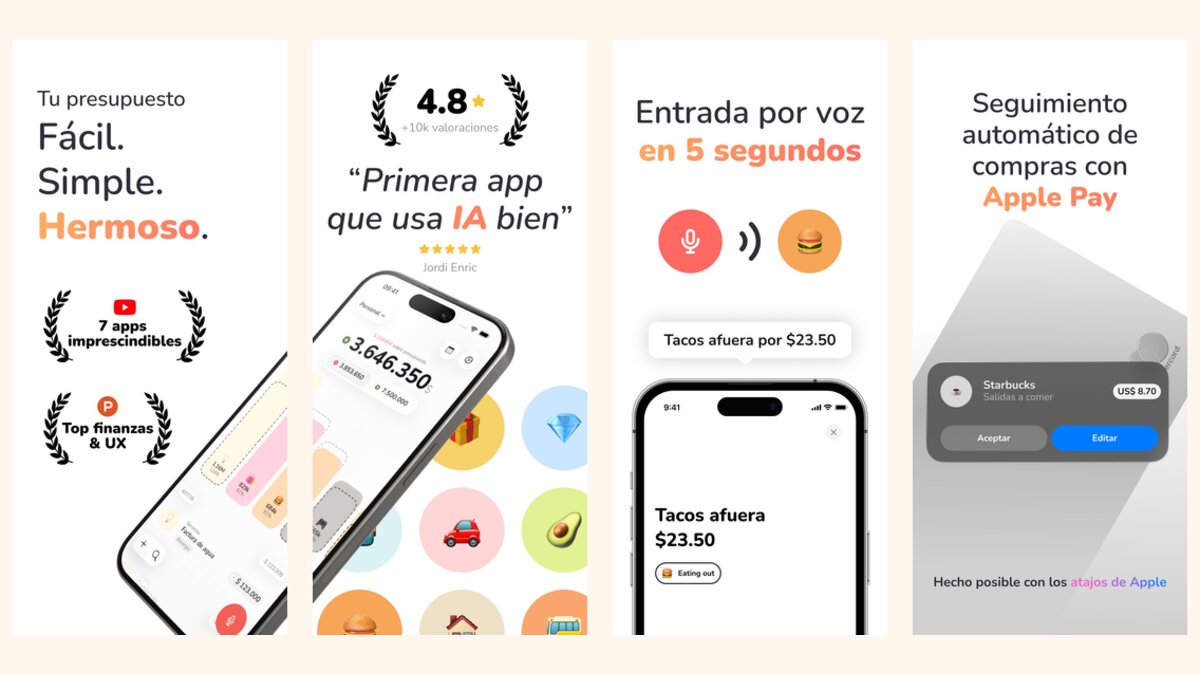
MonAI was designed with extreme minimalism — not even a bottom tab bar, with the home screen displaying only what truly matters: where your money went. It offered three ways to record an expense:
- Speak a sentence: for example, "coffee this morning was $4, then groceries were $40," and the AI automatically splits them into two entries with categories and tags;
- Apple Pay automated logging: using Apple Shortcuts, every time you tap to pay with Apple Pay, the app prompts you to log the purchase;
- Manual entry.
Users could also query the AI directly: "I want to save €300 a month, where should I cut back?" The AI would analyze the transaction history and generate a tailored budget. All data was stored locally in the user's private iCloud, requiring no account registration.
The product was sleek and well-received, but over the next eighteen months, with Florian handling marketing alone, MonAI's MRR hovered stubbornly around $300 a month.
During that year and a half, he was far from idle. He posted development updates consistently on X; launched MonAI on Product Hunt (finishing 25th due to his small initial following); and built a second utility app, Mindr, a household chore and maintenance tracker born out of a personal tool for his coffee machine. He also planned to tackle App Store Optimization (ASO) and X ads. Yet none of these efforts catalyzed true exponential growth.
He readily admits that marketing was a complete mystery to him: "It always felt like a black box."
Phase 4 · The Creator Reaches Out First
The breakthrough arrived completely out of the blue.
Florian had included his personal social media handles inside the app's profile screen. One day, a tech creator from Colombia named Charlie Álvarez spotted those links inside the app and reached out to him directly.
Charlie was not an average influencer. As profiled by Forbes Colombia and other outlets, he possessed a background in UI/UX design and had worked at a Y Combinator-backed startup; during the pandemic, encouraged by his brother, he began posting videos on TikTok, eventually amassing nearly 8 million followers across social platforms, known for his cinematic storytelling approach to consumer tech.
The two talked for a while and struck an agreement: Charlie would produce and post 3 videos spotlighting MonAI on his primary channels each month.
In late 2024, the first video dropped. It was a straightforward product walkthrough, but because Charlie's audience had never seen expense tracking presented this way, the response was explosive: within one week, MonAI's MRR grew 10x; within a month, it approached $8,000.
When another video followed, MRR jumped to $13,000. Indie Hackers reported that over the first two months of their collaboration, MRR skyrocketed from $300 to roughly $12,000.
Phase 5 · Not an Employee, a True Business Partner
Why did partnering with just one creator yield such outsized results? The secret lay in the incentive structure.
Initially, they agreed on a revenue-share split. However, they soon realized that pure top-line revenue sharing didn't scale well with infrastructure and operating expenses, so they restructured to a profit-share agreement combined with a fixed monthly retainer.
Florian explains: "Because his income is predominantly tied to profit share, he genuinely cares about the app's success. He doesn't act like a hired vendor who delivers a video and washes his hands; he constantly brainstorms what angles to take and how to craft the highest-converting video possible."
Today, Charlie functions as his commercial co-founder, conceiving every creative angle. Florian no longer has to stress over marketing trends and can channel 100% of his energy into product engineering.
Their content playbook directly contradicts prevailing industry norms:
- Quality over volume: only 3 videos a month, each meticulously scripted and polished;
- Story-driven narratives: every clip is structured around relatable storytelling with extended production cycles;
- High conversion over viral vanity: while view counts aren't always in the tens of millions, audience trust translates into exceptionally high paying conversion rates.
Florian even built a custom internal tool mapping video publication timestamps against his revenue curve. The chart makes it unmistakably clear: virtually every revenue leap aligns perfectly with a video drop.
In June 2025, they were invited together by Apple to attend WWDC. That provided stellar story material, resulting in a video that racked up 1.7 million views and added nearly $5,000 in incremental MRR. Later, another video showcasing a highly requested community feature propelled MRR past $35,000.
That year, Florian finally quit his agency job to dedicate himself full-time to his apps. Indie Hackers reported that across his portfolio, monthly revenue had reached approximately $50,000.
Looking back, the turnaround wasn't born of growth-hacking gimmicks, but from two individuals executing at world-class levels in their respective domains: Florian ensured the product was frictionless and delightful enough that visitors instantly converted; Charlie translated its utility into compelling stories seen by millions. Strip away either half, and that $35,000 MRR simply doesn't exist.
Phase 6 · The Accidental Epicenter: Colombia
One of the most fascinating nuances of MonAI is that its primary market is neither Germany nor the United States, but Colombia.
Across Spanish-speaking App Stores, MonAI is localized as "Finanzas personales - MonAi" (Personal Finance). As of October 2026, it boasts 4,675 ratings in Colombia, 1,181 in Mexico, and just 875 in the US. Its official website reports over 8,500 total ratings worldwide with a 4.8-star average.
Starter Story producer Gus observed during the interview: "At the end of the day, it's another expense tracker. Left to my own devices, I'd say: this has been done a million times. But that doesn't matter; distribution matters." He highlighted: "He didn't build it for Germans, nor for Americans, but partnered with a Colombian creator. The App Store in other parts of the world is massive."
Regarding monetization, MonAI originally operated on a freemium model. A/B testing revealed that a 7-day free trial paired with a hard paywall generated superior conversion, prompting him to pivot entirely.
On the cost side, Florian openly shared his tooling expenses: Claude Code at $100/month, RevenueCat (subscription management and paywall A/B testing) at roughly $400/month, Appwrite (backend and cloud database) at $25/month, OpenAI and Anthropic AI inference at roughly $200/month, plus a one-time purchase of development utility Helm (~$175). In total, software infrastructure runs under $1,000 a month — negligible against $35,000 MRR. However, his largest expenditure — the creator's profit-share percentage and monthly retainer — remains confidential.
His sole regret was delaying paid advertising: "I stayed away from Meta ads forever out of fear of burning cash. But my partner produces such incredible creative assets that testing ads with them is effortless. We only started a few weeks ago, and results are already stellar. Had we started earlier, we would have captured far more revenue."
Thinking
1. The product wasn't broken; nobody knew it existed
Making just $300 a month for eighteen months could easily lead a developer to believe the product had no market fit. Yet a single video from a creator — nothing more than an honest feature walkthrough — multiplied revenue tenfold in a week.
Pat Walls' diagnosis was spot-on: "The only thing wrong with your app is that nobody's seen it." Too many developers get trapped endlessly polishing features when their only real bottleneck is distribution.
2. Turn creators into partners, not transactional vendors
Paying flat fees per post means the creator moves on the second the video is delivered. Offering a profit share makes the creator think like an equity partner, obsessing over conversion and customer lifetime value. Florian moving from revenue share to "profit share + monthly retainer" aligned both parties' long-term incentives.
Structuring the partnership correctly is often far more critical than who you partner with.
3. One exceptional creator beats a hundred mediocre videos
Instead of churning out dozens of daily clips hoping for an algorithm lottery ticket, MonAI released three meticulously crafted narrative videos a month. Aggregate view counts were moderate, but buyer intent and brand equity were unmatched.
This model is a godsend for developers who dislike or lack the skills for content creation: delegate marketing to elite specialists while focusing entirely on shipping product.
4. Stop obsessing exclusively over the US market
MonAI's crown jewel is Colombia. The American market is notoriously saturated and cost-prohibitive for customer acquisition; regions like Latin America and Europe harbor millions of willing subscribers and enthusiastic regional creators eager for genuine partnerships.
The identical product, adapted to a different geography and language, can unlock an uncontested blue ocean.
5. Fail fast once to master velocity
CORDI devoured two years only to launch to silence; MonAI shipped in under two months. That early failure taught Florian the golden rule: abandon perfectionism, ship the MVP, and let the market vote.
The real existential risk is not shipping a failed product; it is wasting years building one.
Action
Step 1: Embed your personal social handles inside your app (Do this today) In your profile, settings, or "About" view, display your X, Instagram, or TikTok links. Creators and strategic partners frequently discover indie tools from inside the app itself.
Step 2: Ship your MVP within 1–2 months Start strictly from your own recurring pain point and build only the single core capability. Do not spend two years polishing like Florian did with CORDI.
Step 3: Scout creators whose content tone mirrors your product's ethos Look beyond vanity follower counts. Prioritize creators whose aesthetics, voice, and audience demographics naturally align with your product, and who actively respond in comment sections.
Step 4: Cultivate authentic rapport before pitching commercial deals Engage with their content consistently. When reaching out, reference specific videos, explaining concisely why your utility solves a problem for their specific audience. Keep pitches brief, ideally with a personalized video.
Step 5: Lead with willingness to pay and align economic incentives Demonstrate that you respect their craft. Adopt Florian's framework: a profit share paired with a baseline retainer, backstopped by category market data to illustrate earning upside.
Step 6: Target international markets outside North America Localize your metadata and app strings into Spanish, Portuguese, or French, and pursue regional tier-one creators across Latin America or Europe.
Step 7: Amplify top-performing creator assets through paid channels Take the winning organic video hooks and deploy them directly as Meta and TikTok ad creatives to multiply acquisition velocity.
Not for you if:
- Your product experience is flawed, causing incoming creator traffic to churn immediately;
- You refuse to share long-term financial upside with external collaborators;
- You require absolute autocratic control over every marketing narrative without partner input;
- Your value proposition is too abstract to be communicated through a human story and visual demonstration.