Building Apps After Work, Betting on Volume Over Hits: A Father of Two Shipped 28 Small Apps in 8 Months — a Year Later, 40 Apps Make $36K a Month
Max is an iOS engineer of about eight years, married with two kids. He spent a long time polishing a single app of his own and nothing worked. In February 2025, a video from another indie developer changed his thinking: instead of betting on one perfect app, build many small apps with a single feature each, let them go after launch and move on. He first uses the keyword tool Astro to find keywords with enough searches, manageable competition and competitors that actually make money, then builds fast with AI and his own code templates — his record is 2 hours from idea to App Store submission. Working only before and after his day job, he shipped 28 apps in 8 months and grew from about $200 to $10,000 a month. Per his year-end post on X, 2025 revenue was $84,000 and MRR grew from $130 to $25,000+, and he went full-time indie in 2026; in March 2026 he told Starter Story that about 40 apps make a combined $36,000 a month. Tools cost about $285 a month, with no team and no funding.
Process
In the indie developer community, there are two starkly contrasting paths.
One is betting on a single product: pouring all your time and energy into one flagship application, polishing it endlessly, and nurturing it to maturity. The previously discussed HabitKit is a prime exemplar of this route: a single habit-tracking app that scaled to $600,000 a year solo.
The other path is casting a wide net: casting perfectionism aside to build dozens of focused, single-feature micro-apps, launching them, immediately letting them go to tackle the next idea, and letting the market dictate which ones survive.
Max chose the second path.
He is an iOS engineer, married, and a father of two. Throughout 2025, he maintained his normal day job and built apps strictly in the early mornings and evenings outside work hours, shipping 28 apps in 8 months. By March 2026, his portfolio held roughly 40 small apps which, according to his interview on the entrepreneurial show Starter Story, collectively generate around $36,000 per month.
Before this breakthrough, he had spent years obsessively refining a single pet app, testing every known growth tactic, and nothing ever took off.
Disclaimer: These revenue figures represent self-reported founder metrics that have not undergone independent third-party financial audits.
Stage 1: Years Polishing a Single App, Nothing Happened
Max started iOS software development approximately eight years ago.
Like many programmers, he had a beloved personal project—an app he desperately wished to scale into something monumental. He poured countless hours into it, experimenting with virtually every growth hack and marketing playbook imaginable.
The final verdict: "Nothing worked."
This is a familiar dilemma for software creators: you convince yourself that just one more feature, one smoother transition, or one UI tweak will finally bring users in droves. Yet months and years slip away, and the anticipated audience never arrives.
A harsher constraint was time. Max worked a full-time corporate job and had a wife and two young children. The only moments available for his personal side projects were fragmented slivers of time before the workday began and after family dinner at night. Sinking this precious, finite time into a stagnant project with zero traction was far more costly than it appeared on the surface.
Stage 2: A Single Video Upends His Approach to App Development
In February 2025, Max stumbled upon a YouTube video by an indie developer (Adam Lyttle) who built a diverse portfolio of mobile apps. That video, in his own words, "completely revolutionized my understanding of building apps."
His previous worldview held that having a project meant committing all your time and all your energy to it until it became massive.
The video demonstrated an entirely different paradigm: consistently produce simple apps. Give each app a single feature, launch it, forget about it, and move immediately to the next.
Max reflected: "It was something that had never even crossed my mind. I was astonished that such a methodology existed, and I am profoundly grateful that I stepped onto this path."
Stage 3: Find Keywords First, Find Ideas Second
Max's core framework involves working in reverse: instead of deciding what to build first, he looks at what consumers are already actively searching for.
His thesis is simple: "When a user encounters a specific problem, they open the App Store and type a search query into the search bar." Therefore, identifying the right keyword means discovering the right validated product.
His primary investigative tool is an App Store keyword research utility named Astro. His workflow proceeds as follows:
- Pick a general direction: choose any random category or an interest area he genuinely finds intriguing, and search for associated keywords;
- Evaluate two critical metrics: the keyword must have a popularity of at least 20 and a difficulty score between 60 and 70—meaning real people are actively searching for it, but the competition is not insurmountably fierce;
- Verify competitor monetization: check the monthly revenue of top-ranking competitors using tools like Sensor Tower, demanding that they make at least €100 to €200 per month. If even the top competitors cannot clear that modest threshold, it proves the niche lacks commercial intent and is not worth entering.
He also employs another tactical technique: identifying clusters of interrelated keywords. For instance, when targeting education apps, one could build separate apps for "Physics AI," "Chemistry AI," and "Math AI"—the search terms differ, but the target audience of students is identical. Once one is assembled, the architecture can be immediately replicated across adjacent keywords.
He demonstrated this live on the show: searching "tree identifier" revealed an adjacent term, "wood identifier," with respectable search volume and minimal competition. He remarked: "I will build this, because targeting this term is very likely to yield strong results."
Stage 4: From Idea to Launch in 2 Hours
Once the keyword is validated, Max's build execution is astonishingly rapid.
- Focus solely on the core capability: inspect two or three top competitors, isolate the single primary feature most directly tied to the target keyword, and "disregard everything else";
- Have AI generate the implementation blueprint: prompt ChatGPT or Gemini with the keyword-focused concept, supply the exact UI layout and interaction requirements, and have it produce a comprehensive step-by-step implementation plan;
- Assemble via drag-and-drop reusable templates: ubiquitous screens needed by every utility app—such as settings, onboarding flows, and paywalls—already exist in his modular component repository and can be dragged directly into the codebase. In several apps, he reuses up to 90% of the existing code;
- Template visual marketing assets: duplicate previous project screenshot layouts and icon templates in Figma, tweaking colors and text in minutes;
- Draft app descriptions via AI: prompt ChatGPT to generate the App Store description, populating the title, subtitle, and keyword metadata fields with the exact search terms selected earlier.
His single most emphatic piece of advice for newcomers revolves around deployment velocity: "Never be afraid of shipping. Do not waste your time endlessly polishing an app. Stop obsessing over adding 'one more killer feature' to draw a crowd. Build a clean, single-feature version with zero glaring bugs, ship it to the store, let real users tell you what they think, while you are already head-down building the next app."
Depending on complexity, some apps took him a week while others took just hours. His fastest personal record: from initial thought to App Store submission in exactly 2 hours.
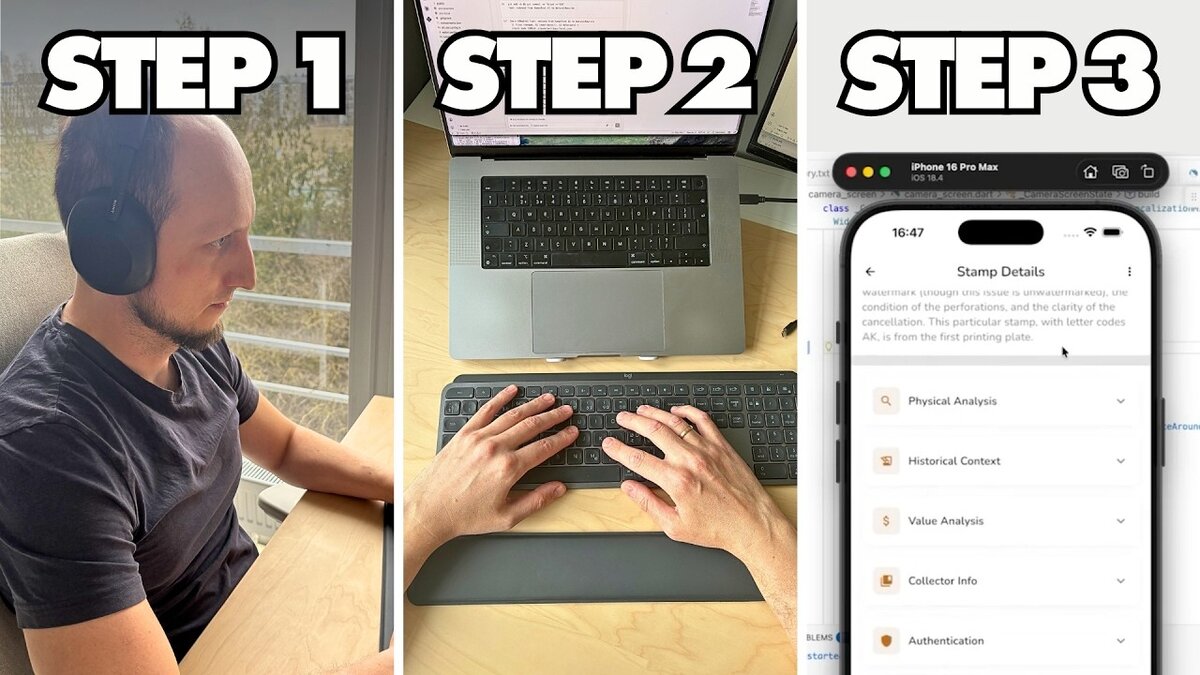
In March 2026, during another episode of Starter Story, he demonstrated building the complete foundation of a stamp identifier app on camera in just 17 minutes—encompassing keyword research, AI-assisted code generation, and store listing assets. For that live demo, he leveraged Claude to write the code.
Stage 5: Ship and Let Go, Let Data Crown the Winners
Max's fifth phase is arguably the most counterintuitive and psychologically demanding: the moment an app goes live, let go completely and start the next.
He explains that newly published apps receive an initial algorithmic boost ("fresh release traffic") from the App Store, which eventually fades. After that grace period, he closely monitors each app's trajectory: does it plummet to zero, stabilize, or demonstrate steady organic growth?
"If an app refuses to sink, it means it has genuine market traction."
After a reasonable observation window, he circles back to the apps demonstrating healthy organic growth or high retention, patches minor bugs, polishes user experience details, and begins running paid ads to accelerate their scale.
This framework produces a classic Pareto distribution: when interviewed in December 2025, out of his 28 live apps, the top 4 apps generated roughly $1,500 each per month, while the long tail contributed modest residual income.
His operational toolchain remains remarkably lean:
| Tool | Purpose | Monthly Cost |
|---|---|---|
| Flutter | Cross-platform iOS and Android codebase | Free |
| Fastlane | Automated deployment & build pipeline | Free |
| Cursor | AI coding assistant | $20 |
| Firebase | Backend, authentication, database & hosting | $5–$10 |
| OpenAI | Vision recognition & AI capabilities | ~$200 |
| Gemini | Multimodal AI capabilities | $50 |
| Mixpanel | Behavioral product analytics | Free |
| Astro | iOS App Store keyword research | $10 |
| FoxData | iOS & Android store keyword research | Free |
His total monthly operating expenses hover around $285.
Stage 6: From $200 a Month to $36,000 a Month
Max continuously documented his journey and financial metrics on X.
In October 2025, he announced that just days after crossing his €7,000 MRR target, his revenue had surged past the next milestone. Yet he offered a candid, level-headed caveat: "This recent surge was driven primarily by weekly subscriptions, which inflates the theoretical MRR, while realized cash collection lags behind. I cannot predict if churn rates will be severe, nor where this will settle." He highlighted that this momentum reflected the power of a diversified portfolio: several apps were gaining simultaneous traction across iOS and Android, bolstered by modest ad spend and a viral TikTok slideshow for one specific app, "with the rest owing largely to luck and disciplined App Store Optimization."
By December 2025, he shared on Starter Story that in 8 months of side-hustle development he had launched 28 apps, scaled monthly revenue from ~$200 to $10,000, surpassed 1,000 paying subscribers, and attracted 4,000 to 5,000 daily active users across his ecosystem.
At the close of December, he published his 2025 year-end reflection:
- Total 2025 revenue: $84,000;
- MRR: soared from $130 to over $25,000;
- Daily revenue: escalated from $9 to $900 per day;
- Portfolio size: grew from 2 apps to over 30 apps;
- Crucially: he resolved to resign from his software engineering job in 2026 to pursue indie hacking full-time.
It is essential to distinguish between his realized 2025 cash collections ($84,000) and his year-end annualized run-rate (MRR exceeding $25,000). The bulk of his revenue steepened rapidly in the final four months of the year, and MRR calculations mathematically magnify short-term weekly subscription cash flows. MRR served as a snapshot of velocity entering the new year, rather than a flat annualized average.
In March 2026, he returned to Starter Story, this time overseeing roughly 40 active apps generating a collective monthly run-rate of approximately $36,000.
He outlined his 2026 roadmap: scale portfolio MRR to $100,000, shifting his philosophy "gradually from quantity to quality" to ensure higher conviction on new launches while doubling down on top performers. He also disclosed plans to engineer a standalone B2B SaaS product, "so that my livelihood is not 100% beholden to app stores and their fluctuating editorial guidelines."
Stage 7: His Wife Adopts the Playbook
In May 2026, amid widespread developer gripes online that "ASO is dead," "the app store is inundated with AI junk," and "Android users refuse to pay," Max shared an illuminating update.
His wife, utilizing Claude and his technical guidance, began spending 3 to 4 hours a day creating simple micro-apps. In just 1.5 months, her MRR expanded from $100 to $1,000. She had launched 9 apps, with revenue split equally between iOS and Android, achieved with "zero paid advertising, zero social marketing, nothing."
Their joint strategy: continue expanding her portfolio until MRR hits $2,000 to $3,000, establishing a self-sustaining marketing budget to selectively amplify promising apps via paid acquisition, TikTok, and Instagram.
Max concluded his post with an enduring observation: "Stop overthinking, and stop wondering if it is too late to begin. The best time to start was yesterday, but starting today is still in time."
Thinking
1. Hedging Uncertainty With Sheer Volume
No founder possesses clairvoyance regarding which app will capture lightning in a bottle. Max's tactical answer is to replace guesswork with high iteration velocity. Across his 28 apps, a mere 4 generated the lion's share of cash flow. Had he poured his soul into a single app, mathematical probability dictates it would likely have been one of the 24 duds.
When the probability of any individual success is inherently low, multiplying your attempts is not a gamble—it is a coherent risk mitigation strategy.
2. Discover Demand Before Writing Code
The conventional developer mistake is conceiving a product in isolation and subsequently hunting for customers. Max reverses the chronology: he interrogates what search queries real users are typing and whether incumbent apps are extracting revenue before writing a line of code. Every app he ships is positioned from day one inside an empirically validated pool of commercial intent.
3. Modular Reusability Is the True Engine of Speed
While AI coding assistants accelerate baseline syntax generation, Max's authentic competitive moat is his proprietary component repository: onboarding carousels, settings menus, RevenueCat paywalls, App Store metadata, and Figma canvases are standardized and modular. Every app shipped accelerates the completion of the next. This is the compounding dividend of a portfolio architecture.
4. MRR Is a Seductive Metric: Scrutinize the Fine Print
Max himself highlighted that heavy reliance on weekly subscriptions mathematically inflates MRR figures while cash collection lags and long-term cohort churn remains unpredictable. A cumulative annual revenue of $84,000 alongside a year-end MRR of $25,000 tell distinct financial stories.
When evaluating public revenue disclosures, always differentiate cumulative cash collections from annualized run-rates, and inspect the underlying subscription intervals and computation methodology.
5. Portfolio Strategies Carry Inherent Ceilings
Operating dozens of independent apps introduces operational maintenance drag, compliance overhead, and concentrated platform risk: an abrupt shift in Apple or Google review guidelines can jeopardize the entire portfolio simultaneously. Recognizing this, Max began pivoting toward a "quality over volume" model and planned external SaaS ventures to diversify platform exposure.
Casting a wide net is an exceptional bootstrap springboard, but enduring defensibility requires concentrating resources into a handful of enduring, defensible assets.
Action
Step-by-Step Execution Guide
Step 1: Subscribe to an ASO Keyword Intelligence Tool (Day 1)
Procure an account on Astro (tailored for iOS) or FoxData (covering both iOS and Android). Dedicate a few uninterrupted hours to understanding search popularity scores, difficulty indices, and competitor revenue benchmarks.Step 2: Establish Quantitative Keyword Screening Filters
Adopt Max's baseline criteria: a search popularity score exceeding 20, a difficulty rating bounded between 60 and 70, and top-3 organic competitors netting at least €100 to €200 monthly. Curate a shortlist of 10 qualified candidate keywords.Step 3: Construct a Reusable Architecture & UI Design System
Build standardized, modular templates for settings screens, onboarding flows, subscription paywalls, App Store promotional screenshot framing, and icon templates in Figma. Investing front-loaded time here saves dozens of engineering hours across subsequent builds.Step 4: Restrict Each Build Strictly to One Core Feature
Dissect two leading category competitors and isolate exclusively the single utility feature most directly tied to your keyword. Use AI models to outline the technical implementation blueprint and assemble the codebase using your pre-built components.Step 5: Enforce a Relentless Shipping Rhythm
Set a non-negotiable cadence, such as shipping one complete app per week. If managing a full-time corporate role, quarantine fixed early morning or evening hours exclusively for development.Step 6: Release and Detach: Let Empirical Data Sift the Winners
Publish the build and immediately clear your cognitive slate to begin the next. Track the retention and organic search performance of past launches after the initial algorithmic novelty boost subsides, identifying which apps sustain organic search traction.Step 7: Reinvest Concentrated Resources Into Top Performers
Return exclusively to the apps displaying organic growth and healthy user retention. Resolve user-reported defects, polish UI/UX workflows, and experiment with measured Apple Search Ads or short-form video acquisition to compound growth.
This Model Is NOT For You If:
- You lack foundational app development and deployment competence: If you cannot comfortably compile and ship code independently without hands-on tutoring, building an asset portfolio at scale will prove paralyzing.
- You yearn to craft a deeply emotional, branded flagship product: If your primary motivation is building an iconic brand with deep narrative connection and extensive feature depth, launching disposable micro-utilities will feel unfulfilling.
- You cannot tolerate high failure rates across individual builds: If you feel emotionally crushed when 80% to 90% of your created apps generate negligible or zero revenue, the portfolio approach is psychologically unsuited for you.
- You have zero tolerance for single-platform policy exposure: Relying entirely on mobile app stores leaves your revenue stream vulnerable to sweeping store guideline alterations and account-level compliance adjustments.