14-Year-Old Built $14K/Month Habit App: How Evan Yadegari Mastered Influencer Marketing and AI Coding
Evan Yadegari started making Roblox games at 9; his first app, the homework helper Problem Pal, peaked at about $2,000/month and was sold. At 14 he spent two weeks designing in Figma, then built Locked with Xcode and Claude Code in about six weeks: a gamified habit tracker with XP, levels and leaderboards, priced at $40/year or $7/week. Growth came almost entirely from influencers. He only takes deals where CPM (cost per 1,000 views) is below RPM (revenue per 1,000 views), often with minimum-view clauses such as $800 for at least 600,000 views. One video brought ~1M views, 1,800 downloads and $3,000 in revenue. In April 2026 he told Starter Story the app reached $14,000/month four months after launch. As of October 2026, the app no longer appears in several App Store regions.
Process
In April 2026, the founder-interview channel Starter Story published a video titled "I'm 14 And I Built A $14K/Month App."
Its subject, Evan Yadegari, built Locked: a gamified habit tracker where you complete daily tasks to earn XP, level up and climb leaderboards. He designed, built and marketed it alone, and says it reached $14,000/month about four months after launch.
What's worth learning here isn't the "age 14" hook. It's his clear-eyed math for influencer marketing: only take deals where the cost per 1,000 views is lower than the revenue per 1,000 views.
Three things up front:
- The revenue figure is his own statement in the interview, with no third-party verification;
- As of October 2026, we could not find Locked in the US, UK, Canadian, Australian or German App Store (the app page says it doesn't exist), for reasons unknown;
- His older brother is named Zach, and it was Zach who suggested he build apps. A co-founder of the hit app Cal AI is also named Zach Yadegari, and the two are often described online as brothers, but the Starter Story interview doesn't mention Cal AI and we couldn't confirm it.
Phase 1 · From Roblox to a first app (ages 9–13)
Evan started making games on Roblox at 9. Later his brother Zach suggested he try building apps.
His first app was Problem Pal, a homework-helper Chrome extension: snap a question and get a step-by-step answer. It peaked at about $2,000/month, and he later sold it.
His second project, Clear AI, took a few weeks to build but didn't take off.
That history matters: Locked wasn't his first try. It was his third product, after one small win and one failure.
Phase 2 · Building Locked in six weeks (late 2025)
Locked went from idea to the App Store in about six weeks:
- Two weeks of design in Figma: working out the screens and flow first;
- The rest on development: Xcode, YouTube tutorials, what he already knew, and Claude Code ($200/month);
- Backend on Supabase (free tier);
- Paywall A/B tested with Superwall (which takes 1% of revenue).
On product design, he turned habit tracking into a game:
- New users pick a character during onboarding;
- A set of starter tasks is pre-loaded so the app works right away;
- Completing tasks earns XP, levels, ranks and badges;
- Leaderboards let users compete with each other.
Pricing is $40/year or $7/week with a three-day free trial. When users close the paywall, a $20/year half-price offer pops up to win them back.
Phase 3 · Influencer marketing: only deals with CPM below RPM (early 2026)
Locked's growth came almost entirely from influencer partnerships. Evan's method breaks down into steps:
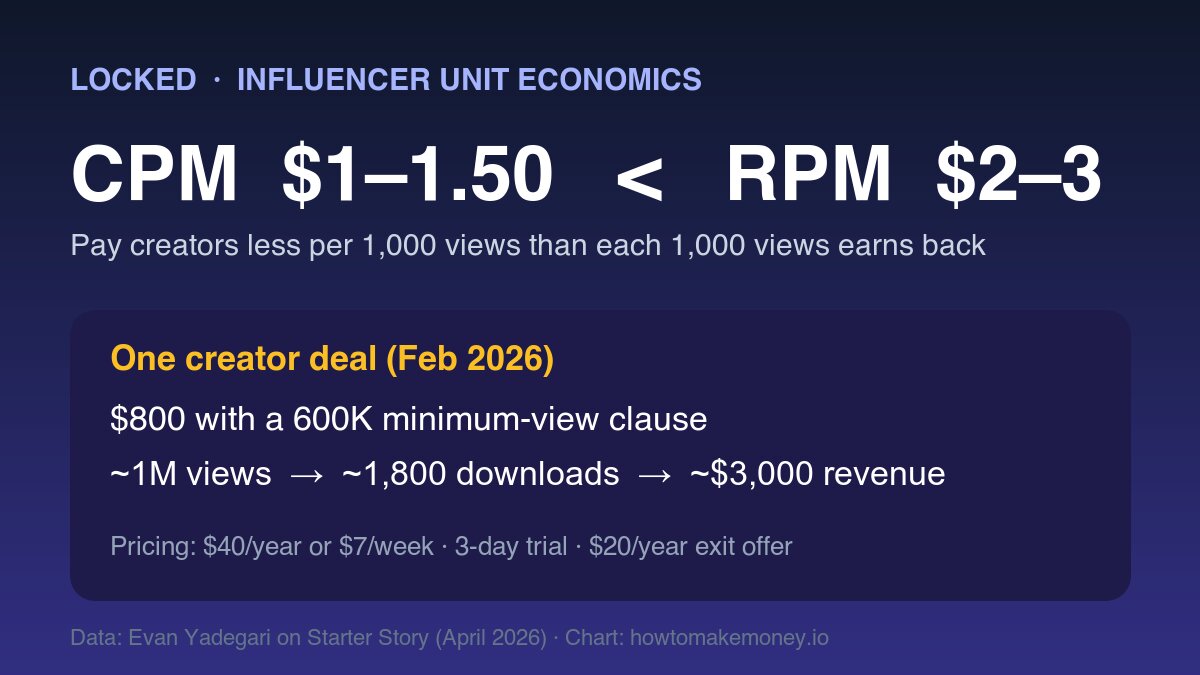
1. Work out your RPM first RPM is revenue per 1,000 views. He calculated Locked's RPM at about $2–3: every 1,000 views of a creator video brings in roughly $2–3.
2. Only negotiate prices with CPM below RPM CPM is cost per 1,000 views. His target is $1–1.50. As long as CPM is below RPM, every extra view makes a little more money.
3. Use different deal structures to control risk Depending on the creator, he offers several options:
- Flat rate: $500 for one video, or $1,200 for four;
- Pay per CPM: $1–2 per 1,000 views, with a cap;
- Minimum-view clause: for example, $500 with a 500,000-view minimum — he says this is the one he uses most;
- Bonus: $500 base, plus $500 more if it passes 1 million views.
4. Finding creators is simple Search for creators in the niche on Instagram and TikTok, send a standard DM that opens by asking "paid promo?" He cares about comment quality, not follower count.
5. Write requirements into the deal The app must appear in the first 15 seconds of the video; the first video goes live within a week; if it performs well, the partnership continues.
Phase 4 · The ledger for one video (February 2026)
He gave a concrete example: a deal with creator Jeremiah Jones for $800 with a 600,000-view minimum.
The video went up around February 6, 2026. Results:
- About 1 million views across platforms;
- About 1,800 downloads;
- About $3,000 in revenue.
Do the math: $800 for 1 million views is an effective CPM of about $0.80; $3,000 in revenue means an RPM of about $3. Cost was less than a third of revenue.
He also mentioned App Store Optimization (ASO) as a channel that brings organic traffic over the long run.
Phase 5 · $14K/month, and after (2026)
In April 2026 he told Starter Story that Locked was making $14,000/month about four months after launch. His advice to peers: "Worry less about school and put more time into building."
But by October 2026, we could no longer find the app in several App Store regions. Whether it was removed, renamed or moved to another developer account isn't public. It's a reminder that consumer apps that spike fast can also have short lives.
Thinking
1. Influencer marketing isn't luck — it's arithmetic
Most people do influencer promotion as "pay, post, pray." Evan first calculates his RPM, then only buys views below that price. As long as CPM < RPM holds, influencer spend turns from a cost into a trade with positive expected return, and you can scale it with confidence.
A minimum-view clause shifts the risk of "nobody watched" back to the creator. To get paid in full, the creator works harder on the content.
2. Comments matter more than follower counts
Followers can be bought; comment sections are hard to fake. Creators with active, genuine comments have audiences more likely to actually download. For indie developers on small budgets this is crucial: the same money goes further with the right creator than with a bigger account.
3. Pricing and the paywall are growth levers too
$7/week looks cheap but costs far more than $40 over a year; its job is to make the annual plan look like a bargain. The $20/year exit offer recovers some users who would otherwise leave. Pricing is a big reason his RPM reaches $2–3 — and the higher your RPM, the more views you can afford to buy.
4. "Age 14" isn't the point; building consistently is
He made games at 9, earned some money on his first app and sold it, failed with his second, and succeeded with his third. AI let a 14-year-old write a native iOS app, but what made money was years of accumulated product sense and the discipline to do the marketing math.
5. Read this case with a cool head
- The numbers can't be verified: $14K/month is self-reported, with no Stripe or third-party data;
- The app can no longer be found: as of October 2026 it's missing from several App Store regions, which suggests ad-driven apps can come and go quickly;
- Habit apps struggle with retention: gamification helps early on, but habit apps commonly lose users after a few weeks, and weekly subscriptions are especially easy to cancel;
- Minors face special conditions: contracts, payments and developer accounts usually require a parent, a practical factor ordinary readers should consider.
Action
Step 1: Calculate your RPM first (1–2 weeks after launch) After launch, run a little paid promotion or post your own content and track views → downloads → payments. Work out revenue per 1,000 views. Without an RPM, don't scale up influencer deals.
Step 2: Set a CPM ceiling Set your target CPM at around half your RPM (e.g., RPM $2–3 means a CPM target of $1–1.50) to leave a safety margin.
Step 3: Find creators in daily batches Search niche keywords on TikTok and Instagram and list candidates. Check the comments first: are they genuine, and are people discussing the content? Send a batch of standard DMs each day, opening by asking whether they do paid promos.
Step 4: Control risk with the contract Lead with a minimum-view offer, such as "$500 with a 500,000-view minimum, or you post again until it's met." Spell out that the app must appear in the first 15 seconds and the first video goes live within a week.
Step 5: Test with one video, then go long-term Start every creator with a single video. Those who hit your CPM target get multi-video packages; those who don't, don't get renewed.
Step 6: Optimize pricing and the paywall in parallel Test weekly vs annual plans, free-trial length and exit offers. Use a tool like Superwall to A/B test and keep pushing RPM up.
Step 7: Don't rely only on paid promotion Work on App Store Optimization (title, keywords, screenshots) at the same time to build organic traffic and reduce dependence on influencers.
Not for you if:
- Your app hasn't proven views → downloads → payments, and you're rushing to spend on influencers;
- Your price point is so low that your RPM comes out under $1 — you'll rarely find views that cheap;
- You won't send DMs, negotiate prices and chase deliveries every day;
- Your product only makes money with long-term retention, yet you rely solely on short bursts of paid acquisition.