Mailing Chore Lists Written on Melons: The Rise and Fall of a Pun Business — Miami's Honeydew Lists Got 30 Orders on Day One, Then Quietly Shut Down Five Years Later
Americans call the list of chores a partner hands them a 'honey-do list' ('Honey, do this...'), and the melon happens to be called a 'honeydew.' Miami's Ivory Mouzon and partner Jermaine Lamar seized the pun and in October 2018 built a Wix site called Honeydew Lists: customers typed a list online, and the pair wrote it on a fresh honeydew with edible markers, wrapped it in gold paper and mailed it. It cost $12.95 plus shipping, about $6 to make, and got 30 orders on day one. The two split funding 50/50 and fully bootstrapped. Starter Story's headline says '$5K per month,' but in the interview itself that was a pre-launch projection, and the '$60K/year' on its profile page has no other source. The business shut down in 2023. This piece compares it with two similar prank-mail businesses — glitter and potatoes — to show how far a pun business can go and where it gets stuck.
Process
In America, couples have shared a joke for many years: the honey-do list.
The idea is simple: "Honey, do this... Honey, do that..." — fix the faucet, clean the garage, take out the trash, change the light bulb. That long list of chores your partner writes for you is the honey-do list.
The phrase is everywhere in American homes. On a weekend morning there's a sticky note on the fridge listing seven or eight jobs; a friend invites you fishing on Saturday and you can only grin and say, "I've got to get through my honey-do list first." Half complaint, half affection — nearly every married American gets it.
And precisely because everyone gets it, it could be turned into a business.
Meanwhile, there's a pale-green, smooth-skinned melon in the supermarket called a honeydew. Say it out loud and it sounds almost exactly like "honey-do."
In 2018, Ivory Mouzon in Miami thought: if they sound the same, why not write the chore list on an actual honeydew and mail it?
That became Honeydew Lists. On its first day, 30 people placed orders.
The story was later covered by the founder-interview site Starter Story under the headline "Making $5K Per Month Mailing People Melons," and retold online as "a pun turned into a $5,000-a-month solo business."
But read the interview carefully and you'll find two things the headline leaves out:
- "$5,000 a month" was a pre-launch projection, not actual revenue. At the time of the interview, the site had been live for only a few weeks;
- The business shut down in 2023.
So this isn't a "passive income" story. It's a more interesting one: how far can a funny idea go — and where does it get stuck?
Phase 1 · A good pun, tested on her husband first (2018)
Ivory had been on a different path. She studied nursing and planned to become a nurse. At 26, she decided to switch to entrepreneurship. Before Honeydew Lists, she had run a successful Etsy shop, and she was also part of a tech startup planning to launch in January 2019.
The idea came from her cousin, who was always talking about the "honey-do list." Hearing it so often, Ivory pictured something: a melon covered in chores.
She ran into her friend Jermaine Lamar on an off-the-beaten-path trail and pitched the idea on the spot. Jermaine's verdict: it was "the corniest but most ingenious thing" he'd ever heard.
The two decided to partner, splitting the funding 50/50 and fully bootstrapping. Jermaine had another job and took part on the side.
Before building anything, Ivory ran a clever test: she tried it on her husband first. Her standard was simple — if her husband got the pun the instant he saw the melon, the idea was gold. She cleaned out the refrigerator, put a melon with writing on it inside, and waited for him to open the fridge.
He got it instantly. The site's later tagline — "Instead of a note on the fridge, a note in the fridge!" — probably came from that moment.
Phase 2 · Launching the cheapest way possible (October 2018)
Launching Honeydew Lists cost almost nothing:
- Website: built by Ivory herself on Wix, chosen for speed and minimal investment;
- Sourcing: no inventory. Melons spoil, so they were bought from nearby farmers markets and produce stores only after orders came in, choosing fresh ones that weren't overripe;
- Writing: edible markers only, written on the melon's rind;
- Packaging: gold wrapping paper bought on sale, wrapped around the melon like a basketball, tied with ribbon and a label, and surrounded by paper confetti;
- Shipping: padded envelopes or boxes, depending on where the recipient lived.
The price was $12.95 each (plus shipping), and each one cost about $6 to make. Ivory described the margin as "pretty good" and planned to get better rates from wholesale markets later.
In October 2018, the website and social media accounts went live together.
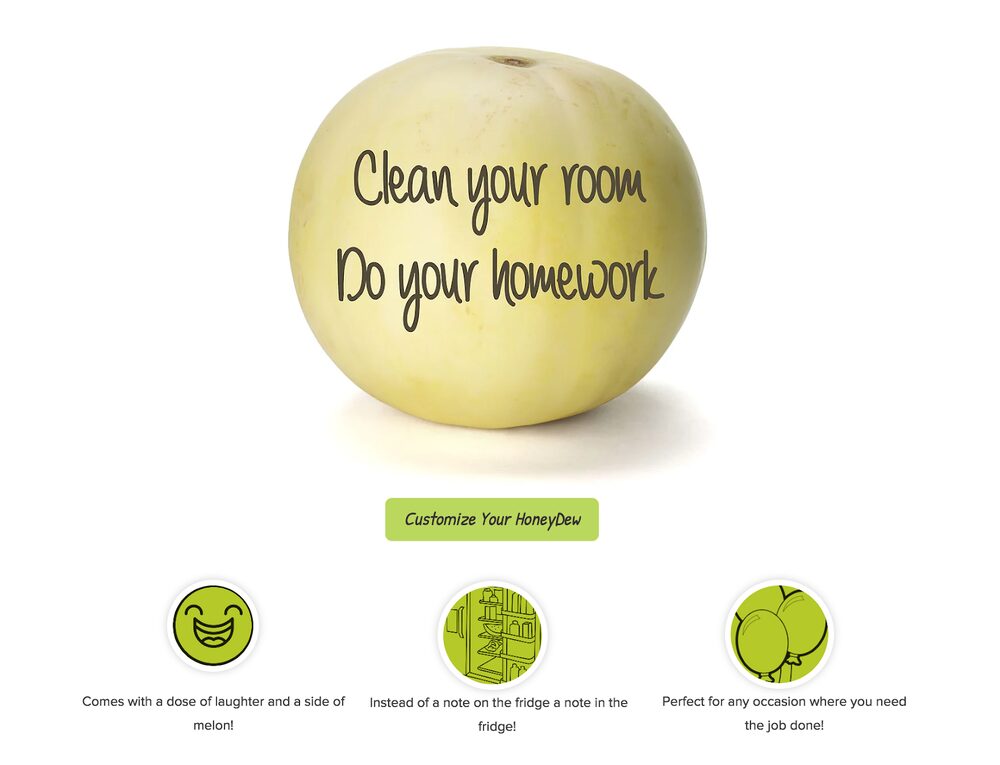
The homepage copy was fun, too. Besides "Instead of a note on the fridge, a note in the fridge!" it had two taglines: "Comes with a dose of laughter and a side of melon!" and "Perfect for any occasion where you need the job done!" The sample melon on the homepage didn't carry a couple's chores but "Clean your room, Do your homework" — it aimed beyond partners to parents and kids.
In other words, Honeydew Lists was never really selling melons. It was selling a way to turn nagging into a joke: asking someone to do chores easily starts an argument, but when a hefty melon arrives reading "wash the dishes," the recipient will most likely laugh first — and then wash the dishes.
Phase 3 · 30 orders on day one, and "stupid sells" (October–November 2018)
On launch day, Honeydew Lists received 30 orders.
One of the most popular messages came from several women, nearly word for word: "Wash the dishes, or else."
For customer acquisition, the pair used a few low-cost methods:
- Reddit: a few days before launch, they did an "Ask Me Anything" (AMA) on Reddit. Many people liked the idea and the packaging design; some were blunt critics. Ivory's response was relaxed: "stupid sells."
- Facebook ads: a small test-budget campaign using images from their social posts, which got its first click on day one;
- Social media: a commitment to post every day.
At the time, her expectation for the first month was "at a minimum of $5,000." That number later made its way into Starter Story's headline as "$5K per month."
She also saw the risks clearly. She said she worried about suddenly getting an order for 1,000 melons in one day that farmers markets couldn't supply — "a good worry for tomorrow." At the time, they were working to ship on time from two locations in the US.
Phase 4 · Looking back: did similar businesses go further?
To understand Honeydew Lists, it helps to place it in a larger family of "prank mail" businesses.
Glitter: Ship Your Enemies Glitter (2015) In January 2015, 22-year-old Australian Mathew Carpenter launched a site: for $9.99, you could mail someone you dislike an envelope full of glitter that spills everywhere when opened. It went viral overnight, and orders piled up faster than he could handle. He wrote on the site: "Please stop buying this horrible glitter product — I'm sick of dealing with it." That same month he auctioned the site on Flippa and sold it for $85,000.
Potatoes: Potato Parcel (from 2015) The same year, Alex Craig started Potato Parcel: write a message or print a photo on a potato and mail it, from $9.99. They reportedly made more than $215,000 in their first 13 months. In 2016, the two founders appeared on the US startup reality show Shark Tank dressed in potato costumes and took Kevin O'Leary's $50,000 for 10% equity plus a royalty. In 2018 they told CNBC they had sold 70,000 more potatoes since the show, with yearly revenue in the six figures.
Put the three side by side and the ideas are equally funny and equally "zero explanation needed." But the endings differ completely: the glitter site sold at a high price, the potato became a business that lasted years, and the melon shut down after five.
Phase 5 · Five years later, a quiet shutdown (2019–2023)
According to Starter Story's profile page, Honeydew Lists operated until 2023, with the closure reason listed simply as "shut down." The page also lists "about $60K a year" in revenue, but we found no other source to back up that figure.
Today, honeydewlists.com no longer works.
Looking back at the 2018 interview, Ivory's plans were actually ambitious: stabilize the US first, then expand to other countries; once profitable, go beyond melons with all kinds of "product pairings" to create lasting memories for customers. She summed up operations in three words: brand (write), wrap, ship.
She also cited two ideas that shaped her. One came from investor Rodney Sampson: "create a business that is affordable so you can fund ideas that cost more." The other was Airbnb's early cereal-selling story — before anyone else believes in you, you have to believe in yourself.
Seen that way, Honeydew Lists may never have been meant as the end goal, but as an "affordable" small business: little money in, a fast way to test an idea and gain experience. Why it never grew bigger isn't stated anywhere in the record. What we can do is look for clues in how it was built.
At the end of that 2018 interview, Ivory offered other founders this: "Don't hesitate. Just begin and begin again. Don't be afraid of your ideas."
She was also candid about her biggest lessons: "Not hiring for marketing is a huge mistake." "Trying to do it all is the biggest failure anyone can make."
Thinking
1. The value of a good pun: zero explanation cost
Honeydew Lists' greatest strength was that it needed no explanation. Americans see a melon covered in chores and instantly laugh, get it and want to send it to their partner. Ideas with "zero explanation cost" are naturally shareable — which is why it got 30 orders on day one.
The flip side: the pun only works in English-speaking culture. In another language, the "honeydew/honey-do" sound-alike disappears, and the product loses its entire joke. That limited its market from the start.
There's another easily overlooked problem: jokes have a shelf life. A joke is hilarious the first time and stale after a while. Ship Your Enemies Glitter went viral within a month and was sold within the same month, partly because its founder saw that the heat comes fast and leaves fast. A good joke is great for a cold start but rarely sustains a long-term business on its own.
2. The carrier you choose sets the business's ceiling
Mailing glitter, potatoes or melons — the ideas are equally funny, but the carriers are very different:
| Carrier | Perishable? | Weight & fragility | Storage |
|---|---|---|---|
| Glitter | Never spoils | Light, shock-proof | Can stock in bulk |
| Potato | Keeps for a long time | Sturdy | Can batch-process |
| Melon | Overripe in days | Heavy, bruises easily | Must buy after each order |
A melon spoils, is heavy and bruises easily; you can't stock it, shipping is expensive, and it may rot on long trips. Ivory herself worried about "1,000 orders in a day." Pair a great idea with a hard-to-handle carrier, and scaling becomes very difficult.
Now look at why the potato went further. Potatoes are cheap, sturdy and keep well; you can buy a big batch, print and pack them in bulk, and even hand production to staff or contractors. Glitter is the extreme case: it essentially never spoils and ships in an envelope, so one person can process it in bulk at home. Every melon, by contrast, has to be bought, written on and wrapped to order, then delivered before it overripens. Among prank-mail businesses, the carrier's physical properties largely decide whether the work can be handed to others and scaled up.
3. The unit economics of cheap novelty products
At $12.95 minus about $6 in cost, gross margin per order is under $7. Shipping is charged separately, but packaging, ads and two people's time still come out of it. If customers come from Facebook ads, the cost of a click and a conversion can easily eat most of the profit.
Let's run a hypothetical estimate (these numbers are illustrative only, not Honeydew Lists' actual data): a melon sells for $12.95 and costs $6; if ad spend per order is $5 and packaging is $1, less than $1 of profit remains per order. To earn $5,000 in profit you'd need to sell five or six thousand melons — each one picked, written on, wrapped and shipped by hand.
Gag gifts naturally have low repeat purchases: a joke is funny the first time, less so the second. Low price + low repeat rate + high fulfillment cost is the most common ceiling for businesses like this.
4. The cost of running it part-time
Both founders had other work: Jermaine had a job, and Ivory was also working on a tech startup. From the website, sourcing, writing and packaging to shipping and marketing, they did almost everything by hand.
Ivory summed it up well: "Trying to do it all is the biggest failure." A business that requires handling fresh produce by hand every day is hard to grow part-time.
5. Reading "$X a month" headlines
This case was repeatedly retold online as "a $5,000-a-month solo business," but in the original interview that was a projection a few weeks after launch; the "$60K a year" on the profile page can't be verified; and the business ultimately shut down in 2023.
That doesn't mean it failed — for five years it made a lot of people laugh and let its founders test an idea. But it's a reminder: when reading startup stories, separate projections from actual results, and pay attention to how the story ends.
Action
Step 1: Find a cultural joke with zero explanation cost (1 week) In a language and culture you know, look for puns, slang, holiday customs and family jokes. The standard: your target users laugh within a second of seeing the product and want to share it right away.
Step 2: Test it on one person first Like Ivory testing on her husband, show a sample to the most typical target user you know and watch whether they get it instantly and actually laugh. If it needs explaining, the joke isn't good enough.
Step 3: Choose a carrier that ships easily Prefer things that don't spoil, are light, sturdy and can be prepared in batches ahead of time. Avoid hard-to-handle carriers like fresh produce, glass and liquids.
Step 4: Do the math on every order Take the price and subtract product cost, packaging, shipping, platform fees and average customer acquisition cost. If only a few dollars remain, consider raising prices, offering bundles, or going after corporate and holiday bulk orders.
Step 5: Launch as cheaply as possible Use site builders like Wix or Shopify to launch fast, post on Reddit, TikTok and Instagram, and validate demand with real users' reactions.
Step 6: Plan for holiday peaks in advance Demand for gag gifts clusters around Valentine's Day, Mother's Day, Father's Day and Christmas. Prepare materials and help ahead of time so you don't miss shipments at the peak.
Step 7: Think about your exit Novelty businesses tend to run in cycles. If you don't have the energy to run it long term, you can list it on a marketplace like Flippa at its peak, as Ship Your Enemies Glitter did.
Not for you if:
- You want a stable, multi-year business with high repeat purchases — gag gifts are usually one-off buys;
- You don't have time for handmade production, packaging and after-sales on every order;
- Your carrier spoils easily, breaks easily or costs a lot to ship, and you have no reliable logistics plan;
- You only read the "$X a month" in the headline without checking whether it's a projection or an actual result.