A Meta Engineering Manager Quit to Make a Text-Based Game: Just a Few Hundred Active Players, $150K in a Year, $0 on Ads
Ken spent about 12 years in big tech, first as a software engineer at Amazon and then as an engineering manager at Meta, and hadn't written code in over four years. After Meta's layoffs began in 2022, he realized no amount of hard work guarantees job security. In early 2024, he used AI coding tools to build a card game in six weeks for practice, then started Harpagia: a text-based idle RPG for fans of old-school games like RuneScape. He forced himself to launch after six months of development; a player spent $10 within days, and by the end of month two he'd made about $1,500. His goal: quit once monthly revenue grew organically to $10,000. About six months after launch, his first Reddit post drew overwhelmingly critical comments but took off, and monthly revenue jumped overnight from about $1,000 to $10,000; he left Meta that month. According to what he told Starter Story in September 2026: about $13,000 a month on average over the past year, peaking at $18,000, over $150,000 for the year; about 50,000 downloads with roughly a 6% paying conversion; about $500 a month in costs and $0 on ads.
Process
When it comes to making money with games, most people think of mega-hits like Angry Birds or Clash of Clans: tens or hundreds of millions of players, a massive team, and huge marketing budgets.
Ken's game is nothing like that.
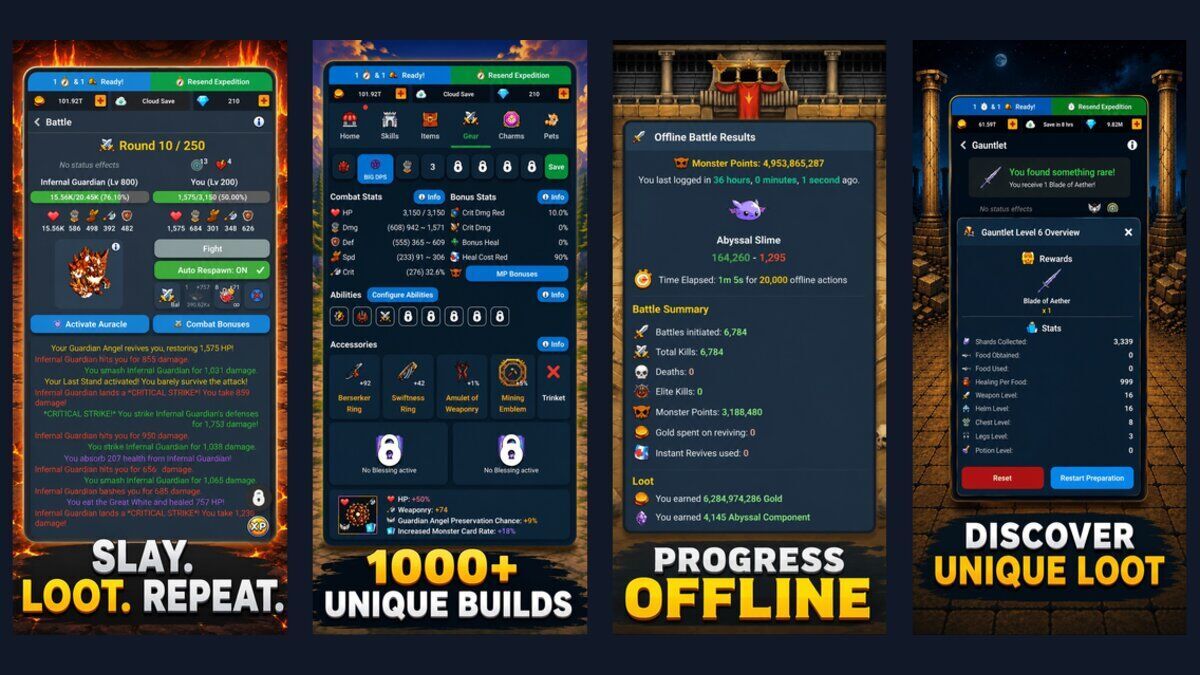
It is called Harpagia, a purely text-based idle RPG with almost no graphics. It has very few players: according to Ken on the show, there are only a few hundred truly active ones. It also has no publisher, no marketing budget, and Ken hasn't spent a single cent on advertising.
Yet, according to his own account on the startup interview show Starter Story in September 2026, this little game brought in over $150,000 in revenue over the past year, averaging about $13,000 a month.
Because of it, Ken quit his job as an engineering manager at Meta.
He said: "I never imagined I could make over $100,000 a year with just a few hundred active users. This completely changed my perspective on niche businesses and small audiences."
Note: These numbers are self-reported by the founder and have not been third-party audited.
Phase 1: 12 Years in Big Tech, No Code Written in Four Years
Ken followed a very "standard" path: he studied computer science at the University of California, San Diego (UCSD) and went straight into the tech industry after graduation.
He worked in big tech for about 12 years: first as a software engineer at Amazon, and later at Meta, where he became an engineering manager.
During the first half of his career at Meta, he learned a lot, had great mentors, and the company took good care of its employees. But after moving into management, he had not written a single line of code in over four years.
The turning point occurred in 2022. That year, Meta began massive layoffs. Ken said his view on "job security" completely changed after that: "I realized that no matter how hard you work, job security is never guaranteed. I wanted to control my own future."
Phase 2: Picking Up Coding Again with AI, Building a Card Game for Practice
In early 2024, AI coding tools started becoming popular. Ken wanted to see if he could build an app with the help of AI.
He didn't start with a massive project; instead, he picked a very small goal: a card game called Big 2 Wild. It was a game he often played with friends in high school, so he was familiar with it, and the rules were simple. He deliberately kept the scope tiny so he could actually finish it and publish it in a short amount of time.
He spent about six weeks completing the game.
This small project taught him a lot: how to use AI for development, how to take a product from start to finish, how to pass app store reviews, and what it really takes to release a product to the world.
Armed with this experience, he began his next project: Harpagia.
He chose to make a game because "gaming is something I feel I know very well."
This point is crucial. For someone who has been away from frontline coding for years, relearning to program is hard enough; if he had chosen a completely unfamiliar field, the difficulty would have multiplied. But games are something he's played for years: he knows what kind of stats are addictive and what kind of design makes people quit. AI supplemented his ability to write code, while his understanding of games came from years of his own accumulation.
Phase 3: Launching Forcefully After Six Months of Development
Harpagia is a text-based idle RPG, primarily aimed at players who enjoy "incremental games" like RuneScape.
In this type of game, you aren't really "playing" most of the time: the game automatically progresses while you're away, and you return to collect rewards and decide what to do next. There are 16 skills to upgrade in Harpagia: some are very simple—click "start mining" and you get a continuous stream of resources; others are more interactive, like "archaeology," where you click different tiles for various bonuses. You can use resources to upgrade your gear and then fight monsters. Combat is fully automatic, but there's a vast array of gear and skills to combine, offering a lot of gameplay variety.
Ken had a grand vision in mind, but he set a hard rule for himself: launch after six months of development, no matter what.
He later said this was one of the best decisions he ever made. "Looking back, if you don't put the game in the hands of real players, it can't improve that quickly. If you aren't embarrassed by your V1, V2, or even V5, you probably launched too late."
According to the App Store, Harpagia's release date was November 2024. At the time, he was still working full-time at Meta.
Phase 4: The First $10 and a Goal to Quit
After launch, a small group of players found the game and started giving him feedback.
A few days after launch, he made his first revenue: a player spent $10.
"That was incredibly encouraging. It proved that even though my game was a very early beta, someone liked it enough to spend $10 on something I made."
By the end of the first month, he had made about $150; by the end of the second month, his cumulative revenue was about $1,500.
At this point, he started realizing this might be more than just a hobby. He set a goal for himself: if the game can organically grow to $10,000 a month, I'll quit my job and dive in full-time.
After that, the game grew slowly but steadily.
Phase 5: A Criticized Reddit Post That 10x'd His Revenue
About six months after launch, Ken made his first Reddit post to introduce the game.
The post was simple: a few screenshots, a brief introduction to what the game was, and some data showing how friendly it was to free-to-play users. He emphasized this because players generally want to try before they decide to spend money.
The reaction in the comments was, in his words, "overwhelmingly critical." The game was indeed still very rough at the time.
But this post gained a huge amount of attention, putting Harpagia in front of tens of thousands of players.
His monthly revenue jumped from about $1,000 to $10,000 almost overnight.
He hit the goal he had set. That same month, he left Meta.
He admitted that his salary at Meta was far higher than the game's revenue. "But I really wanted to do something for myself for the first time. I thought, even if the revenue isn't enough to cover my expenses, I still have to do it. If not now, then when?"
Phase 6: The More Criticism, The More Popular It Got
From then on, Reddit became Ken's most important marketing channel. Almost every post he made brought in a large wave of new players.
But Reddit also has rules: many subreddits only allow developers to promote their products once a month. So, he usually only posted every few months when there was a major update.
He discovered an interesting pattern: the posts with the most heated discussions usually worked the best, especially the ones that received the most criticism. "Although the game was still rough back then, it didn't matter at all. It sparked a lot of discussion and criticism, which actually helped the game spread tremendously."
These criticisms also served as feedback for him to improve the game.
Relying on these periodic Reddit update posts, Harpagia's monthly revenue grew from around $10,000 to a peak of about $18,000.
He uses Discord to manage the player community. Technically, he uses Cursor to write code, ChatGPT for brainstorming and fixing icons, React Native for the frontend, Firebase for the backend, login, and data analytics, and Vercel to host the website. For art, he buys ready-made assets directly from platforms like the Unity Asset Store, saving massive amounts of time on drawing; screenshots, icons, and promotional videos are outsourced to freelancers on Fiverr and Upwork, allowing him to focus on writing the game.
Phase 7: A Few Hundred Players, $150K a Year
By September 2026, Ken shared Harpagia's report card:
| Metric | Data |
|---|---|
| Average monthly revenue in the past year | ~$13,000 |
| Peak monthly revenue | ~$18,000 |
| Total revenue in the past year | Over $150,000 |
| Average annual contribution per active user | $3+ |
| Cumulative downloads (iOS + Android) | ~50,000 |
| Paid conversion rate | ~6% (he noted the industry average is 2% to 5%) |
| Monthly operating costs | ~$500 |
| Ad spend | $0 |
The monetization model is free to download with optional in-app purchases: players can pay to unlock premium features or speed up their progress, with most prices ranging from $2 to $10. After extensive testing, he found that $4.99 to $9.99 was the most acceptable range for players, "above $9.99, conversion becomes much harder."
He also mentioned that he wasn't too concerned about making money at first; instead, he focused purely on retention: making a game that players would want to keep playing.
A rough calculation based on his numbers: $500 in monthly costs against an average of $13,000 in monthly revenue. Even after deducting Apple and Google's 15% to 30% cut, the profit margin is still incredibly high. This is the exact charm of a niche game: you don't need a lot of players, just a group of people who genuinely love it.
Ken also discussed opportunities in the gaming industry on the show. Gaming is a hundred-billion-dollar industry, but many people have a misconception: they think you need hundreds of thousands or millions of players to build a sustainable business. "What I've learned over the last few years is that as long as you build something people truly love, a very small audience can bring in substantial revenue."
The host Gus's summary was simple and grounded: make what you truly understand and are genuinely interested in. Because you know the field, you'll be more motivated; because you are the target user, you understand what the customer is thinking; and this passion will carry you much further than "chasing a trendy idea."
Thinking
1. Niche can be a great business
A few hundred active players, $150,000 in annual revenue. Ken's story shatters the myth that "a game must have a massive user base to make money."
He said: "The opportunity isn't necessarily making the next Flappy Bird or Clash of Clans, but making something you genuinely care about, and finding people who also care about it." A small group of paying hardcore fans is worth far more than a large crowd of non-paying passersby.
2. Build what you know best
Ken chose to make a game because he was a player of this exact genre. He knows what idle game players want: deep progression systems, rich gear combinations, and offline progress. When you are the target user yourself, your judgment of the product is far more accurate.
3. Build a small project first to validate the process
Before making Harpagia, he spent six weeks making a card game. This small project familiarized him with the entire workflow of AI-assisted development and app store publishing. Many people fail not because their idea is bad, but because they have never actually finished a product.
4. Criticism is also exposure
Ken's first Reddit post was heavily criticized, but it multiplied his revenue by 10. In a community, sparking discussion is more important than getting likes. Don't be afraid to put out a rough product; criticism itself is attention and feedback.
5. Set a clear threshold for quitting
"Quit when monthly revenue naturally hits $10,000"—this goal allowed Ken to validate demand while keeping his day job, and it let him pull the trigger without hesitation when he hit the target. Quitting shouldn't be an impulse decision, but a natural outcome of hitting a data threshold.
Action
Step 1: Pick a niche you've played or used long-term (1 week) List the game genres you've played for years or the tools you've used for years. Think about what people in this circle want the most and what they complain about the most.
Step 2: Use AI to build a small practice project (4-6 weeks) Pick a project with simple rules and a tight scope, finish it completely, and publish it to an app store to learn the process.
Step 3: Set a forced launch date for the main project For example, launch after six months of development, no matter how rough it looks.
Step 4: Free to download, test pricing with small in-app purchases Test the $4.99 to $9.99 range to see which price converts best. Focus on retention first, then optimize revenue.
Step 5: Post in Reddit communities where your target users gather Understand the subreddit's rules first. Introduce your project with screenshots and real data, emphasizing that it's friendly to free users. Seriously reply to every comment, including criticism.
Step 6: Create a Discord community Give core players a place to discuss and offer suggestions. Turn their feedback into updates, and use major updates as an excuse for your next post.
Step 7: Set a quitting threshold For example, "when monthly revenue stabilizes at $10,000". Until you hit it, keep your job and continue iterating in your spare time.
Not for you if:
- You have no programming foundation and aren't willing to spend time learning AI-assisted development;
- You have no personal interest in the game genre or field and just want to make quick money;
- You can't handle massive criticism after a public release;
- You expect a game to bring in millions of players—this path is suited for small, beautiful businesses.