Same Founder, Same AI: Why Danny Postma's HeadshotPro Makes $300K a Month While HairstyleAI Sold Just 1,298 Orders
Dutch indie hacker Danny Postma is a star of the AI product scene: his 2020 AI copywriting tool Headlime sold for about $1M within a year, and HeadshotPro, the AI professional-headshot tool he built in about 30 days in 2023, made $100K in two weeks and reportedly earns about $300K a month today. But in the same period, HairstyleAI — an AI hairstyle try-on site built on the same face-AI technology — shows just 1,298 customers on its own website at a $9 one-time price, implying roughly $12K in total revenue. The customer counter has stayed frozen at 1,298 from July 2023 into 2026. The widely repeated claims that HairstyleAI makes '$80K a month,' launched in '48 hours' with '85% net margins' have no source. This case asks: same person, same technology — why did one product become a money machine while the other barely sold?
Process
Let's start with a story that has spread widely.
Legendary Dutch indie hacker Danny Postma spent 48 hours building an AI hairstyle site called HairstyleAI. No subscriptions, just one-time credit packs — and it made $20,000 to $80,000 a month at 85%+ net margins.
It sounds inspiring. The problem: the story is almost entirely false.
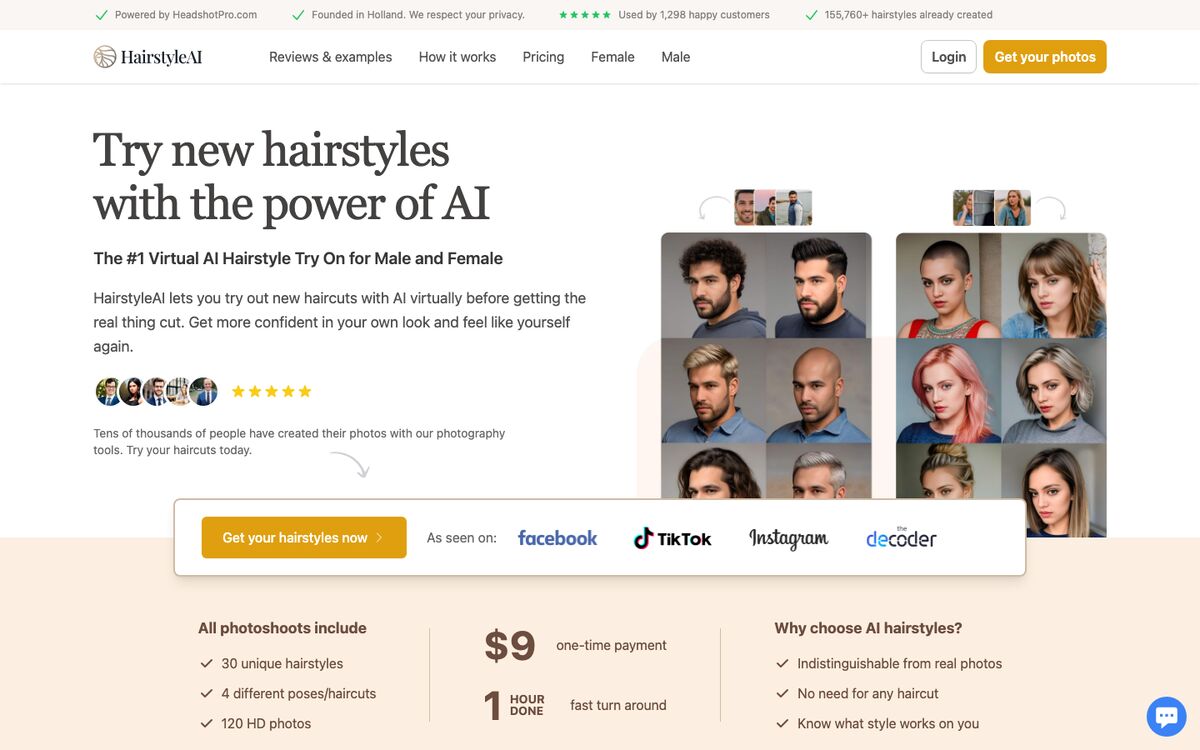
Open hairstyleai.com and a line of small text at the very top reads: "Used by 1,298 happy customers." The price is $9, one-time. Do the math and HairstyleAI's total revenue since launch is about $12,000 — less than a sixth of the legendary "one month at $80K."
Even more interesting, we checked web archives: from July 2023 into 2026, that "1,298" has never changed.
But Danny Postma himself really is a successful founder. In the same period, another product he built on the same AI technology — HeadshotPro — reportedly brings in about $300,000 a month today.
Same person, same technology, launched in the same period — why did one become a money machine while the other barely sold? That's the story this case is really worth telling.
Phase 1 · A marketer who couldn't code (2015–2019)
Danny Postma is Dutch. He started out as a web marketer, freelancing in conversion rate optimization. For years he couldn't write code.
In 2015, at 21, he was struggling to find good references while designing landing pages for clients, so he built Landingfolio, a WordPress site collecting great landing-page designs. It was his first successful project.
By his own account, he only really learned to code around age 25.
Phase 2 · Headlime: his first AI product, sold for about $1M within a year (2020–2021)
In 2020, Danny built a tool called Headlime, initially just a copywriting tool with headline templates.
The turning point was GPT-3. A friend introduced him to OpenAI's new model, and Danny emailed OpenAI co-founder Greg Brockman directly to request access, becoming one of the first users to get it. He plugged GPT-3 into Headlime, making it one of the earliest products to use GPT-3 in production.
Reportedly, Headlime made about $60,000 in its first week and reached about $20,000 a month by March 2021. Within a year, he sold it for about $1 million.
The experience convinced him: when new AI technology arrives, whoever first packages it into something ordinary people can use earns the first pot of gold.
Phase 3 · After Stable Diffusion: a burst of small products (fall 2022)
In September 2022, the open-source image model Stable Diffusion was released. Danny started experimenting immediately.
He first built Stock AI, an AI stock-photo site, but soon abandoned it: output quality was inconsistent, and it risked legal trouble from image giants like Getty Images.
So he turned to "using AI on faces." He built ProfilePicture.AI, which generated social media avatars. He says it "exploded on Twitter, generating significant sales in just a week" — but sales soon declined.
Next he rolled out a string of small products: Tattoos AI for tattoo designs, Deep Agency for hiring AI models, Meme Morph for memes... HairstyleAI was one of them. Web archives show hairstyleai.com was already live in November 2022, priced at $8.
The logic of this approach is clear: same technology, new use case, new product. Build fast, keep costs low, and keep going with whatever takes off.
Phase 4 · HeadshotPro: the real hit (2023 to today)
Of all these experiments, the one that broke out was HeadshotPro — AI-generated professional headshots.
In 2023, Danny and developer David built HeadshotPro in about 30 days. Deep Agency, launched at the same time, got more press, but HeadshotPro made the money: about $100,000 in its first two weeks.
After that, Danny put almost all his energy into it:
- Custom models: beyond Stable Diffusion, it uses LLaVA to filter uploads and CodeFormer to refine faces, and the team spent a full year developing its own models, aiming for photos "indistinguishable from real photos";
- Strict quality requirements: users upload 15 to 17 photos for the best results;
- Focus on one use case: while competitors expanded into avatars and dating photos, HeadshotPro stuck to professional headshots;
- Programmatic SEO: 200+ city-specific landing pages (like "professional headshots San Francisco"), ranking in the top ten for "professional headshots," with about 222,000 visits a month;
- Pricing: $29 for one session, $69 for three, plus bulk orders from company teams.
HeadshotPro reportedly makes about $300,000 a month today and has generated about 18 million headshots for about 197,000 customers. Danny also moved from working solo to building a team. "I should have started a team way earlier," he says.
Phase 5 · HairstyleAI: a counter stuck at 1,298 (2023–2026)
Now back to HairstyleAI.
Today's hairstyleai.com says "Powered by HeadshotPro.com" at the top — it runs on HeadshotPro's technology. The product is simple: upload selfies, and in about an hour you get 30 hairstyles, 4 poses and 120 HD photos for $9, one-time. The footer reads "© 2023 Postcrafts PTE LTD" — Postcrafts is the company Danny uses to run his products.
But its numbers haven't moved. Web archives show the same figures on the homepage in July 2023, February 2024 and February 2026: 1,298 customers, 155,760 hairstyle photos.
In February 2024, Danny said in an interview that he was "in the process of selling most of these products to fully focus on HeadshotPro." HairstyleAI is still online, but it looks like a side product that has been set aside.
As for the online claims of "$20K to $80K a month," "built in 48 hours" and "85% net margin," we found no source. By the site's own published numbers, those claims are far from the truth.
Thinking
1. Strength of need decides everything: replacing an expensive service, or satisfying curiosity?
HeadshotPro solves a "must spend money" problem: job hunting, LinkedIn updates and company websites all need professional headshots, and a photographer can cost hundreds of dollars plus scheduling, makeup and travel. AI headshots are dozens of times cheaper, so users have a clear reason to pay.
HairstyleAI solves "I want to see it before I cut it." It's a real but not urgent need: many people are just curious and move on after looking — and phones are full of free hairstyle filters and apps that do something similar.
A product that replaces an expensive service sells far more easily than one that satisfies curiosity.
2. Price point and customer type set the ceiling
HairstyleAI sells for $9; HeadshotPro sells for $29 to $69 and takes company orders for dozens of headshots at once. With the same traffic, HeadshotPro earns more per visitor (reportedly about $1.35 each).
Low-priced products need enormous traffic to make money — and the hairstyle use case simply doesn't have the search volume or willingness to pay to support that scale.
3. Concentrating resources on the winner is the key to a portfolio strategy
Danny's playbook is "try many things, validate fast": put the same technology into different use cases and ship a batch of small products. Most don't take off, which is normal.
The key is that once HeadshotPro broke out, he immediately concentrated the team, model development and SEO on it, while planning to sell the rest. HairstyleAI got none of that investment and naturally stayed where it was.
A portfolio strategy isn't "make every product great" — it's "find the winner fast, then go all in."
4. Acquisition: the commercial value of search intent
HeadshotPro used programmatic SEO to capture high-commercial-intent searches like "professional headshots + city": people searching those terms are basically ready to spend.
People searching "AI hairstyle" mostly want a free tool; commercial intent is weak, and the results are crowded with free apps. Same SEO tactic, very different willingness to pay behind the keywords.
5. Be wary of "hit product revenue" rumors
The original version of this case turned HairstyleAI into a "$80K a month in 48 hours" legend, while the site itself shows 1,298 customers. The indie hacker world is full of secondhand stories like this: attaching someone's total income to one small product, or calling a peak month "steady monthly revenue."
When you see an astonishing revenue number, check it against the product's website, web archives and the founder's own public statements first.
Action
Step 1: Test several use cases cheaply with the same technology (2–4 weeks) If you've mastered a capability (say, AI image generation), don't build just one product. Pick 3–5 different use cases, build a minimum viable version of each and launch fast to test.
Step 2: Set a continue/stop threshold for each product For example, paying users, revenue or organic traffic growth within 30 days of launch. If a product misses the bar, stop investing decisively, or leave it running on autopilot with no further maintenance.
Step 3: Prefer use cases that replace an expensive service Ask yourself: how much do users currently spend on this? If the answer is "hundreds of dollars for a professional," your AI product has lots of pricing room; if it's "free," be very careful.
Step 4: Check the willingness to pay behind your keywords Use Google's keyword tools or Ahrefs to check search volume for your target keywords, and see whether results are mostly paid services or free tools. The former means people are willing to spend.
Step 5: Once a winner appears, concentrate everything on it When a product clearly breaks out, focus your time, money and team on it: improve quality, do SEO, build a B2B version.
Step 6: Deal with underperforming products List them for sale on platforms like Flippa or Acquire.com, or set them to run on autopilot so they don't split your attention.
Step 7: Be honest when you publish numbers If you share your revenue publicly, say which product, which period, and whether it's monthly or cumulative. Real numbers build more long-term trust than inflated stories.
Not for you if:
- You only want to build one product and expect the first to succeed — a portfolio strategy means most attempts will fail;
- You can't switch quickly between small products or won't decisively drop underperforming projects;
- Your use case relies mainly on curiosity, and the market already has plenty of free alternatives;
- You're easily swayed by online "hit revenue" stories without checking where the numbers come from.