A Grid of Squares Behind $600K a Year: A German Developer's First App Made $100 in Six Months — His Second Changed His Life
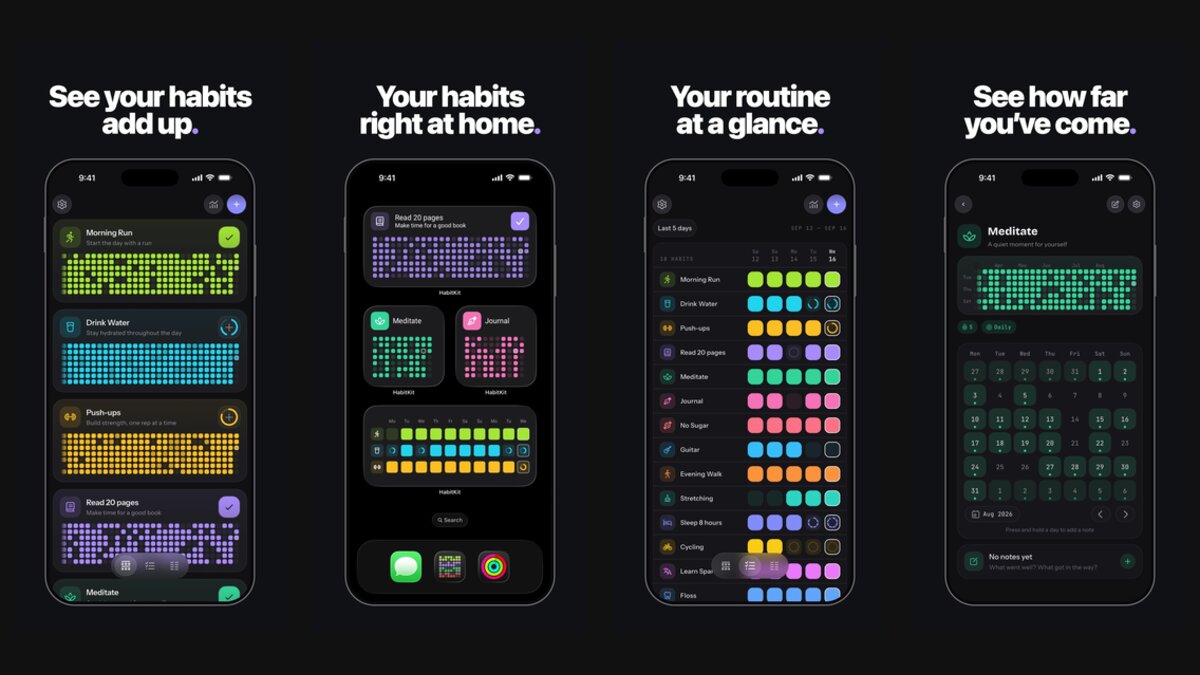
Sebastian Röhl is a German software engineer who spent three years writing C# and .NET at an enterprise software company. He quit and gave himself 12 months to go indie; his first app, a workout log, got about 10 downloads a week and made roughly $100 in six months. He then spent two months building HabitKit, a habit tracker that records daily consistency in colored squares like a GitHub contribution graph — his first screenshot got 800 likes on X. It launched in November 2022 and made $1,500 in its first month, but his 12 months were up, so he went back to work four days a week. A few months later, HabitKit suddenly jumped into the top five search results for 'habit tracker' and revenue took off, so he quit again. In January 2025, after a feature on a channel from MKBHD's team, it made $112,000 in a single month; in 2025 it made $602,000, with 562,000 downloads and 25,100 paying subscribers. Third-party platform TrustMRR, verified through RevenueCat, showed about $32,000 in monthly recurring revenue in September 2026. He still builds it alone, with no funding.
Process
If you're a software engineer, you've almost certainly seen that little grid of green squares on a GitHub profile: each day you push code, the corresponding square lights up green; the more commits you make, the darker the green becomes. Over the course of a year, that screen full of green is undeniable proof of your daily consistency.
German software developer Sebastian Röhl wondered: what if you could use this exact same visual grid to track real-life personal habits? If you go for a run today, the square turns green; if you read a book, the square turns purple. Watching those squares connect day after day, you become fiercely protective of not breaking the chain.
He turned that idea into a habit-tracking mobile app named HabitKit.
In 2025, that app generated $602,000 in revenue, reached 562,000 downloads, and surpassed 25,000 paying subscribers. In its single best month, it brought in $112,000 — an amount Sebastian noted was more than he used to make working full-time for an entire year.
Yet just before this, his very first indie app had made a grand total of roughly $100 over six long months.
To this day, HabitKit is built and run entirely by Sebastian alone — no team, and zero venture capital.
Phase 1 · Quitting His Job, Giving Himself 12 Months
Sebastian studied computer science and software engineering in Germany. After graduating, he joined an enterprise software company where he spent his days writing C#, .NET, and Angular.
The work wasn't particularly thrilling, but it was stable, gave him a rock-solid engineering foundation, and surrounded him with experienced senior colleagues.
Still, another thought kept nagging at him. He later reflected: "I'm the kind of developer who loves coming up with concepts myself, figuring out how to solve problems, building them with my own hands, and watching them work out in the real world."
After three years at the company, he made a bold leap: he quit. He had saved up a modest financial cushion to cover living expenses for a while. Without a polished business plan, he set himself one strict rule: within 12 months, build a self-sustaining indie app business.
Phase 2 · His First App: $100 in Six Months
His first creation was LiftBear, a workout-logging app designed to record sets, reps, and weights. It was an app he initially built for his own personal gym routines.
He built it quickly, skipped testing phases, and relied on a single promotional strategy: sharing development milestones on X (formerly Twitter). Later on, he also experimented with App Store optimization and Instagram promotions.
The reality was crushing. LiftBear averaged only about 10 downloads per week. Over its first six months on the market, it made roughly $100 in total, peaking at around $150 in monthly recurring revenue.
The most agonizing part wasn't outright disaster, but being stuck in limbo: it wasn't dead enough to abandon without regret, yet there were zero signs that "pushing just a little harder" would ever turn things around. Sebastian said: "After six months, I just couldn't take it anymore. I knew that if I wanted to make this business work, I had to pivot."
That painful journey taught him a critical lesson: if a product gains no real traction long after launch, cutting your losses and changing direction is far smarter than stubbornly grinding away.
Phase 3 · One Screenshot, 800 Likes
He gave himself a tight two-month window to build his second app.
This time, the core premise was dramatically simpler: a habit tracker visualizing consistency through GitHub-style colored contribution grids. One row of squares per habit, lighting up every time a task was completed that day.
While still mid-development, he shared his progress on X as usual, posting a clean screenshot of HabitKit's dashboard. That tweet went instantly viral, racking up over 800 likes.
Sebastian remarked: "At that exact moment, I knew: okay, this has the potential to do much better than LiftBear."
The reaction was night and day compared to LiftBear. People instantly understood what the app did at a single glance, and their immediate reaction was "this looks gorgeous" and "I want this." That unprompted pre-launch demand was a signal LiftBear had never once provided.
In November 2022, HabitKit launched. It pulled in about $150 on day one, and wrapped up month one with $1,500 in revenue — over ten times what LiftBear had earned across half a year.
Phase 4 · Betting Big on the Hardest Keyword
Nearly all of HabitKit's subsequent organic growth stemmed from app store search traffic. That was entirely thanks to a deliberate strategy he devised prior to release.
Before launching, he spent countless hours researching keywords, looking for that mythical "high search volume, low competition" keyword phrase. He never found one. So he chose the exact opposite path: he targeted the single most important, most competitive keyword in the entire niche — "habit tracker" — and went all-in.
- He baked the keyword straight into the app's title: in app store listings, HabitKit was officially named "Habit Tracker - HabitKit";
- He placed his second and third most vital keywords directly in the subtitle: "Streaks & Accountability".
Within a single month of launch, HabitKit broke into the top ten search results for "habit tracker" across the UK App Store.
He also paid meticulous attention to user reviews and ratings:
- Requesting ratings at the psychological sweet spot: triggering native system rating prompts right after a user checked off their very first completed habit;
- Replying personally to every single review, going out of his way to troubleshoot bug reports, frequently turning 1-star complaints into 5-star praise;
- Adding a humble closing line when answering user support emails: "If you enjoy the app, would you mind leaving a quick review on the App Store? It really helps others discover it." He discovered that users were often genuinely thrilled to get a direct email from the actual founder and gladly left glowing ratings.
He also tested Apple Search Ads with a modest $100 monthly budget. But after calculating an acquisition cost of roughly €2.50 per install, he joked that "it was pretty dumb" and seriously weighed cutting it entirely.
Phase 5 · Deadline Reached: Returning to a Day Job
HabitKit enjoyed a promising debut, but Sebastian's 12-month self-imposed deadline had arrived. At that time, its revenue alone wasn't enough to sustain him full-time.
He made a pragmatic choice: he returned to his former employer, working four days a week, keeping Fridays exclusively for his own apps.
Many onlookers might have viewed this as a retreat. But for Sebastian, that fallback provided the two most precious assets he needed: stable financial survival and the luxury of time to wait.
The inflection point arrived unexpectedly. In June 2023, roughly two months after returning to his day job, HabitKit suddenly surged into the top five search results for "habit tracker" — first in Germany and the UK, followed closely by Google Play. Downloads and daily revenue exploded simultaneously.
The strangest part was that this breakthrough happened without any obvious catalyst: no viral tweets, no major store listing redesign. Even today, Sebastian cannot pinpoint a single trigger. The only certainty was that his persistent work on product craftsmanship, review volume, and continuous updates had finally reached critical mass and crossed an algorithmic threshold.
By September 2023, HabitKit was generating several thousand dollars every month. Once again, he faced a fork in the road: "Should I stay employed, or quit to go all-in on indie development? I spent months wrestling with it because I felt guilty leaving my boss, and I had great friends at the company. But looking at the numbers, I really had no other choice."
This second resignation was grounded in undeniable real growth, not wishful thinking.
By the end of 2023, HabitKit had accumulated 120,000 downloads and brought in $51,000 for the calendar year.
Phase 6 · A Big Tech Creator's Shoutout: $112K in a Single Month
From that point on, growth accelerated with each passing season.
- Between January and May 2024, HabitKit pulled in $110,000, more than double its entire 2023 annual revenue;
- He kept fine-tuning store positioning, climbing into the top three search ranks for "habit tracker" across multiple countries.
In December 2024, HabitKit was featured on The Studio, a creative channel from tech reviewer MKBHD's production team, in a video highlighting "apps you'll actually use." Combined with the massive wave of New Year's resolutions around January 1st, it created a genuine "perfect storm."
In January 2025, HabitKit cleared $112,000 in a single calendar month. Sebastian recounted: "I stared at the dashboard thinking, there's no way this is real. But it was."
In 2025, HabitKit finally cracked the top five for "habit tracker" searches in the United States. He noted that the US is "the market that truly matters" — once you rank there, everything shifts; monthly revenue consistently floated above $40,000 for most of the year. Mid-year, he was interviewed on Starter Story, which drove yet another wave of organic installs.
By the end of 2025, he shared his full-year performance breakdown:
| Metric | Figure |
|---|---|
| Total Annual Revenue | $602,000 |
| Monthly Recurring Revenue (MRR) | $28,000 |
| Paying Subscribers | 25,100 |
| App Store Downloads / Rating | 272K downloads / 4.8 stars (6,630 ratings) |
| Google Play Downloads / Rating | 290K downloads / 4.6 stars (9,443 ratings) |
During the ten days surrounding New Year's 2026, HabitKit's MRR surged again from $28,000 to $31,500; its US ranking for "habit tracker" climbed all the way to #2. According to third-party verification platform TrustMRR (verified directly via RevenueCat subscription data), by September 2026, HabitKit was producing roughly $32,400 in MRR.
Consider the underlying unit economics: 25,000 paying users generating $28,000 in MRR means the average user pays barely over a dollar per month. The price point is accessible, but the user base is massive — and almost entirely driven by free, recurring search intent. It represents the pinnacle of an ideal solo indie app business model.
Phase 7 · The Flip Side of Success
Breakthrough success brought its own set of headaches.
A flood of copycats emerged. Sebastian temporarily stopped sharing public revenue numbers out of fear of inspiring more clones. But copycats kept showing up regardless. He eventually decided to resume sharing: "Since people are going to copy me either way, I might as well share authentic numbers with those who genuinely care and draw motivation from my journey."
Platform dependency risks proved all too real. In August 2025, he woke up to discover HabitKit had been abruptly pulled from the App Store by Apple. The sole culprit was an address update in his developer account that Apple failed to verify, triggering an automated delisting without warning. Thankfully, it was resolved within 24 hours. Shortly after, Google threatened to remove the Android app because it contained an external link to his Substack newsletter, forcing him to purge all external links.
His takeaway was sobering: "Never forget that you are building your house on someone else's rented land."
To avoid putting all his eggs in one basket — and to rediscover the pure joy of crafting software — Sebastian spent late 2025 teaching himself Apple's native SwiftUI from scratch, creating his second flagship app: a clean focus timer called FocusKit. Launched in late November 2025, it saw 1,600 downloads and $874 in revenue in month one. While tiny compared to HabitKit, it's a product he uses personally every single day.
Thinking
1. The Value of an Early Failure Is Helping You Spot the Next Opportunity Faster
LiftBear made only $100 in six months, but it taught Sebastian an indispensable truth: if a product generates no genuine momentum after months of effort, walk away decisively. Because he didn't waste years clinging to LiftBear, he freed up the mental space and time required to build HabitKit.
Many founders fail not because their idea was inherently terrible, but because they stayed chained to a hopeless project for far too long.
2. Products That Can Be Explained in a Single Image Spread the Easiest
HabitKit's primary selling proposition is that elegant field of colored squares. It requires zero written explanation; you understand it the second your eyes glance across it, and it feels intrinsically rewarding. Those 800 likes on X were the market's first unambiguous validation signal.
Before writing a single line of code, ask yourself: Can my product be completely understood through one screenshot? If not, word-of-mouth distribution will be an uphill battle.
3. App Store Search Is the Most Underrated Organic Channel for Solo Developers
HabitKit spent virtually nothing on paid advertising; its growth was powered by climbing organic search results for "habit tracker." Sebastian's execution was remarkably straightforward: put the core keyword in the title, continuously collect 5-star reviews, keep iterating the product, and wait patiently.
Search traffic compounds exponentially: higher ranks yield more downloads, and more downloads cement your ranking. Once established, it delivers an unending stream of high-intent, free users.
4. Keeping a Safety Net Isn't Failure — It's Good Strategy
When his 12-month runway ended, Sebastian went back to work four days a week. That safety net was the exact buffer that allowed him to patiently wait out HabitKit's algorithmic breakthrough, rather than giving up out of sheer financial panic.
Quitting your job to go all-in isn't the only viable path. Using a day job to cover base living expenses while letting your side project compound on nights and weekends dramatically lowers existential risk.
5. The Bigger You Get, the More You Must Guard Against Platform Risk
Sudden delistings by Apple, warning strikes from Google — these hazards can strike at any moment, and indie developers have near-zero negotiating leverage. HabitKit's income remains fundamentally tethered to the two major mobile gatekeepers.
Building direct channels to your audience — like an email newsletter, an engaged social media presence, and diversifying into secondary products — is homework every solo developer must tackle early.
Action
If you want to build a profitable, sustainable indie app or digital product:
Step 1: Draw Inspiration From Tools You Use Personally Every Day (Week 1)
List the apps and tools you open daily. Brainstorm whether there's a simpler, more visually satisfying, or cleaner way to accomplish the exact same task.Step 2: Test Demand With a Single Screenshot Before Writing Code (Weeks 1–2)
Mock up the core screen in Figma. Share it on X, Reddit, or developer forums. Gauge the likes, comments, and incoming "where can I download this?" questions as an early signal of genuine market pull.Step 3: Ship an MVP Within Two Months
Use Flutter, SwiftUI, or AI-assisted coding tools to build only the bare-essential core feature. Give yourself a strict, non-negotiable launch deadline and ship the day it arrives.Step 4: Take App Store Optimization (ASO) Seriously
Identify the highest-intent keyword in your vertical. Place it squarely in your app title and subtitle. Prompt users for reviews immediately after their first moment of success, and reply personally to every review.Step 5: Set a Firm Stop-Loss Point
If an app shows no meaningful growth in organic downloads or revenue after 3 to 6 months post-launch, cut your losses cleanly and direct your energy toward the next concept.Step 6: Maintain a Financial Safety Net to Let Compounding Work
If app earnings don't fully cover living expenses, work part-time or negotiate reduced hours. Use the remaining days to refine the product until undeniable metrics justify going full-time.Step 7: Build Direct Relationships Beyond the App Store
Start a newsletter, build in public on social media, and cultivate an audience that follows you as a creator, dampening your reliance on third-party app store gatekeepers.
Who This Path Is NOT For
- Developers expecting instant viral wealth on launch day: HabitKit didn't achieve its dramatic growth spurt until more than half a year of quiet iteration post-launch.
- People unwilling to build in public and share metrics openly: transparent sharing on social platforms was the catalyst for initial traction and creator shoutouts.
- Founders targeting crowded categories without a distinct visual hook: if established giants dominate the search rankings and your product looks generic, breaking through via ASO is nearly impossible.
- Anyone unable to stomach the constant volatility of platform gatekeepers: relying on Apple and Google means playing strictly by their ever-shifting rules and automated enforcement whims.