Laid Off Because of AI, Three Veteran Sales Pros Used $300 and 12 AI Agents to Reach $300K ARR in 10 Weeks
Ben Hooten spent 10 years as a U.S. Army computer intelligence specialist, then became an award-winning medical device sales rep. He found that even the best reps still prospected with Google searches, old spreadsheets and gut instinct, so he built himself an AI prospecting tool and used it to plan a demo event in El Paso, Texas that closed $440,000 in a single day. In November 2025, he co-founded Fathom AI with Sam Brown, a former SaaS executive laid off because of AI, and Dan Crump, a Marine veteran with 25 years in enterprise sales. Its core product, Fathom Prospector, scores every medical aesthetics practice in a rep's territory from a zip code and tells reps which door to knock on first. The three invested just $300 and use 12 AI agents for work like customer service and competitor monitoring. According to Fortune in April 2026, the company reached $300,000 in annual recurring revenue about 12 weeks after launch, with gross margins above 90%; its first customer opened 225 new accounts in a quarter, and the founders turned down a VC term sheet at the last minute.
Process
In the summer of 2025, 48-year-old Sam Brown lost his job.
He had been climbing the corporate ladder since 2000, serving as an executive at SaaS startups overseeing fundraising, marketing, and operations. His layoff was stark and immediate. As he later told Fortune: "I was laid off nine months ago, and it was because of AI."
For someone approaching fifty, that is typically where the darkest chapter of the story begins. But Sam's story took an unexpected turn: months later, alongside two partners who were also far from young, he founded a company with just $300 in initial capital, powered by 12 autonomous AI agents. According to an April 2026 profile in Fortune, roughly 12 weeks after launching, the company reached $300,000 in annual recurring revenue (ARR), sustained a gross margin above 90%, and operated profitably from its very first month.
That company is Fathom AI, and its flagship product is called Fathom Prospector. What it does sounds deceptively simple: It tells field sales reps exactly which door they should knock on next.
AI knocked Sam out of his career, and AI was the exact lever that put him back on his feet.
A note on figures: all revenue numbers are self-reported by the founders in interviews with Fortune and have not undergone third-party audit.
Phase 1 · An Old Friction Uncovered by a Top Sales Rep
The story begins with the youngest of the trio, Ben Hooten, 39, founder and CEO of Fathom.
Ben's background is uncommon. He served 10 years in the U.S. Army as a computer intelligence specialist while completing a degree in computer science. After leaving the military, he transitioned into medical device sales — and excelled remarkably: winning Rookie of the Year, making the "President's Club" (reserved for the top tier of revenue producers), and repeatedly earning Teammate of the Year honors.
Yet amid all the trophies and accolades, he spotted a glaring structural inefficiency.
The daily routine of a medical device rep involves driving territory routes, visiting clinics and physicians door-to-door. Which accounts you visit — and whom you prioritize first — dictates your entire commission. Yet even the highest-earning reps in the industry prospected in remarkably primitive ways: running manual Google searches, combing through stale spreadsheets, relying on gut feel, or blindly cold-calling and driving aimlessly through suburban medical plazas.
Legacy customer relationship management (CRM) software could tell you "who you already know," but completely failed to tell you "who is actually ready to buy right now."
Ben's conclusion was clear: no software on the market was built for people who actually sell on the front lines. His operating mantra: "If the tool doesn't exist, build it yourself. If it exists but falls short, build a better one."
So, while working his sales territory, he built one for himself.
Phase 2 · Closing $440,000 in a Single Day
Initially, the software served a user base of one: Ben himself.
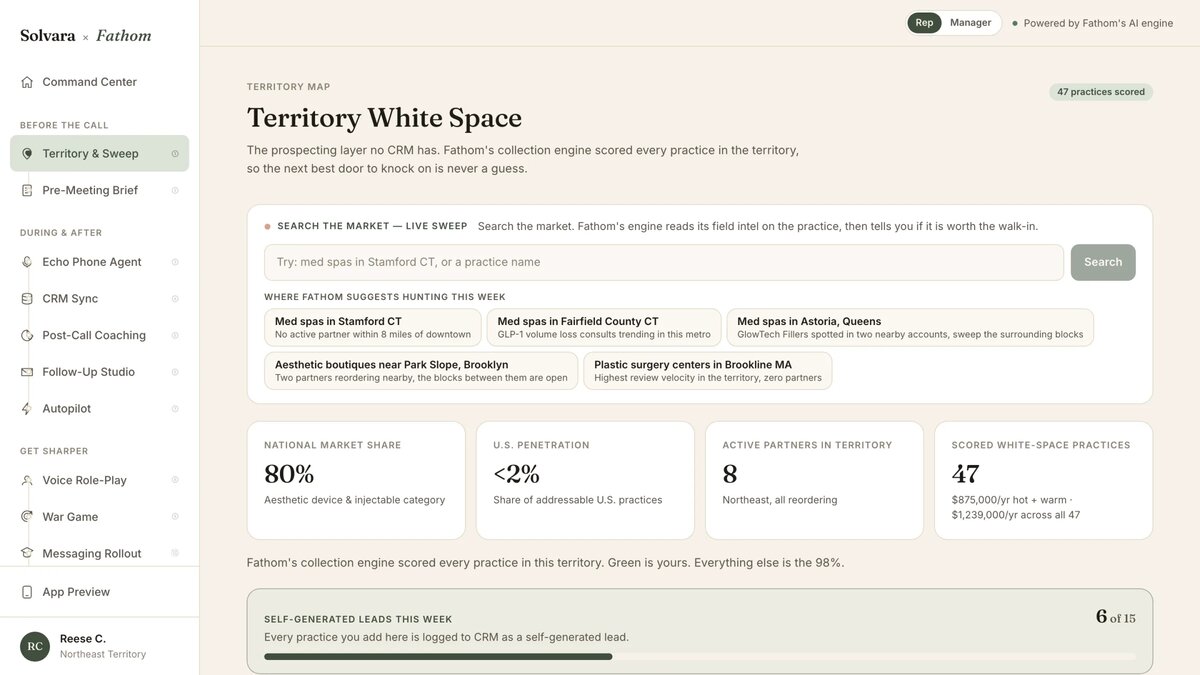
The technical architecture was straightforward: scrape publicly accessible operational data for every potential account across a sales territory, then apply AI scoring models to determine who had the highest propensity to purchase and who represented the largest deal size. A sales rep simply typed in a zip code to instantly view a ranked queue of qualified leads.
The defining trial took place in El Paso, Texas.
While still working as an enterprise rep, Ben used his custom tool to plan and execute a single-day clinical product demonstration event. The tool surfaced high-probability prospects, scored them against product compatibility, and generated dossier-level account briefs so he walked through every clinic door fully armed with contextual intelligence.
The result: He closed $440,000 in sales in a single day.
Such outsized performance could not stay secret for long. Within weeks, Ben's employer rolled the internal tool out across its entire senior national sales organization.
The most convincing proof of whether enterprise software works is never a slick slide deck — it is how much cash it generates on the battlefield. Before Ben ever attempted to sell the software externally, he had already proven its ROI with his own quota.
Phase 3 · Three "Old Guys" and $300
In November 2025, Fathom AI officially launched. The founding executive team comprised three seasoned operators:
- Ben Hooten (39, CEO): Leads technology and product design, steeped in the acute friction of frontline enterprise selling;
- Sam Brown (48, President): Former SaaS startup executive, directs enterprise business development, strategic partnerships, and financial operations, while architecting their strict bootstrapped discipline;
- Dan Crump (56, Chief Revenue Officer): Marine Corps veteran with over 25 years of enterprise technology sales experience spanning Compaq, HP, Sprint, and various medical device firms, overseeing enterprise pricing, high-stakes contract negotiations, and commercial strategy.
Combined, the founders' ages exceeded 140 years. This was not the archetypal Silicon Valley archetype of twenty-something founders in hoodies; it was a battle-hardened squad of commercial veterans who had spent decades in the trenches.
Their total initial cash outlay was just $300.
They deliberately organized the entity as a partnership. The thesis was intentional: when the business generates profit, cash is distributed immediately to the partners, completely bypassing the standard venture-backed treadmill of burning cash, diluting equity, and waiting a decade for an uncertain liquidity event.
Phase 4 · The Anchor Customer: From 6 Pilot Reps to a National Rollout
With an engine built, they needed their first commercial anchor client.
The pivotal catalyst was Kirk Gunhus, a legendary commercial veteran in medical aesthetics. Kirk had served as Chief Revenue Officer at Venus Concept, spent seven years at Zeltiq (the creator of CoolSculpting), and managed commercial organizations across three continents.
As reported by Fortune, Kirk was initially deeply cynical about automated sales technology. The breakthrough happened over casual after-work drinks, where he voiced intense frustration regarding how fragmented, siloed, and counterproductive existing sales tools were. Fathom's founders seized the opening to demo their prototype.
Kirk agreed to pilot the software with six field sales reps. Looking back, his verdict was blunt: "It made them too much money."
That pilot customer was aesthetic device maker Tiger Aesthetics. According to Fortune, Tiger Aesthetics had not opened a single new customer account in the entire year of 2024 (Fathom's website notes fewer than 40 accounts opened); after deploying Fathom, their field team opened 225 new accounts in a single quarter. The exact same sales reps, the exact same territories, selling the exact same hardware — the only variable introduced was Fathom.
Dave Becattini, Sales Training Manager at Tiger Aesthetics, observed: "There were 149 targets in a 40-mile radius with contact info, target products, phone numbers, websites, rankings, and talk tracks. That would have taken me at least a week to compile manually. We finished it in under 2 hours."
Following the pilot, Tiger Aesthetics rapidly deployed Fathom across its entire national sales force. The client's stance shifted to: "Whatever they need, give it to them."
Phase 5 · How Fathom Prospector Actually Works
Deconstructed into components, the foundational mechanics of Fathom Prospector are remarkably disciplined:
- Territory Auto-Scanning via Zip Code: Enter a postal code, and the engine automatically isolates every addressable commercial target within that radius, such as medical spas and plastic surgery clinics.
- Dual Predictive Scoring: Every account receives two distinct scores: Readiness to Buy (are they actively seeking solutions right now?) and Opportunity Size (is their deal volume worth field time?).
- 200+ Dynamic Signals: Each practice is analyzed across more than 200 operational data points grouped into 10 intelligence categories, including localized patient search volume on Google for relevant procedures.
- Client-Specific Model Tuning: Rather than offering a generic algorithm, Fathom tunes scoring models specifically to each enterprise client's catalog and ideal customer profile (ICP), deploying within days.
Around Prospector, the team engineered a cohesive product suite: Prophet synthesizes pre-call intelligence briefs seconds before a rep walks into a clinic, recommending precise talking points; Coach runs AI role-play simulations to sharpen rep pitch delivery; and BOS serves as an AI-orchestrated operational backbone designed to displace legacy, cumbersome CRMs.
Crucially, internal operations run entirely on automation. Fortune noted that the three partners deploy 12 autonomous AI agents to absorb operational headcount: one manages national customer success, another monitors competitors' pricing and product moves every two hours, and an automated support agent resolves customer queries — reportedly handling interactions so seamlessly that many enterprise users never realize they are speaking to software.
This architectural leverage explains why three people can support an enterprise footprint: Operating overhead remains under 10% of revenue, sustaining gross margins above 90%.
The unit economics are striking: on a $300,000 ARR baseline with sub-10% operating overhead, roughly $270,000 in net cash flow is available annually for partner distribution. The partnership structure allows that cash to be paid out directly rather than hoarded for burn, yielding approximately $90,000 per partner annually — just three months post-launch. For an executive recently blindsided by a layoff, that cash flow proved far more compelling than any corporate job offer.
Phase 6 · Walking Away from a VC Term Sheet at the Finish Line
With growth accelerating, institutional venture capital arrived quickly.
According to Fortune, Fathom reached the final stages of signing a venture capital term sheet. Yet at the eleventh hour, the founders walked away. The reasoning was disarmingly simple: they could not identify anything meaningful to spend the capital on.
As Sam summarized: "We don't have large costs." Dan reinforced the reality: "We just got paid today. We have positive cash flow."
This dynamic illustrates a profound shift in the AI era. Historically, software startups raised venture capital because scaling required hiring armies of junior developers, account executives, and support staff, burning millions before reaching cash-flow break-even. When AI agents absorb those operational layers, capital ceases to be the scarcest resource — deep industry domain expertise and commercial trust are.
By September 2026, Fathom's official site reflected 5 enterprise clients across 4 distinct verticals — expanding from aesthetic devices into general medical devices, ENT/surgical equipment, and commercial real estate (including the U.S. operations of Japanese homebuilding giant Sekisui House). The system had scored over 32,000 accounts, identified 83,000+ commercial opportunities, and published a benchmark report analyzing 48,198 U.S. medical aesthetic practices.
Client feedback across new verticals proved equally enthusiastic. The Chief Insights Officer at Sekisui House stated in an official endorsement: "Okay, this is officially amazing. I think the psychographics piece beat several of our marketing teams." Another executive noted: "You guys push updates faster than we can reply."
Leaping from aesthetic devices to homebuilding appears vast on the surface, but the underlying operational physics are identical: Any B2B industry relying on field sales reps knocking on commercial doors must answer one fundamental question: 'Which door should I knock on next?' The core AI architecture remains constant; swapping the data inputs and scoring weights enables instant replication into adjacent verticals.
At the time of Fortune's reporting, the founders targeted $5 million in ARR by year-end across 15 to 18 enterprise accounts. Whether that milestone has been reached remains unverified by subsequent public filings.
Thinking
1. The Best B2B Products Are Built by Frontline Operators
Fathom was not conceived by engineers brainstorming in a vacuum. It was built by an award-winning enterprise sales rep desperate to eliminate the friction that wasted his own working hours every day.
This grants an unbeatable advantage: He understood the exact pain point and knew precisely what corporate buyers would open their budgets for. For anyone seeking to build enterprise software, frontline industry experience is often infinitely more valuable than pure technical ability.
2. Prove Traction on the Battlefield Before Pitching the Software
Before presenting the software to any outside prospect, Ben used it to close $440,000 in revenue in a single afternoon. That metric carried more credibility than any pitch deck ever could.
Your own documented financial results are your ultimate marketing collateral. If the tool you built cannot generate demonstrable cash for yourself, you will never convince cynical enterprise buyers to pay for it.
3. Autonomous AI Agents Redefine the Minimum Team Size for Startups
Twelve AI agents handle customer success, competitor reconnaissance, and tier-one support, empowering three operators to service a national enterprise sales force. Overhead remains beneath 10% of gross revenue.
Operations that once required 15 to 20 full-time salaries now run on three founders. The barrier to building software companies is shifting from 'How much venture capital can you raise?' to 'How effectively can you orchestrate AI?'
4. Vertical Specialization + Bespoke Model Tuning Is the Ultimate Moat
Rather than creating a generic sales enablement tool competing with Salesforce or Apollo, Fathom carved out an ultra-specific beachhead in aesthetic device sales, training custom scoring models for each client.
Horizontal tools fight brutal commodity wars. Vertical industry solutions command massive price premiums because customers gladly pay for software that speaks their exact industry language, while tech giants overlook the niche. That is the ideal territory for lean teams.
5. Age and Corporate Layoffs Are Not the End of the Road
The founding team shares an aggregate age exceeding 140, with one founder recently displaced by AI. To traditional Silicon Valley investors, they seemed an unlikely profile for a high-growth tech startup.
Yet they possessed what youthful founders rarely have: decades of domain mastery, enterprise networks, and commercial closing instincts. As AI radically lowers the barrier to software development, domain expertise becomes the rarest commodity. The very workers displaced by AI are often best positioned to harness it profitably.
Action
Step 1: Identify the single most painful operational bottleneck in your industry (1 week) Reflect on your career: What recurring task wastes hours of your and your colleagues' time every week? Prospecting, document triage, report synthesis? Document it and calculate the exact hours lost weekly.
Step 2: Build a solution strictly for yourself first Use modern AI development environments (Cursor, Claude Code) or automation infrastructure (n8n, Zapier) to construct a lightweight tool addressing that solitary problem. Do not think about selling; focus entirely on using it yourself.
Step 3: Validate the impact in live operational conditions Deploy the tool in a real-world project. Log quantitative before-and-after results: How many hours were saved? How much incremental revenue was generated? That performance delta is your sales pitch.
Step 4: Secure an industry insider to open enterprise doors Approach a respected former boss, senior colleague, or industry veteran. Demonstrate your documented operational results and ask them to broker an introduction to your first pilot account.
Step 5: Lower adoption friction through a controlled pilot Do not demand an immediate enterprise-wide contract. Mirror Fathom's strategy: pilot with 5 to 10 reps, establish verifiable revenue lift, and let user demand drive the enterprise-wide rollout.
Step 6: Deploy AI agents to absorb repetitive operational overhead Delegate customer onboarding, competitor tracking, and routine support tickets to AI workflows. Keep payroll minimal and maintain a sub-10% cost structure.
Step 7: Prioritize cash flow and scrutinize external capital If your unit economics produce positive cash flow from day one, ask a hard question: What exact bottleneck would venture capital solve? If the answer is unclear, protect your equity and retain your independence.
This model is not suitable for you if:
- You lack frontline domain experience and customer relationships, attempting to build a generic horizontal AI wrapper;
- You dislike high-touch B2B enterprise sales, which demand in-person relationship building and lengthy sales cycles;
- You expect overnight consumer viral growth — enterprise clients are fewer, highly demanding, and require deep customization;
- Your target industry lacks accessible public or operational data for AI models to analyze effectively.