An Alarm You Can Only Turn Off With Push-Ups: How a 24-Year-Old Accountant Rode a New Apple API to $50K/Month in 4 Months
Jake Glacer, 24, did a four-year accounting degree and a master's, earned his CPA and worked at a Big Four firm for just over a year, while teaching himself to code for four years after a string of failed businesses. Struggling to wake up early, he texted a friend every night: 'I'm going to send you a video of me doing push-ups by 6 a.m. tomorrow.' He turned that habit into the app Erly and got it on the App Store in 19 days — though the first version didn't even have an alarm. In September 2025, Apple opened the AlarmKit API in iOS 26, letting third-party apps use the iPhone's native alarm for the first time. Jake changed course and, 19 days later, added 'do push-ups to turn off the alarm,' with AI checking the video to confirm you actually did them. He put nearly all his effort into finding TikTok and Instagram creators, paying about $2–3 per thousand views with view guarantees. According to what he told Starter Story, revenue hit $30,000 in month three and over $50,000 in month four, with more than 200,000 downloads in the first half of 2026.
Process
There are at least a thousand alarm clock apps on the App Store. The best known, Alarmy, has been around for nearly a decade and has more than 240,000 ratings.
By all logic, it's a crowded market with no room for newcomers.
Yet in fall 2025, a 24-year-old accountant made a new alarm app. It has just one selling point: want to turn off the alarm? Do push-ups first. You have to do them in front of your phone's camera, and only when AI confirms you actually did them does the alarm stop.
The app is called Erly (pronounced "early"). According to founder Jake Glacer, speaking on the founder interview show Starter Story in July 2026, it went from zero to $50,000 a month in just four months, and passed 200,000 downloads in the first half of 2026.
Host Pat Walls opened by marveling: "Hands down one of the simplest ideas I've ever seen on this channel."
Its success didn't come from complex technology, but from three things coming together: a pain point almost everyone has, a platform window that had just opened, and an almost obsessive approach to marketing.
A caveat: these revenue and download figures are self-reported by the founder and haven't been independently verified.
Phase 1 · A CPA who spent four years coding on the side
Jake's résumé looks completely unrelated to making apps.
He did a four-year accounting degree, then a one-year master's, earned his CPA, and joined a Big Four firm, where he worked in public accounting for just over a year.
But alongside that "standard elite path," he had been teaching himself to code for about four years. Along the way he tried several businesses, and "nothing really worked."
Those failures taught him one thing: marketing is the most important thing.
So he set himself a new playbook: build an app as fast as possible that solves a painful problem in a simple way, then copy growth models that are already proven — like the influencer marketing so many apps use.
Phase 2 · A nightly text: "A push-up video by 6 a.m."
The idea came from his own life.
Jake always struggled to wake up. So he came up with a trick: every night he texted a friend — "I'm going to send you a video of me doing push-ups by 6 a.m. tomorrow."
With someone watching, he couldn't bring himself to sleep in. It worked.
Around then, he was seeing lots of people on X (formerly Twitter) doing well with apps, and he was brainstorming his next idea. He thought: if this works for me, why not turn it into an app?
He also remembered his college roommate. The two of them talked about the same thing almost every night: tonight we'll go to bed early, tomorrow we'll get up early. "Every single day it was something that we would talk about."
Later, whenever he showed people Erly, the reaction was almost always the same: either "I need this," or "I don't need this, but my friend (or my girlfriend) needs this." As Jake put it: "It's pretty much every single time."
His test is simple: if a problem goes through your head at least once a day, it's a genuinely painful one.
Phase 3 · Live in 19 days — without an alarm
It took Jake just 19 days to go from his first commit to the App Store. The App Store lists Erly's release date as September 3, 2025.
Funnily enough, the first version of Erly had no alarm at all. It was just a "wake-up check-in" app: set a target time the night before, record a video after getting up the next morning to prove it, and keep your streak going.
Once it was built, Jake saw a problem: he didn't know how to market it. He'd planned on influencer marketing, but a "wake-up check-in" app had nothing particularly eye-catching about it.
So he spent a whole day walking and thinking about direction. He listed a few paths and settled on one: add an alarm.
The timing of that decision turned out to be remarkable.
Phase 4 · Apple opens AlarmKit, and a window opens
Apple was just about to release iOS 26. The new system included an interface called AlarmKit, which for the first time let third-party apps plug into the iPhone's native alarm system.
Before that, there were plenty of alarm apps on the App Store, but Jake says they were "sort of gimmicky and not reliable," because they relied on in-app sounds and other workarounds to simulate an alarm. If the phone was muted or the system closed the app, the alarm might not go off.
For an alarm, "it rings most of the time" isn't good enough — miss once, and the user deletes it.
With AlarmKit, third-party alarms could finally be as reliable as the system alarm. Jake seized the chance and, 19 days after the app hit the App Store, launched "do push-ups to turn off the alarm."
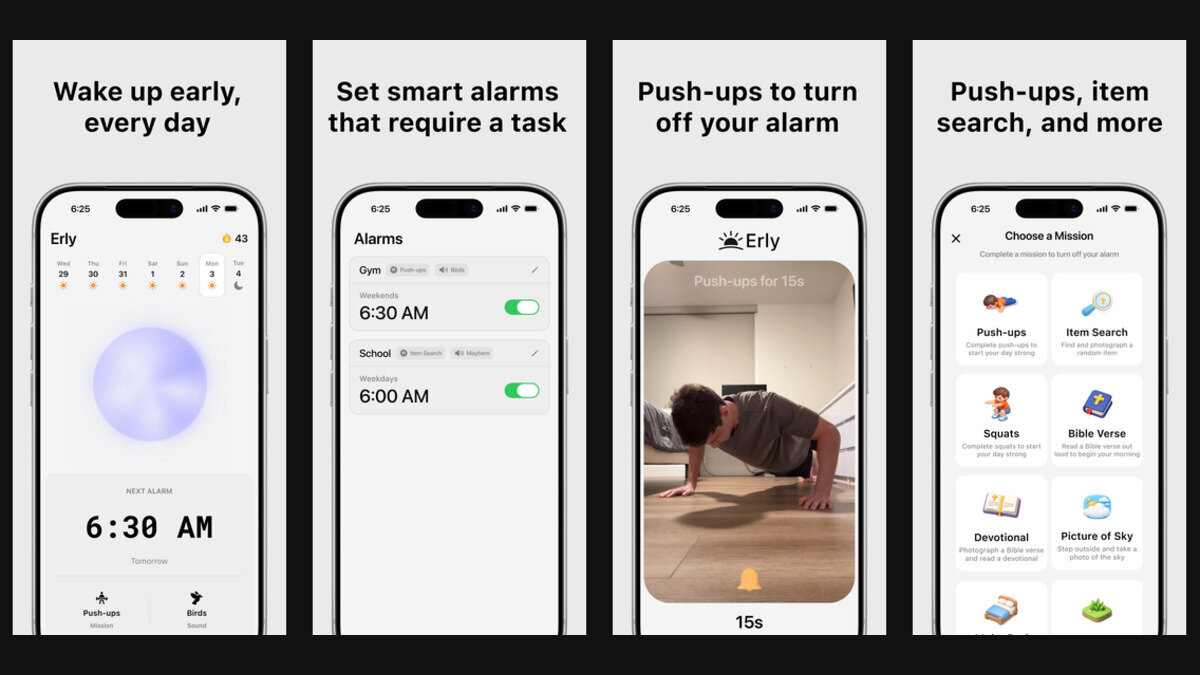
Here's how Erly works now: set a wake-up time, pick a "mission" (push-ups, say) and a sound. When the alarm goes off, open the app and do push-ups in front of the camera; AI analyzes the video, confirms you really did them, and a green check appears with "alarm turned off." You can't fake it.
Later, missions expanded to squats, photographing a random item, stepping outside to photograph the sky, reading a Bible verse and more.
Phase 5 · Get views first, worry about the rest later
Jake knew one thing clearly: he could build the product, but whether anyone would watch was the big unknown.
So he started marketing almost immediately. Seven days after adding the alarm, his first influencer video went live — and people bought from it. At that moment, he knew the idea was validated.
From there, the progression went like this:
- Three weeks after the first influencer video, he hit $1,000 in revenue;
- In month three, he had his first $30,000 month;
- In month four, monthly revenue passed $50,000.
Phase 6 · Influencer marketing: only "day in the life" creators
Nearly all of Jake's growth came from influencer marketing, but his approach had a few key details.
First, only creators whose content fits naturally. He sent DM after DM on TikTok and Instagram, specifically targeting creators who made "day in the life" and lifestyle content. It was a tough start, with very few replies.
Why those creators? Because an alarm fits naturally into their videos: the alarm goes off in the morning, they get up, do a few push-ups. Creators don't have to change their content to earn extra money. Jake says a lot of influencer ads come off as "too much of an ad," so creators need more money and more reason to take them; content that fits is a much easier sell.
Second, one video says it all. He shared his best example: a first-person day-in-the-life video of a college student — the alarm goes off, push-ups, the app analyzes, a green check, "alarm turned off." The whole thing is "super subtle, super natural."
He calls it a "win-win-win": creators keep making their videos and get paid; he gets downloads; and viewers find a solution to their problem without really watching an ad. Under almost every well-made video, someone asks "what's the app name?", the creator replies "Erly on the App Store," and on Instagram they usually pin that comment.
Third, pay on view guarantees to cap risk. Deals are typically 2 to 4 videos a month per creator, settled on guaranteed views, at about $2 to $3 per thousand views. Videos peak about a day after going live, so returns show up quickly.
Some rough math: at $2.50 per thousand views, $5,000 buys about 2 million guaranteed views. For an app that costs $29.99 a year, if just one or two out of every 1,000 viewers end up paying, that spend pays for itself. The point of a view guarantee is that the worst case is predictable, while the best case has no ceiling.
He says it's a classic power law: most videos do okay, but every once in a while you get a one-million, two-million or even five-million-view video, and that's where the real money is made.
Fourth, track results the simplest way. Influencer marketing is hard to measure precisely. Jake's method: log every video's views, and when a spike in views coincides with a spike in purchases, you can be reasonably sure that video drove it.
He treats it as a "black box": "put in 5K and you get out 10 — that worked." You won't necessarily know which creator made the most, and losing money on individual creators is inevitable.
Phase 7 · A one-person tech stack
Jake is a solo founder who now has some help. His toolkit:
- Building: Claude Code (which he calls "the absolute best tool for actually building the app")
- Database, auth and cloud functions: Firebase
- Paywall and subscription management: Superwall
- AI verification: OpenAI's API
- Analytics: Mixpanel
- Creator management: a dedicated creator-management tool for tracking and payments, Sideshift for sourcing and managing UGC creators, Instantly for mass outreach emails, Cal for booking meetings, Agreed for contracts
- Operations: Google Sheets for everything, QuickBooks for accounting
Pricing is standard: a free trial, then $29.99 a year or $9.99 a month.
By October 2026, Erly had about 16,000 ratings on the App Store, averaging 4.8.
But once a window opens, he's not the only one who climbs through. After AlarmKit opened, a wave of similar "mission alarm" apps appeared on the App Store: Wayk, launched in February 2026, already has nearly 20,000 ratings; PushClock, launched in March 2026, has over 6,000. As Starter Story producer Gus summed up on the show: "Every time a platform exposes a new API, a slew of apps gets released — but there's a short window of time."
This is the most thought-provoking part of Erly's story. Anyone could use the same API to build the same idea; Erly got ahead not because it had more features, but because it started spending earlier and got views earlier. While others were still polishing features, Jake was already signing his first creators. Inside a window, speed itself is a moat.
Thinking
1. New platform APIs are ordinary people's windows of opportunity
Before AlarmKit, third-party alarms couldn't be truly reliable, so even a great idea couldn't become a great product. Once AlarmKit opened, that limitation suddenly vanished.
This keeps happening: when Apple opened widget APIs, a flood of widget apps followed; when it opened Screen Time APIs, a wave of "phone-blocking" apps appeared. Watching the new APIs Apple, Google and other platforms release each year often lets you see opportunities before others do. But the window is short — competitors like Wayk and PushClock caught up within months.
2. The best ideas are painful + simple + inherently shareable
Jake's framework: "Solve a painful problem in a simple way, and it should be inherently viral. If the idea itself isn't inherently viral, add some sort of novel aspect to make it so."
Waking up is the pain point, an alarm is the simple solution, and "push-ups to turn it off" is the novel twist. It turns an ordinary alarm into content you understand in seconds and can't help asking "what's that app?"
3. Validate that people will watch before deciding to scale
After building the first version, Jake didn't rush to add features. He asked himself: can this get views? When the answer was no, he changed direction.
After adding the alarm, he launched his first influencer video within seven days, validating demand with real purchases rather than friends' compliments or sign-ups.
4. The keys to influencer marketing are fit and risk control
Many people fail at influencer marketing because they pick the wrong creators or the wrong terms. Jake chose only creators whose content fit naturally, so the product appeared organically, and paid on view guarantees so every dollar stayed within what he could afford to lose.
More importantly, he understood it as a power-law game: most videos don't pay off, and a few hits pay for everything. So the job is to keep spending and wait for the hits, not to demand that every video break even.
5. In the AI era, the scarcest skill is getting noticed
Jake's advice to anyone building an app comes down to one line: "Focus on top of funnel only."
As he put it: "That is the most valuable skill right now is marketing. There's so many people that can build an app and it's so easy with AI, but there's not so many people that know how to market and know how to get views. If nobody knows about your app, it doesn't exist."
Action
Step 1: Find a problem that bugs you every day (1 week) Write down the frustrations you think about at least once a day. Ask people around you: if a tool solved this, would they say "I need this" or "my friend needs this"?
Step 2: Watch for new platform APIs Each year when Apple's WWDC and Google I/O announce new systems, list the newly opened APIs and ask: which products that used to be impossible to do well can now suddenly be done well?
Step 3: Build an MVP in three weeks with AI coding tools Use tools like Claude Code with off-the-shelf services like Firebase, Superwall and Mixpanel. Build one core feature and ship as fast as possible.
Step 4: Add a novel, instantly understandable twist Ask yourself: can this product be explained in a five-second video? If not, add a visually striking element — like "push-ups to turn off the alarm."
Step 5: Find creators whose content fits naturally (ongoing) On TikTok and Instagram, look for creators whose everyday content could naturally feature your product, and reach out by DM or email in bulk.
Step 6: Pay on view guarantees and test small Agree on 2–4 videos a month per creator, paid on guaranteed views, and test with a few thousand dollars first. Log each video's views alongside purchases in the same period to find the creators who work.
Step 7: Keep spending and wait for the hit Accept that most videos won't pay off, keep putting budget behind creators who perform, and wait for that one video with a million-plus views.
Not for you if:
- You only want to write code and don't want to spend lots of time sending DMs, negotiating deals and marketing;
- Your product's value can't be shown in a few seconds of short video;
- You can't accept that most ad spend will lose money and want every dollar to break even;
- You hope to own a market for the long term — windows opened by new platform APIs are short, and competitors follow fast.