A Baby Registry App That Helps Expecting Moms Not Overbuy: A Brazilian Developer Went Solo and Hit 10K Downloads and R$40K in Month One
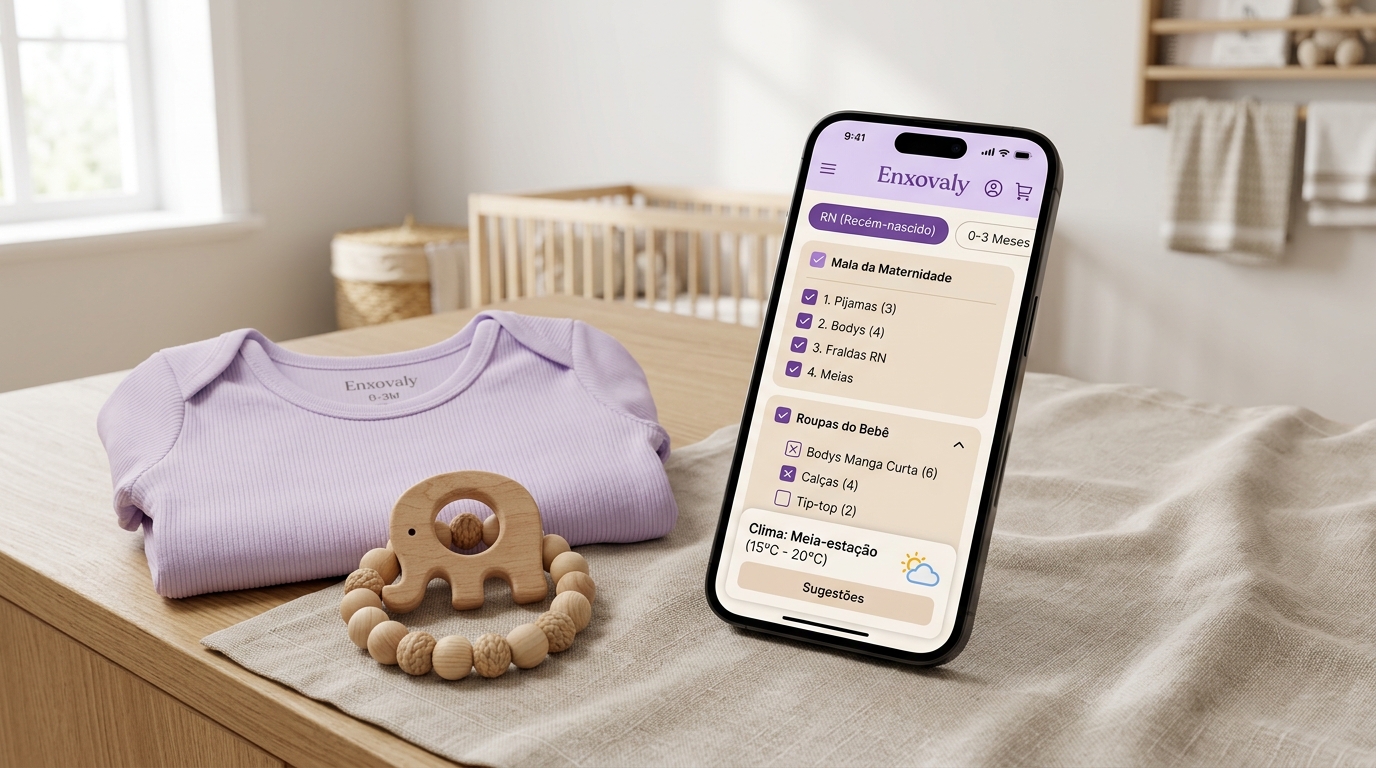
Gabriel Buzzi Venturi has been writing code since 2012. He was Head of Product & Technology at Rocketseat, Brazil's largest developer-education company, leading a team of 6 (peak of 8), and in 2020 co-founded MEDsimple, a medical exam-prep platform with $1M+ in annual recurring revenue. In June 2026, he left Rocketseat to run a one-person company, while he and his wife Bruna were expecting their daughter Esther. On August 4, he launched Enxovaly, a baby registry checklist app: based on the baby's birth month and the local climate, it builds a checklist with sizes and quantities under the motto 'Sem exageros' (no excess). Users can also photograph clothes they already have, share the list with family to avoid duplicate gifts, and ask the in-app AI assistant Lia for help. According to his personal website, Enxovaly passed 10,000 downloads and R$40,000 in revenue in its first month; his second app, the AI study Bible Bíblia Raízes, launched six days later and gained 2,000+ subscribers and R$200,000+ in its first month. He says he routinely orchestrates three to six AI coding agents in parallel.
Process
In Brazil, the set of clothes and supplies you prepare for a newborn has its own word: enxoval.
Almost every expecting mother runs into the same question: how much should I actually buy? Lists online are all over the place — some run to hundreds of items, others miss essentials. Buy too little and you scramble; buy too much and many clothes are outgrown before the baby ever wears them. Worse, what you need depends on whether the baby is born in summer or winter, and whether you live in the hot north or the cooler south.
Brazilian developer Gabriel Buzzi Venturi built an app for this called Enxovaly. Its website sums it up in two words: "Sem exageros" — no excess.
According to his personal website, Enxovaly launched on August 4, 2026, and passed 10,000 downloads and R$40,000 in revenue in its first month (roughly US$7,000–8,000). Six days later, he launched another app that made more than R$200,000 in its first month.
He built both apps on his own, after leaving his job to run a one-person company.
A caveat: these figures are self-reported on his personal website and haven't been independently audited, and he hasn't published a detailed interview about how he built or grew the apps. This piece covers only what can be verified: his public résumé, Enxovaly's website and its App Store listing.
Phase 1 · Fourteen years of building software
Gabriel lives in Rio do Sul, a small city in the southern Brazilian state of Santa Catarina.
He started coding in 2012, first building e-commerce stores and company websites at an agency. He went on to work as a full-stack developer at an accounting firm, as CTO/CIO at a tech company called PRTE, and as a senior frontend developer at a software studio.
In 2022, he joined Rocketseat — Brazil's largest developer-education company — as Tech Lead, and in February 2025 became Head of Product & Technology, leading a product, engineering and design team of 6 (peak of 8).
His résumé lists a few results: driving the company's shift to product-led growth, which raised self-serve revenue from 12% to 25–30% of monthly revenue; leading the tech team's AI adoption strategy; and cutting infrastructure spending without hurting reliability.
Alongside his day job, he had a long-running side project: in 2020, he co-founded MEDsimple, an exam-prep platform for medical residency, as CTO. According to his résumé, it was bootstrapped and now reaches 50,000+ medical students with $1M+ in annual recurring revenue (about $80,000 a month).
In other words, before going solo he already had three things: strong engineering skills, experience leading teams to ship products, and a profitable product under his belt.
Phase 2 · Leaving to run a one-person company
In June 2026, Gabriel left Rocketseat.
His résumé describes his new role this way: "Design, build, launch, and grow consumer apps end-to-end as a one-person company — product, engineering, design, marketing, and support."
At the time, he and his wife Bruna were expecting their daughter Esther. He hasn't publicly explained exactly what prompted Enxovaly, but the app serves precisely the stage they were in: new parents preparing for their first child.
The App Store shows Enxovaly's page was created on June 30, 2026, with Gabriel himself as the developer.
Phase 3 · One person, several AI agents at once
How does one person build an app in just over a month, then a second one days later?
Gabriel's answer is AI-assisted development. His résumé says he has used Claude Code since it launched, builds with Claude and GPT, and "routinely [orchestrates] 3–6 parallel agents through Conductor on real work" (Conductor is a tool for running multiple AI coding agents at the same time).
He sums up the approach as: "Ship at solo speed by leaning on AI-assisted development — Claude Code and parallel agents across the whole stack."
His stack centers on TypeScript: React Native for mobile apps, Next.js for websites, Node.js for the back end, plus AWS, Vercel and PostgreSQL — technologies he has used for over a decade. AI didn't decide what he should build, but it let one person handle a workload that used to take a small team.
Phase 4 · What Enxovaly does
Enxovaly's website describes four steps:
- A personalized list: you tell the app when the baby is due and where you live. The birth date sets the sizes needed for each stage, and the local climate picks the right fabrics and items. The site's example: for a baby born in autumn in Curitiba, in southern Brazil, the list includes "long-sleeve bodysuits, 8 pieces (newborn to 3 months)," "rompers, 5 pieces" and "pajamas, 4 pieces";
- Know what you need — and what you don't: every category in one place with suggested quantities "so you don't buy too much," which users can add to, remove or adjust;
- Track progress: tick items off as they arrive and watch each category fill up to 100%. As the site puts it, that late-night worry of "am I missing something?" goes away;
- Share with family: Brazil has a tradition of baby showers (Chá de bebê), where friends and family bring gifts. Users can send a link so loved ones can pick what's still missing, and the app tracks what's been reserved and received — so nobody gives duplicates.
The list covers categories including the nursery, clothing, bath and hygiene, sleep, feeding, items for mom, laundry, the hospital bag and outings. The App Store description adds that you can photograph clothes you already have to add them to a closet, save products from any store, follow a preparation timeline, and chat with the in-app AI assistant Lia for help getting organized.
The site says it's "made for moms," offers Portuguese, English and Spanish, and focuses mainly on Brazil. As of October 2026, Enxovaly had 579 ratings on the Brazilian App Store, averaging 4.7.
Phase 5 · Two apps in a week and their first months
According to Gabriel's personal website, he launched two apps in August 2026:
| App | Launch date | First month (self-reported) |
|---|---|---|
| Enxovaly (baby registry checklist) | August 4, 2026 | 10,000+ downloads, R$40,000+ revenue |
| Bíblia Raízes (AI study Bible) | August 10, 2026 | 2,000+ subscribers, R$200,000+ revenue |
Bíblia Raízes is an AI study Bible "grounded in trusted sources." By the numbers, its first month brought in five times as much as Enxovaly's. It shows that the same person, using the same development approach, can get very different results depending on the topic.
He hasn't disclosed either app's pricing, acquisition channels or costs. On the App Store, Enxovaly is listed as free with in-app purchases.
Thinking
1. "Don't overbuy" is a selling point in itself
Most baby products encourage you to buy more. Enxovaly does the opposite with "Sem exageros." For a new family on a budget and afraid of buying the wrong things, "help me not overbuy" is more appealing than "here are ten more things to get."
In a market where everyone is selling, helping users save money and worry less builds trust.
2. Localization isn't just translation — it's understanding daily life
Enxovaly adjusts its list to the climate in different parts of Brazil, and its sharing and anti-duplicate features are built around the baby-shower gift tradition. Details like these only occur to someone who knows local life.
When you build for your home market, your understanding of local customs is an advantage that's hard to copy.
3. A decade of experience is what makes "solo speed" possible
An app in a month, two apps in a week — it looks fast. But behind it are 14 years of engineering, experience leading product teams and a side project making $1M+ a year.
AI amplifies what one person can do, but only if that person already knows how to build.
4. The topic sets the ceiling
Same person, same method: Bíblia Raízes made five times what Enxovaly did in its first month. Execution matters, but picking a topic with stronger willingness to pay and a broader audience can change the outcome entirely.
Before you commit, compare willingness to pay and market size across several directions.
5. Know where the numbers come from
All the figures in this case come from the founder's personal website, with no third-party verification and no interview detail. That doesn't mean they're wrong, but readers should keep it in mind.
Action
Step 1: Find a life stage where people fear buying the wrong things or too much (1 week) Trying for a baby, renovating, moving, starting school, getting a first pet. List the purchases that make that stage most stressful.
Step 2: Build a "just right" list Research what's actually needed at that stage and in what quantities, adjusted to each user's situation — season, region, budget.
Step 3: Design around local customs Think about your market's unique traditions, like Brazil's baby showers, and build sharing, gifting or collaboration features around them.
Step 4: Build fast with a stack you know and AI coding agents Don't switch to unfamiliar technology. Use AI coding agents like Claude Code on a stack you already know, and ship as soon as you can.
Step 5: Test several topics If you can build quickly, try what Gabriel did: build one app in each of a few topics and see which has stronger willingness to pay.
Step 6: Share your results publicly Record your products and numbers on a personal website or social media — it's both a portfolio and a source of attention.
Not for you if:
- You can't yet build and launch an app on your own;
- You don't understand your target users' life stage or local customs;
- You want long-term retention — a baby checklist naturally becomes less needed after the birth;
- You want a detailed growth playbook to copy — this case doesn't disclose how users were acquired.