From a Home 3D Printer to 100,000 Units: How a Sydney Couple Built Contour Cube on TikTok and Got 4 Shark Offers
Sydney's Sarah Forrai worked a day job at Australian e-commerce company The Iconic. Her mum loved ice facials, but ice cubes are slippery and freezing — and Sarah has Raynaud's, which makes her fingers extremely sensitive to cold. During the 2020 lockdown, she and partner Lewis Battersby used their home 3D printer to make an ice mold with a silicone holder: Contour Cube. In early 2021, her third TikTok sold out the first 100 units overnight, and a video about her mum hit 6M views. Priced at A$34.95, it reached Urban Outfitters within three months, later 450 Priceline stores in Australia, and Kendall Jenner recommended it unprompted. It sold 100,000+ units in under four years, with 1B+ social views. On Shark Tank Australia in 2023, four Sharks made offers; according to later interviews, the couple ultimately didn't take the investment and remain a two-person team.
Process
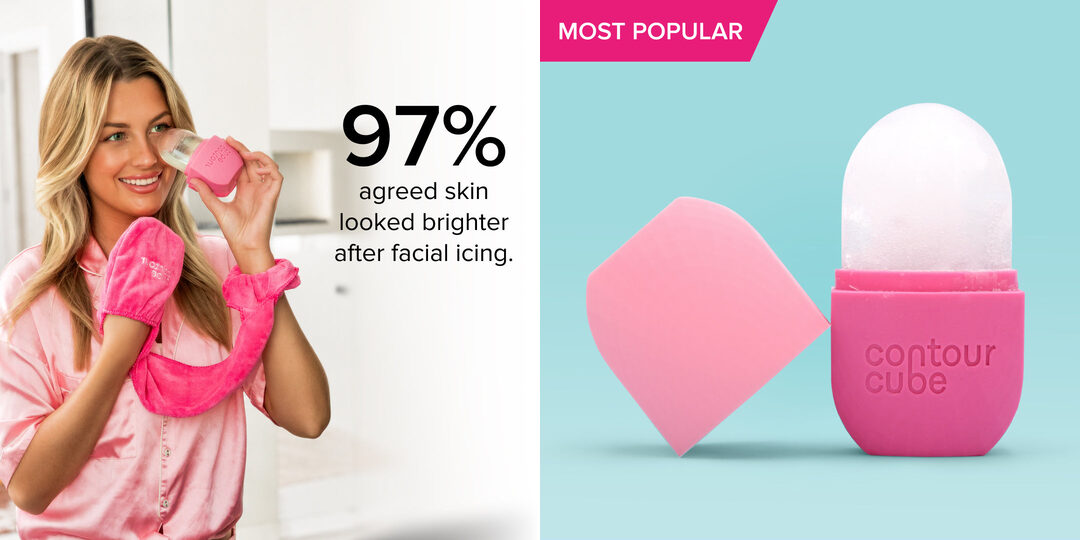
Rubbing ice on your face is a beauty trick that has been around for years: wake up puffy, roll an ice cube over your face, and supposedly it depuffs and wakes you up.
The problem is that doing it is a mess. Ice is slippery and hard to hold; your fingers ache from the cold; meltwater runs down your wrist and drips everywhere.
Sarah Forrai in Sydney knows this well. Her mum loves ice facials and kept urging her to try. Sarah found it far too fiddly — and worse, she has Raynaud's, which makes her fingers extremely sensitive to cold, so she couldn't hold ice for more than a few seconds.
So she made a small thing: an ice mold with a silicone holder. Fill it with water, freeze it, then hold the case and glide the ice across your face — hands warm and dry. She named it Contour Cube.
That small thing went on to sell more than 100,000 units and rack up over 1 billion views on social media. Kendall Jenner recommended it on social media unprompted, and on Shark Tank Australia it drew offers from four investors at once.
It was made by just two people: Sarah and her partner Lewis Battersby. At first, it was only Sarah's after-work side project.
What makes this story worth studying is that ice facials aren't a new invention, silicone molds aren't high tech, and similar products have always existed. So why was it an office worker, a home 3D printer and a phone that turned it into a business selling worldwide? The answer is in every step she took.
Phase 1 · A designer's "second side hustle" (before 2020)
Sarah graduated in commerce from the University of Sydney in 2013. Her career happened to cover several pieces of the puzzle needed to make a physical product:
- A design agency: brand identity work, surrounded by designers from around the world, where she learned how to build a brand;
- A production agency: turning creative ideas into real things, working with major ad agencies like Ogilvy and Saatchi & Saatchi;
- The Iconic: one of Australia's biggest fashion e-commerce companies, where she spent four years and learned how to run online retail.
Before Contour Cube, she had another side project: Sammy's Hand Sanitizer. It also had a TikTok video with 400,000 views, but because hand sanitizer is a liquid, it was hard to ship overseas, and the business never grew.
That failure taught her an important lesson: whether a product can grow depends not just on whether it goes viral, but on whether it's easy to ship and can be sold worldwide.
It sounds obvious, but many small sellers have learned it the expensive way. TikTok traffic is global — one video can reach people in the US, the UK and Singapore at the same time — but if you can't ship your product, that traffic simply slips away. Contour Cube turned out to be the opposite: solid, hard to break, small and light, it fits in a little box that can go anywhere in the world. In a sense, her first failure filtered out a whole category of unsuitable products.
Phase 2 · Mum's ice facial habit and a home 3D printer (2020)
In 2020, Australia locked down for COVID-19. Stuck at home, Sarah worked her day job while mulling new ideas.
Her mum's ice facial habit sparked one. She wanted a tool that she could grip, that kept her hands warm, and that glided along the contours of the face.
Her design background came in handy. She sketched on paper, then handed the drawings to Lewis — who happened to own a 3D printer. A prototype could be printed in a few hours.
Over the next few months, the two kept refining it: the shape had to follow the face's lines, the colors had to look good, the logo had to be clear — they even added a small heart-shaped hole in the case. Sarah says the whole process was "very lean," costing almost nothing.
Once the prototype was settled, she looked for a factory. Searching Google and sourcing platforms, she contacted 5 to 10 suppliers, comparing how quickly they replied, their turnaround times and minimum order quantities, and finally found a factory willing to take small orders of a few hundred units rather than hundreds of thousands.
Phase 3 · The third TikTok, sold out overnight (February 2021)
Contour Cube launched in February 2021. The first batch was just 100 units.
Sarah filmed videos in her living room and posted them on TikTok:
- The first: 15 seconds, about 20,000 views, and orders came in right away;
- The third: before bed, she posted a video about why she made the product. She woke up to find all 100 sold out. The video got about 500,000 views (later reports put it above 1 million) and 80,000 likes, and her following jumped from 5,000 to 25,000;
- The one featuring her mum: telling the story behind the idea, it reached 6 million views and brought in a flood of pre-orders.
Notice the difference between these three videos. The first explained "what this is," the third explained "why I made it," and the one with her mum explained "where it came from." The product didn't change, the price didn't change — only the angle of the story did, yet views went from 20,000 to 6 million. For a small brand with no ad budget, it was close to the cheapest marketing lesson there is.
The product sold out, but new stock wasn't ready. Mass production needed a proper metal mold, which took 3 to 4 weeks.
Sarah didn't sit and wait. She kept posting videos every day to keep the momentum going and collected emails from people who wanted to buy. When the restock arrived, she emailed the list — and sold A$20,000 in two weeks. The second batch sold out quickly too.
Later, she brought on several factories at once so it wouldn't run out again.
Phase 4 · From TikTok into physical stores (2021–2023)
Contour Cube is priced at A$34.95 (US$24 in the US).
Less than three months after launch, US chain retailer Urban Outfitters became its first retail stockist. It went on to Anthropologie and Uncommon Goods in the US, Beauty Bay and ASOS in the UK, 450 Priceline pharmacy stores in Australia, and every Chemist Warehouse store in New Zealand.
For marketing, Sarah used a mix of content, paid ads and email:
- TikTok Spark Ads: putting ad money behind organic videos that had already taken off;
- Email marketing: she calls her email list "gold," with very high returns;
- Repurposing: posting TikTok videos to Instagram Reels as well; she also ran Facebook, Instagram and Pinterest ads, but video clearly beat static images.
Reportedly, Contour Cube spent about $280,000 on paid ads in total over four years.
Let's do some rough math. 100,000 units times A$34.95 comes to about A$3.5 million at retail price. But that's only a ceiling: stock sold through retailers goes at wholesale prices, promotions and discounts lower real revenue, and Contour Cube has never disclosed its actual revenue. Even so, $280,000 in ads bought a brand sold across three continents with over a million followers. More importantly, most of the buzz came from free organic reach — ads were the amplifier, not the engine.
The biggest surprise came from Kendall Jenner. The supermodel, with nearly 300 million Instagram followers, recommended Contour Cube in her Instagram Stories without being paid. Contour Cube then made the holiday gift guide of Poosh, Kourtney Kardashian's lifestyle brand, in consecutive years. In 2023, Kendall personally picked 10 gifts, and Contour Cube was one of them. Her take: "You can customise it with different ice recipes, and I think it makes a great stocking stuffer."
Phase 5 · Four Sharks wanted in — they chose to go it alone (2023 to today)
In September 2023, Sarah and Lewis appeared on season five of Shark Tank Australia.
They asked for A$250,000 for 10%. On stage Sarah said: "You're looking at one of the most viral skincare products on TikTok with over 200 million views."
Rob Herjavec, Jane Lu, Davie Fogarty and Sabri Suby all made the exact same offer: A$250,000 for 20%. In the end, the pair announced on the show that they'd accept a joint deal from all four: A$375,000 for 30%.
The four investors' backgrounds are telling: Jane Lu built the fashion e-commerce brand Showpo from scratch, Davie Fogarty made his name with e-commerce brands, Sabri Suby works in digital marketing, and Rob Herjavec is a veteran investor. In other words, the people who understand e-commerce and online traffic best all wanted in on this ice mold. Four Sharks bidding at once is rare on the show, and it signaled that Contour Cube was no longer just a "viral gadget" but a business professionals took seriously.
In the month the episode aired, Contour Cube's sales reached six figures.
But the story continues. According to several later interviews, Sarah and Lewis ultimately didn't take the investment, choosing to grow at their own pace. Sarah said: "Having four out of the five sharks invest was a really validating moment... it was just a huge confidence boost."
By November 2023, Contour Cube had sold more than 100,000 units. By 2025, it had over a million followers across platforms and more than 1 billion views. The company is still just two people, with production handled by contract manufacturers; in the beginning, they packed and shipped every order themselves.
The product line has grown too: a mini version, a gua sha version, bamboo ice facial cloths and a serum designed to be frozen.
Of course, success brought trouble — copycats. Sarah's father, a lawyer, had warned her early: "This is an easy thing to copy. Just expect this to happen." She registered the trademark in Australia, filed an international trademark through the World Intellectual Property Organization (WIPO), registered the design, filed a patent, and submitted trademark certificates to social platforms so they would take down copycat content. Even so, some people changed the design slightly to get around it.
She admits: "It's definitely taken a toll on my mental health." But she chose to put her energy into innovation rather than lawsuits: "I have to think of it in a positive light — it's flattering to be copied."
Looking back, Contour Cube's path is actually simple: solve a small annoyance for yourself and your family, make a sample the cheapest way possible, sell it with a real story, and only after demand is proven move into stores and run ads. No step needs a lot of money or a professional team. Because every step can be copied, the story is especially useful for ordinary people: you may not build the next Contour Cube, but you can use the same steps to test your own small idea.
Thinking
1. The best product ideas often come from small everyday annoyances
Contour Cube doesn't solve a grand problem — just "ice is too slippery and my hands get too cold." But because the annoyance is specific and common, ice facial fans get it instantly.
More importantly, Sarah was the user herself: her mum loves ice facials, and she has Raynaud's. When you're the person bothered by the problem, your judgment about product details beats any market research.
2. Cross-disciplinary experience is an ordinary person's real edge in physical products
Many people think physical products need lots of money and a professional team. Sarah's advantage was that her career happened to cover the key steps: a design agency taught her branding, a production agency taught her to turn ideas into objects, and an e-commerce company taught her to sell.
Add Lewis's 3D printer, and a prototype took a few hours, with almost no cost to experiment. The barrier to making a physical product is far lower than it was ten years ago.
3. Story videos sell better than feature videos
The first video introduced the product: 20,000 views. The third explained why she made it: sold out overnight. Her mum talking about the inspiration: 6 million views.
People weren't just buying an ice mold — they were buying a real, warm story. This applies to anyone selling on social media: turning the camera on yourself and why you started often works better than repeating product features.
4. The stockout after going viral is the real test
Plenty of products go viral and then miss the window because they run out of stock. During the 3 to 4 weeks of waiting for tooling, Sarah kept posting videos and collecting emails. When the restock arrived, she sold A$20,000 in two weeks.
Going viral is only the start. Whether you can catch the traffic depends on having your supply chain, email list and steady content ready in advance. Later, she brought on multiple factories to keep it from happening again.
5. No investors means full control — and facing copycats alone
Four Shark offers were a huge vote of confidence, but according to later interviews, Sarah and Lewis chose not to take the investment and kept full control.
The cost is facing copycats alone. A simple silicone mold is easy to imitate. Trademarks, design registration and patents stop some of it, but not all. For products like this, the real moat is the brand, steady content and a constant stream of new products.
Action
Step 1: Look for ideas in your and your family's everyday annoyances (1 week) List things you or your family use daily that feel awkward. Focus on situations where people are using a makeshift fix — like rubbing plain ice cubes on their face.
Step 2: Build a prototype cheaply Sketch it, then use 3D printing (buy an entry-level printer or use a local printing service) to make a physical version fast. A few hours per version; iterate until it feels right in your own hands.
Step 3: Find factories that accept small orders Contact 5 to 10 suppliers through Google, 1688, Alibaba and similar platforms, comparing reply speed, turnaround and minimum order quantities. Make only a few hundred units first to validate demand.
Step 4: Tell your story on TikTok Don't just film product features. Film why you made it, where the idea came from and how your family uses it. Post daily or every other day and watch which kinds of content perform best.
Step 5: Prepare for going viral in advance Add a "notify me when it's back" email signup to your site, confirm restock times with your factory, and keep posting during stockouts to keep momentum.
Step 6: Use paid ads to amplify what's already working Put ad money behind videos that performed well organically, using TikTok Spark Ads and similar tools, and cross-post videos to Instagram Reels and other platforms.
Step 7: Protect your IP early while constantly launching new products Register trademarks and designs as soon as possible around launch. But don't expect the law to stop every copycat — new colors, new styles and companion products are the long-term defense.
Not for you if:
- You don't want to show your face and tell your story on social media;
- Your product is hard to ship (liquid, fragile, heavy) and can't be sold overseas;
- You can't accept being copied, or don't have the energy to keep launching new products;
- You want a "set it and forget it" business — physical products need ongoing inventory, logistics and customer service.