Content Before Code: How Two Brothers Turned a Viral Tweet Into Coherence, a Breathwork App That Made $85K in 8 Months
Jack and Nick Sweeney are brothers based in Austin. Jack ran a 20,000-subscriber YouTube channel in college and calls himself completely non-technical; Nick was an NCAA Division I cross-country skier who couldn't walk normally for nearly 10 months after a serious injury, recovered through breathwork, and became a breathwork coach. Instead of building an app first, they posted on X to test which topics took off. A tweet about the 'Vortex Breath' went viral overnight, and the brothers used AI coding tools like Cursor and Claude Code to build an app in a few weeks, launching it in February 2025. In July 2025, one short video hit about 8 million views across platforms. According to what the brothers told Starter Story, in 8 months the app had 15,000 downloads, 2,000+ users and about $85,000 in revenue — about $11,000 a month on average, $22,000 in the best month — at roughly a 50% margin, fully bootstrapped.
Process
Most indie developers build apps in this order: spend months writing the product, launch it, and only then start worrying — how will anyone find out about it?
The result, more often than not, is a beautiful product nobody downloads.
Two brothers in Austin, Jack Sweeney and Nick Sweeney, flipped that order. They posted first and filmed videos first to see which topics took off; only once they knew what people wanted did they start writing the app. And Jack, who handles the videos and marketing, calls himself completely non-technical — he didn't write a single line of code in the entire codebase.
The breathwork app is called Coherence. According to what the brothers said on the founder interview show Starter Story in November 2025: in 8 months it had 15,000 downloads, 2,000+ users and about $85,000 in revenue — about $11,000 a month on average and $22,000 in its best month — at roughly a 50% margin, without a cent of investment.
A caveat up front: these numbers are self-reported by the founders and haven't been independently verified. But what's really worth breaking down here isn't how much they made — it's their method of validating first and building second.
Phase 1 · A content-savvy older brother and a "back from the dead" younger brother
The brothers' backgrounds were almost made for this project.
Jack, the older brother, came from content. In college, he ran a YouTube channel that grew to about 20,000 subscribers. During COVID, he left school to start businesses. He built a few simple web apps with no-code tools — "the first couple apps that I built totally flopped" — but he didn't stop; he kept iterating and getting better.
Nick, the younger brother, came from sports. He was an NCAA Division I cross-country skier. After a serious injury (which he has described on the health podcast Ben Greenfield Life as the result of a bike accident), his doctor told him his athletic career was over and he might never walk normally again. He couldn't walk for nearly 10 months.
Out of desperation, he started doing breathwork in earnest. In his telling, he was walking again within three months, and six months later he was training full time.
The experience changed Nick completely. He began coaching breathwork, helping people with chronic conditions. But one-on-one coaching could only reach so many people, and he kept wondering: was there a way for breathwork to help many more?
One knew content and could tell a story; the other had expertise and a personal story. Together, all they were missing was a product.
Many people worry that going into business with a sibling will strain the relationship. Jack feels the opposite — he calls having Nick "an absolute blessing": when Jack was hurt, Nick kept things going; when Nick got sick for a week, Jack took care of things. For a tiny team with no employees, being able to cover for each other matters more than anything.
Phase 2 · X as an "idea battleground"
They didn't start by writing an app. They started with content — and with content they genuinely cared about.
Jack wrote threads on X (formerly Twitter) about spiritual and esoteric topics; Nick wrote too, mostly about breathwork. In Jack's words, they used X as an "idea battleground": post every day and see which topics got likes, reposts and discussion.
As Jack later put it: "If we weren't just making that content for fun, we never would have discovered what was going viral and which ideas actually resonated with people."
The turning point was a tweet about the "Vortex Breath," an energizing breathing technique Nick designed that counts using the Fibonacci sequence. The morning after it went out, the news came in: "Yo, your Vortex Breath tweet is going super viral!"
The brothers realized: this many people care about breathwork — this is a product worth building.
What gives this decision weight is that it wasn't a guess. Before this, they had posted plenty of content, most of which got a lukewarm response; those "flops" served as a control group, making the Vortex Breath tweet's breakout unmistakable. In other words, they weren't guessing at the market — they were reading the answer the market gave them.
Phase 3 · Zero lines of code, an app in a few weeks
Next came development. Jack didn't know how to code, but that was no longer a problem.
Their toolkit:
- AI coding: Cursor, Claude Code, Codex
- App framework: React Native + Expo (one codebase for iOS and Android)
- Backend and database: Supabase
- Subscriptions: RevenueCat
- Analytics: Mixpanel
- Website: Next.js + Vercel
- Design: Figma, with Rotato for 3D product mockups
The first version took just a few weeks. In February 2025, Coherence launched on the App Store.
Five years ago, an app like this would often have meant hiring an outsourced team and spending tens of thousands of dollars and several months. Now someone who calls himself non-technical, plus a few AI tools costing tens of dollars a month, can turn an idea into a product on the App Store. Jack's earlier failed no-code apps weren't wasted either — they taught him the steps a product goes through from idea to launch.
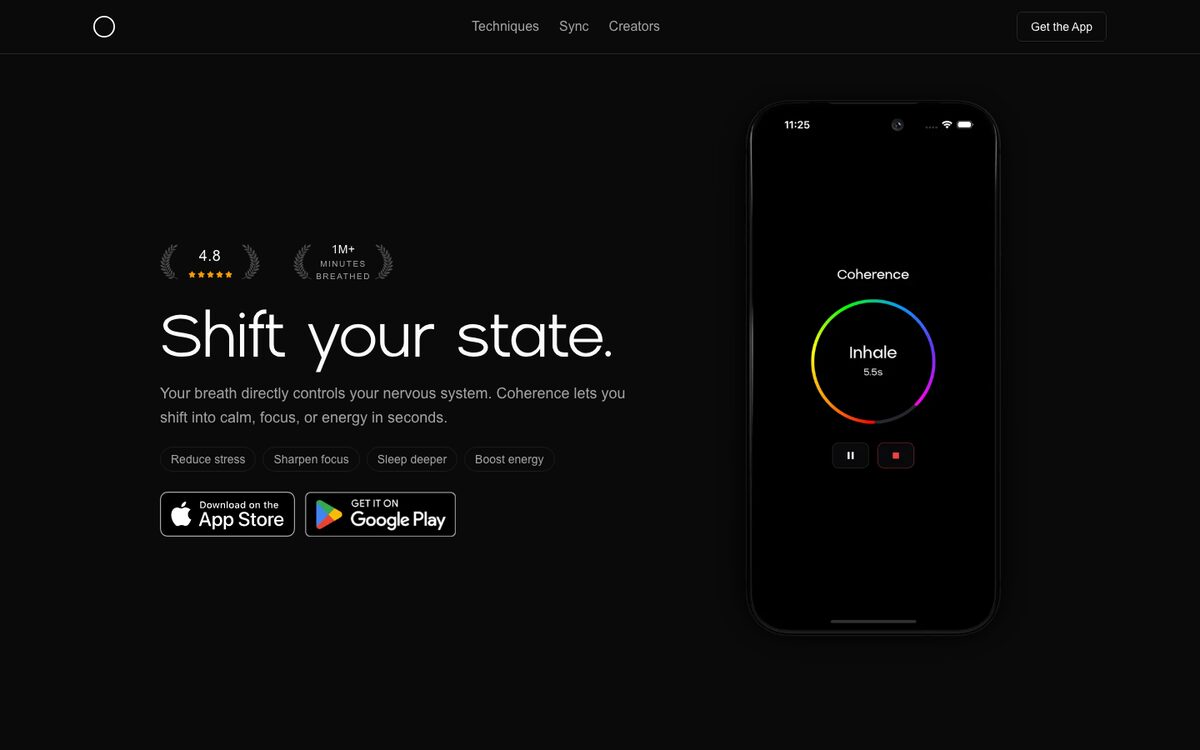
The product itself was very simple: a streak counter on the home screen for a bit of gamification; six main techniques, including coherence breathing, vortex energy, focus, stress relief and sleep; and a minimal session screen where you set a timer, adjust the volume and press start — a sound plays as you inhale and another as you exhale.
It's a subscription: $40 a year with a 3-day free trial, or $10 a month. Note one detail: the free trial is attached only to the yearly plan, steering new users toward a long-term commitment from day one.
Phase 4 · A video he nearly scrapped — 8 million views
The app was live, but what really made the business take off was still content.
The brothers distilled a five-step "content before product" playbook:
- Pick a painful niche and make lots of content about it. Theirs was breathwork.
- Batch ideas weekly, presenting yourself as the solution.
- Film in bulk: shoot 30 to 60 videos at once — "hook, film, done; another one, film, done" — with two months of content in the bank.
- Amplify the winners: see which videos work, then put TikTok Spark Ads and Meta ad money behind them to test whether people will pay.
- Out-market everyone: make as many short videos as you possibly can, hire editors, use whatever means you have.
The content pipeline was clear too: test as a text post on X first; if it hit, rewrite it as an Instagram and TikTok short-video script; if the short did well, turn it into a longer YouTube video. Short to long, cheap to expensive — each step bets only on content that has already been validated.
In July 2025, they published the video that changed everything. After filming it, Jack thought it was bad and re-shot it three more times — then posted the first take anyway. The next day it had a million views; in the end it reached about 8 million views across platforms.
The video opened with a deliberately polarizing hook: "Do you want to know something that they don't want you to know?" Who "they" are, Jack left vague on purpose — in a health context, viewers naturally think of the forces "keeping you sick." He later turned that opener into a series.
This detail is worth remembering for anyone making content: work the creator thinks is a "flop" often isn't a failure in the audience's eyes. What really drives views usually isn't polished visuals, but whether the first few seconds grab people.
Jack says he's the face of the brand and posts "like a madman every single day." They also use ManyChat to auto-reply to Instagram DMs and send viewers to the app download page.
Phase 5 · A business with a 50% margin
After 8 months, Coherence's scorecard read: 15,000 downloads, 2,000+ users and about $85,000 in revenue.
A rough sanity check: if most of 2,000 users paid the $40 annual fee, that's around $80,000 a year — roughly in line with the revenue they reported.
On the cost side, the brothers shared everything:
| Item | Monthly cost |
|---|---|
| Video editors | about $2,500 |
| Influencer partnerships | $1,000–2,000 |
| Ghostwriter (for X threads) | $800 |
| Virtual assistant | $500 |
| AI coding tools | about $300 |
| RevenueCat | about $100 |
| Other tools | about $100 |
That's $5,000 to $6,000 a month in total, for a margin of about 50%.
For a two-person team, that means roughly $5,000 a month left after all expenses. It's not riches, but for an app less than a year old, with no funding and no full-time employees, it's already a business that pays for itself.
The most interesting thing about this table: code costs just $300, while content costs over $4,000. For this business, content isn't a side expense — it's the core cost of acquiring customers.
Phase 6 · Price increase, global synced breathing and creator revenue share (2026)
By October 2026, Coherence looked very different from the original minimal "six techniques plus streaks" version:
- Higher prices: on the App Store, the yearly plan rose from $40 to $69.99 and the monthly plan from $10 to $14.99, plus a giftable "Friend Pass."
- Global synced breathing: a live "Daily Sync" session where users around the world breathe together at the same time, with participants lighting up on a real-time 3D Earth.
- 500+ breathing patterns, and users can build their own sequences, add Spotify music, record their own voice guidance and share them with the community.
- Creator revenue share: referring new subscribers earns a 20% recurring commission, about $14 per conversion on average.
On the App Store, it has 591 ratings averaging 4.8. But the brothers haven't disclosed revenue since the price increase.
On pricing, a yearly increase of more than 70% suggests they've gained confidence in retention and word of mouth. On features, "global synced breathing" and "creator revenue share" both do the same thing: turn a tool for solo practice into a community that people take part in together, so users bring in new users themselves.
At the end of the interview, the host asked the brothers for advice to would-be founders. Nick's answer sounded nothing like startup advice: "Keep meditating... breathe more and try not to sit all day... if you don't, your body will eventually give out if you're coding for 12 hours a day sitting in a chair."
Coming from the founder of a breathwork app, that's only natural. But it's also a reminder: from start to finish, this business sells something the founders themselves truly believe in and use.
Thinking
1. Content is the cheapest market research there is
Most people build products by guessing what users want and then spending months developing it. Jack and Nick used X as an "idea battleground," posting daily and letting likes and reposts vote for them.
A tweet costs almost nothing, yet it tells you whether anyone cares about a topic, and how many people do. By the time the Vortex Breath tweet went viral, they already knew what the product should be — and even had their first users.
2. A founder's personal experience is the best trust signal
There's no shortage of breathwork apps — Calm, Open and Breathwrk are all products of bigger companies. What sets Coherence apart is Nick's story of "the doctor said I'd never walk normally again."
Trust is the hardest thing for health products to build. A real, specific personal experience makes people willing to give something a try more than any ad can. That's why so many small-brand founders are willing to appear on camera themselves.
3. AI coding means "I'm not technical" is no longer an excuse
Jack wrote zero lines of code, yet the app shipped in a few weeks — thanks to AI coding tools like Cursor, Claude Code and Codex, plus mature off-the-shelf services like Expo, Supabase and RevenueCat.
But note that Jack himself says: ideally, find a technical co-founder. AI lowers the barrier to writing code, but keeping a product stable and updated still requires someone on the team who can read code and diagnose problems.
4. See where the money goes, and you see what the business really is
Of $5,000–6,000 in monthly costs, code is just $300, while editing, ghostwriting and influencer deals add up to over $4,000.
In the AI era, building an app keeps getting cheaper, while getting people to know about it keeps getting more expensive. The real edge is shifting from "can you code" to "can you keep making content that takes off."
5. Polarizing hooks cut both ways
An opener like "something they don't want you to know" can bring huge traffic — 8 million views proves it. But in health, this conspiracy-tinged framing carries risks: platforms may limit its reach, and it can set unrealistic expectations about what breathwork can do.
Breathwork can help with relaxation and stress relief, but it isn't a substitute for medical care. In health content, you have to balance reach against credibility.
Action
Step 1: Pick a niche you genuinely care about where people are in pain (1 week) Ideally one where you have personal experience or professional background. List the 10 problems people in that niche complain about most.
Step 2: Post daily on X (or a similar platform) to test topics (2–4 weeks) Post 1–3 times a day about those problems and track likes, reposts, comments and saves. Find your three best-performing topics.
Step 3: Turn winning posts into short videos Rewrite text posts into 30–60 second scripts and post them on TikTok and Instagram Reels. Film 20–30 at once to build a reserve.
Step 4: Build the simplest possible MVP with AI coding tools (2–4 weeks) Build only the single core feature. Use tools like Cursor and Claude Code with off-the-shelf services like Expo, Supabase and RevenueCat — don't reinvent the wheel.
Step 5: Design your pricing Use a subscription and attach the free trial only to the yearly plan to steer users toward long-term commitment. After launch, watch your trial-to-paid conversion rate, then adjust pricing.
Step 6: Put a little ad money behind content that works Amplify videos that performed well organically with small TikTok Spark Ads or Meta ad budgets to test whether paid acquisition pays off.
Step 7: Keep the books — know where every dollar goes Like Jack and Nick, list monthly costs for editing, tools and ads, and calculate your margin. When content is the biggest cost, optimize your content production process first.
Not for you if:
- You don't want to appear on camera or post content consistently every day;
- You have no personal experience or expertise in your chosen niche, making it hard to tell a convincing story;
- You hope one viral hit will let you coast — this model requires ongoing monthly content spending;
- You're building a health product but plan to exaggerate its effects or make medical claims.