Fashion Director Used NASA Data and AI for Cynical Astrology: 20M Downloads Led to Midjourney's First-Ever Acquisition
Banu Guler studied psychology at NYU, worked as a graphic designer and built digital projects for fashion brands like DVF and Michael Kors and the fashion site VFILES. In 2015 she made an astrological chart as a gift, which sparked the idea for an astrology app; with VFILES developers Ben Weitzman and Anna Kopp she launched Co-Star in 2017. It computes birth charts from NASA Jet Propulsion Laboratory (JPL) public data, then an algorithm matches human-written snippets to planetary movements. Its black-and-white minimalist design and blunt push notifications like 'You're not sad, just bored' were screenshotted and shared en masse, driving 20M+ downloads with almost no marketing. The company raised about $20.9M in total (Series A led by Spark Capital). In July 2026, Midjourney announced it had acquired Co-Star — its first acquisition — and Guler became Midjourney's Chief Design Officer. This case is VC-backed and included for reference.
Process
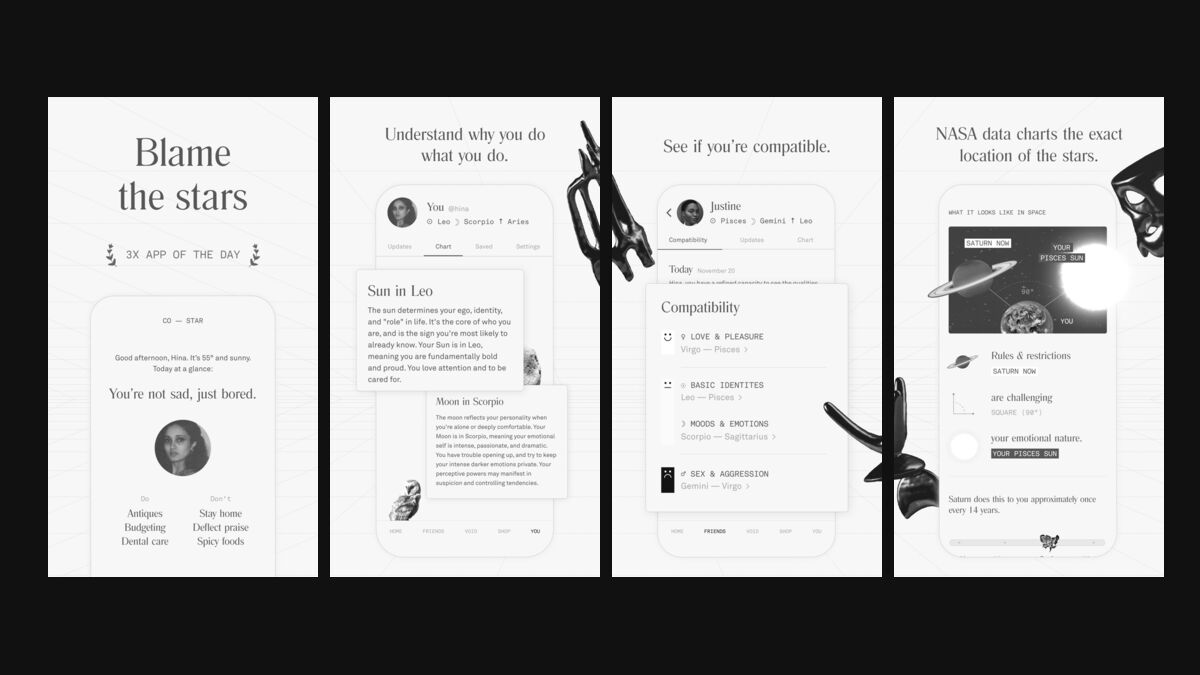
"You're not sad, just bored."
"You talk about other people because you don't have your own life."
If your phone greeted you with a line like that every morning, would you be offended — or would you screenshot it and send it to a friend?
In spring 2019, thousands of young Americans chose the latter. They posted the screenshots on Twitter, competing over who'd been "roasted" hardest that day, and even started making up fake notifications as parodies. Every one of those notifications came from the same app: Co-Star, an astrology app.
Astrology may be one of humanity's oldest "content businesses." Newspaper horoscope columns, street fortune tellers, websites with purple backgrounds and crystal balls... The category looks old and tacky — hardly the place you'd expect a company that excites Silicon Valley investors.
Co-Star pulled it off anyway: more than 20 million downloads with almost no marketing; Axios reported that a quarter of young American women aged 18 to 25 had downloaded it. In July 2026, Midjourney — best known for AI image generation — announced it had acquired Co-Star. It was Midjourney's first acquisition ever.
A note up front: Co-Star raised about $20.9M in total, so it doesn't meet this site's "no VC dependency" criterion. We keep it as a reference case because it answers a question useful to every small team: in an old, crowded category, can design and voice become a moat?
Phase 1 · A psychology grad's detour through fashion (before 2015)
Co-Star's founder Banu Guler studied psychology at New York University. After graduating she didn't go into counseling — she became a graphic designer, then moved into fashion, working on projects for brands like Diane von Furstenberg, Michael Kors, Ann Taylor and Alex and Ani, and at the New York fashion site VFILES.
In fashion she saw the power of digital: brands no longer just sold clothes; they built communities and content online, connecting content to commerce. She gradually shifted toward designing "immersive digital experiences."
Psychology, design, fashion, digital community — seemingly unrelated pieces that would later come together in an astrology app.
Phase 2 · A hand-made birth chart and two VFILES colleagues (2015–2017)
In 2015, Guler made a friend an astrological chart as a gift.
That small act made her realize the core of astrology isn't predicting the future — it's giving people a reason to talk about themselves. As she later put it: "By positioning human experience against a backdrop of a vast universe, Co–Star creates a shortcut to real talk in a sea of small talk."
She shared the idea with two developers she knew from VFILES, Ben Weitzman and Anna Kopp, and the three decided to turn it into a mobile app.
The team spent months studying the "craft" of astrology and set three principles for Co-Star:
- Hard data: use public celestial position data from NASA's Jet Propulsion Laboratory (JPL) to precisely calculate every planet's position at the moment of a user's birth — not just their sun sign;
- Human words: have freelance writers and astrologers write large numbers of short lines, in the tone of friends talking rather than mystical jargon;
- Algorithmic matching: an algorithm combines those lines into daily notifications and "do/don't" lists based on each person's chart and that day's planetary movements.
Co-Star launched on iOS in October 2017.
Phase 3 · Black and white, minimal, like a fashion magazine (2017–2018)
The first impression of Co-Star is: this doesn't look like an astrology app.
No purple starry skies, no crystal balls, no gold zodiac symbols. The whole interface is black and white, laid out like an upscale fashion magazine: large serif type, lots of white space, vintage black-and-white illustrations. The home screen shows a single line for the day, with "Do" and "Don't" columns below — say, "Do: antiques, budgeting, dental care" and "Don't: stay home, deflect praise, spicy foods."
The design hit a previously overlooked audience squarely: well-educated, design-conscious young people who were curious about astrology but found traditional versions tacky. To them, Co-Star looked less like superstition and more like a psychology quiz or a personal magazine.
In early 2018, Co-Star raised a $750,000 pre-seed round from Female Founders Fund.
Phase 4 · Notifications become an internet meme (2019–2021)
Co-Star's real breakout came from its push notifications.
Traditional horoscopes are vague and upbeat: "Something good will happen today." Co-Star's notifications were often short, blunt, even a little offensive. Some people got just "drink water," followed by a message dragging them for not taking care of themselves; some got "You talk about other people because you don't have your own life"; others got "Embrace the possibility of abundant joy."
The media reached for all kinds of words to describe the tone: "slightly robotic," "wildly beautiful," "brutally honest" — some said reading it felt like "a free therapy session."
In March 2019, users began posting screenshots on Twitter en masse, then started inventing fake notifications that were "only slightly exaggerated versions of the real thing." Co-Star's official account joined in, posting fake notifications of its own.
Every screenshot was a free ad.
Growth followed:
- In April 2019, with nearly 3 million downloads, Co-Star closed a $5.2M seed round from investors including Maveron, Aspect and 14W;
- In January 2020, before the Android launch, the waitlist had reached 120,000 people;
- In April 2021, Co-Star raised a $15M Series A led by Spark Capital. Downloads had passed 20 million, and the company said it had done almost no real marketing.
The product also had a key social mechanic: friend compatibility. You add friends and see how well the two of you match on dimensions like "love and pleasure," "moods" and "communication." To see compatibility, you have to bring your friends in — turning every user into a promoter.
Phase 5 · Lots of users — but where's the money? (2022–2025)
As usage grew, Co-Star ran into astrology apps' old problem: most people only want to read their daily horoscope for free.
Co-Star tried several ways to make money:
- In 2022 it launched the Co-Star Plus subscription, moving more features behind a paywall. Critics argue it has gated more previously free features every year (such as some chart relationships, transits and compatibility analysis), upsetting some longtime users;
- In July 2023 it launched "The Void", where users can ask open-ended questions answered using Co-Star's astrological database. The first question is free; after that it's pay-per-question: 5 questions for $2.99, 10 for $4.99, 25 for $6.99.
That same year, industry data put Co-Star at about 30 million registered users. But the company has never disclosed revenue, so outsiders can't tell whether it was profitable.
Phase 6 · Midjourney's first acquisition (2026)
On July 23, 2026, Midjourney announced it had acquired Co-Star. The deal had actually closed in the spring, and neither side disclosed the price.
According to reports:
- Co-Star had about 4.3 million monthly active users at the time;
- Its entire 24-person team joined Midjourney;
- Banu Guler became Midjourney's Chief Design Officer, building and leading design, product and frontend teams, with her first task being Midjourney's native mobile app;
- Co-Star continues to run as a standalone app, still under Guler's "complete control."
Why would an AI image company buy an astrology app? Midjourney founder David Holz said he met Guler about five years earlier and had been talking with her for years about "the ways people reflect and make decisions both in the present, future, and over the past thousands of years." He said: "I respect her insights immensely and am excited to have an opportunity to have her and her amazing team join Midjourney to help build a broader organization around Product and Design."
Guler wrote on X that she and Holz share a belief that "computers can be tools that reveal our humanity to ourselves. Tools that show you what you mean, how you feel, what you're imagining, before you can articulate it yourself."
In other words, Midjourney wasn't just buying an app and 4.3 million users — it was buying a team that knows how to turn technology into a product ordinary people want to open every day.
Thinking
1. The opportunity in an old need is a new aesthetic
The demand for astrology has lasted thousands of years and never gone away, but it has long been dominated by tacky visuals and vague copy. Co-Star didn't invent a new need; it remade an old one with a fashion-industry eye — and attracted a huge number of people who had found astrology "too tacky."
Many old categories hide this kind of opportunity: tarot, dream interpretation, feng shui, budgeting, fitness tracking... When every competitor looks the same, a product with a completely different aesthetic is differentiation in itself.
2. The push notification isn't a feature — it's the product
Most apps treat notifications as a tool to pull users back, with interchangeable content. Co-Star made the notification its core experience: one short, sharp line a day that people want to screenshot, share and compare with friends.
Behind that is a smart choice: make the product's output naturally shareable. Users weren't sharing "I use an astrology app" — they were sharing "look how it roasted me today," which is far more fun and spreads far faster.
3. A "science" veneer builds trust — but be clear about the limits
Talk of NASA data and AI algorithms gave Co-Star a "rational" credibility that made it easier for educated young people to accept. But to be clear: NASA data only tells you where planets are in the sky; astrology itself has no scientific basis. Co-Star's real value is giving people a prompt for self-reflection and conversation with friends.
Using technology as a source of credibility while being honest about what the product is and isn't is what makes it last.
4. There's a gap between usage and monetization
20M+ downloads and millions of monthly users sound impressive. But most people only read the free daily horoscope, and the share willing to pay is limited. Co-Star expanded its paywall while launching pay-per-question AI Q&A — and drew criticism from some longtime users for it.
It was ultimately acquired by Midjourney for an undisclosed sum. We can't tell whether the deal was a success for investors, but one thing is clear: high usage doesn't equal a good business, and the monetization model needs careful design from the start.
5. In the AI era, "design that understands people" is getting scarcer
Midjourney's models are world-class, but it lacked a consumer product experience that ordinary people open daily. What it paid for was the Co-Star team's skill in design, voice and mobile products.
The lesson for every small team: models and algorithms will keep getting cheaper and more alike, while the ability to understand users' emotions and package technology into a great product will keep getting more valuable.
Action
Step 1: Find a category where the need is old and the products are tacky (1 week) List areas people have always used but where existing products look dated: astrology, tarot, dream interpretation, budgeting, journaling, habit tracking... Open the App Store charts and see what the top products look like.
Step 2: Define your voice Write a voice guide: who is your product when it talks? A friend, a snarky best friend, a calm therapist? Draft dozens of sample lines so the style is consistent and recognizable.
Step 3: Find a credible data source Co-Star uses NASA data; you can use public, authoritative data too (weather, astronomy, sports, nutrition databases and so on) as the base for personalized content and added credibility.
Step 4: Make each day's output screenshot-worthy Design a short daily piece of content for a notification or the home screen: one line, one image or a "do/don't" list. The test: will users want to send it to a friend?
Step 5: Add social features that require bringing friends For example, two-person comparisons, friend leaderboards or joint reports. When users want the feature, they'll naturally invite friends.
Step 6: Design monetization early — without betraying existing users Keep the core experience in the free version and make paid features "go deeper" (detailed reports, pay-per-question answers) rather than gradually taking away what used to be free.
Step 7: Be honest about your product's limits If your product touches astrology, psychology or health, tell users clearly that it's for entertainment or self-reflection and isn't a substitute for professional advice.
Not for you if:
- You have no design skills and can't find a designer with standout taste — products like this differentiate mainly through aesthetics and voice;
- You need to make money quickly, but your product is the "free is enough" type, with naturally low paid conversion;
- You aren't good at, or don't want to keep, producing large amounts of copy;
- You lack respect for the domain your product touches (like astrology or psychology) and might mislead users.