Columbia Student Built AI Cheating Tool to Crack Meta and Amazon Offers: Suspended, Dropped Out, Raised $15M from a16z at $120M Valuation
In early 2025, Columbia student Roy Lee built the interview-cheating tool Interview Coder in under a week: an invisible overlay that screenshots coding questions and has AI answer them live, for $60 a month. He used it to land internship offers from Amazon, Meta and TikTok, and posted a recording of his Amazon interview on YouTube. The offers were rescinded, the university disciplined him, and he and co-founder Neel Shanmugam dropped out to launch Cluely in April 2025 with the slogan 'cheat on everything': 70,000 signups in the first week and a $5.3M seed round, then a $15M a16z-led round in June at a $120M valuation. He fueled attention with 60+ contracted creators, 700 video editors and a 2,000-person party shut down by police. In March 2026 he admitted the $7M ARR he'd touted was false — the real figure was about $5.2M — and the product has pivoted from cheating tool to AI meeting assistant. This case is VC-backed and included as a cautionary tale.
Process
In March 2025, a video set the programming world on fire.
In it, a 21-year-old Columbia University student is doing a technical interview with Amazon. The interviewer poses a coding problem; he seems to think it through and answer calmly. Only viewers know that on his screen sits a translucent window the interviewer can't see, with AI feeding him the answer in real time.
His name is Roy Lee (Korean name Chungin Lee). He didn't just pass that interview — he used the same tool to land internship offers from Meta and TikTok too. Then he posted the recording of his Amazon interview publicly on YouTube.
What followed played out like an absurdist drama: the offers were rescinded, the university opened disciplinary proceedings, and he simply dropped out. A month later he founded Cluely with the slogan "Cheat on everything" and raised a $5.3M seed round. Two months after that, top Silicon Valley firm a16z led a $15M round at a $120M valuation.
And the story didn't end there. In March 2026, he admitted on X that the $7M ARR he had publicized was false.
A note up front: Cluely is venture-backed, which doesn't meet this site's "no VC dependency" criterion. We keep it as a cautionary case — it shows how high the AI-era attention economy can lift a company, and how hard it can fall when honesty goes.
Phase 1 · The kid who ground through 600 hours of problems (2003–2024)
Roy Lee was born in 2003, a Korean American who grew up in the small city of Suwanee, Georgia.
His path through school wasn't smooth. He was admitted to Harvard out of high school, but the offer was rescinded after he snuck out during a school field trip. He went to Diablo Valley College, a California community college, planning to transfer to Berkeley, and eventually transferred to Columbia.
To become a programmer at a big tech company, there's one gate you can't avoid: LeetCode, an algorithm practice site. Almost every US tech company's technical interviews test this kind of problem.
Lee spent about 600 hours on LeetCode, reaching the top 1% of ranked users. But he later told CNBC the process "made me miserable, and I almost stopped programming."
In his view, the problem wasn't that he hadn't worked hard enough — it was the interview system itself. Real programmers already wrote code with AI, yet interviews still demanded hand-written algorithms on a whiteboard. "Everyone programs nowadays with the help of AI," he said.
That resentment became the starting point of his first product.
Phase 2 · Interview Coder: a "cheating machine" built in a week (early 2025)
In early 2025, Lee and classmate Neel Shanmugam built Interview Coder in less than a week.
The idea was simple, but the details were carefully thought out:
- A translucent overlay window sits on the screen, invisible to the interviewer during screen sharing;
- It captures the interview question, sends it to AI, and generates solution code and explanations in real time;
- The window is positioned so the candidate's eyes don't visibly wander while reading answers;
- The cursor stays still to avoid raising suspicion.
The website's tagline read "F*ck LeetCode," and it cost $60 a month.
Then Lee tested it himself. He used Interview Coder in internship interviews with Amazon, Meta and TikTok and got offers from all three. He recorded his entire Amazon interview and posted it on YouTube.
The video blew up. Hundreds of comments cheered him on; many programmers said what they'd been thinking all along: these grind-style interviews should have died long ago.
Big companies reacted very differently. After CNBC asked Amazon and Google for comment, YouTube removed the video, citing "a copyright claim" from Amazon. The Amazon, Meta and TikTok offers were rescinded one after another.
Columbia opened disciplinary proceedings too. According to Wikipedia, Lee was first placed on academic probation for an academic integrity violation, then suspended for one year — until May 2026 — for copying and distributing disciplinary hearing materials without authorization (he had posted those online too). Neel Shanmugam was also caught up in disciplinary proceedings.
Neither waited it out. Both dropped out.
Interview Coder itself cashed in on the uproar. Lee told CNBC at the time that it was on track for $1M in annual revenue by mid-May; other reports said it passed $1M in revenue within 36 days. He even paid the internet duo "Costco Guys" to make a promo video.
Getting punished became the best advertising.
Phase 3 · Cluely: "cheat on everything" (April 2025)
Helping people pass coding interviews was too small a market. Lee thought bigger: if AI could secretly help you in an interview, why not on sales calls, in exams, on dates?
On April 20, 2025, they upgraded the product into Cluely and launched it with a third co-founder, Alex Chen.
The launch video was set on a restaurant date: Lee, without the woman across the table knowing, uses AI in his glasses to make up his age and fake knowledge of art. At the end, the lies are exposed.
The video split opinion. Some called it marketing genius; others said it was straight out of Black Mirror. Cluely also published a "manifesto" comparing itself to calculators and spellcheck, which were once also condemned as "cheating."
The bigger the controversy, the bigger the traffic. Cluely got 70,000 signups in its first week.
The next day, April 21, Cluely announced a $5.3M seed round, co-led by Abstract Ventures and Susa Ventures. TechCrunch's headline practically advertised for them: "Columbia student suspended over interview cheating tool raises $5.3M to 'cheat on everything.'"
Was the product really that good? Lee later laid out the thinking: "The whole idea [was] let's launch something that barely works, and if we can get enough initial users, they will find out the use cases for us." He also admitted the product was "in a really raw state" at launch. Independent testing found response delays of 5 to 90 seconds and generic suggestions.
Phase 4 · The attention machine: creators, editors and a party the police shut down (May–June 2025)
What Cluely was truly good at wasn't AI — it was manufacturing buzz.
According to Wikipedia, by July 2025 Cluely had signed 60+ content creators and hired 700 video editors to churn out content across social platforms. The media called its style "rage bait": deliberately saying infuriating things so people can't resist sharing, commenting and attacking it — and every attack is free exposure.
In June 2025, Y Combinator held its "AI Startup School" event, and Lee threw an after-party, promoting it with a satirical video on X. He said he'd only invited friends and friends of friends, but word spread and about 2,000 people lined up, wrapping around blocks and blocking traffic. Police arrived and shut it down.
Lee called it "the most legendary party that never happened" — he was proud and disappointed at the same time.
That same month, on June 20, Cluely announced a $15M Series A led by a16z (Andreessen Horowitz) at a $120M post-money valuation — just two months after launch.
But there were problems beneath the shine. In June 2025, security researcher Jack Cable found a flaw in Cluely's desktop app: websites opened through Cluely could capture screenshots without the user knowing. According to reports, Cluely's response wasn't a quick fix but DMCA takedown notices sent to him.
Phase 5 · That $7 million number (June 2025 – March 2026)
In summer 2025, TechCrunch reported that Cluely had reached $7M in ARR. Lee also promoted on social media that ARR had jumped from $3M to $7M in a single week.
The number became the symbol of Cluely's "explosive growth."
On March 5, 2026, Lee posted on X admitting the number was false. He said it was "the only dishonest thing I've ever said publicly online, so I'm officially retracting it." He shared Stripe screenshots showing that in June 2025:
- Consumer ARR was $2.7M (run rate $3.8M);
- Enterprise ARR was $2.5M (run rate $2.5M);
- Together about $5.2M, roughly a quarter lower than the claimed $7M.
His first explanation was that it was "a random cold call" and he'd "said some bs." But TechCrunch then revealed that Cluely's own PR team had emailed reporter Marina Temkin on June 27, 2025, asking to "set up an interview to dig into the next phase" — a planned, formal interview, not a random call.
Lee followed up with a two-minute video rebuttal calling the discrepancy "fractionally wrong" and saying the company is now profitable and growing steadily.
$5.2M in ARR is not bad for a company a few months old. The real problem isn't the size of the number — it's trust. When a founder admits to saying false things to the press, on social media and in fundraising conversations, investors, customers and employees all start to wonder: what else isn't true?
Phase 6 · From "cheating tool" to "meeting assistant" (late 2025 – present)
Amid the controversy, Cluely has been quietly cleaning up its image.
- In late April 2025, the website removed explicit references to cheating on exams and interviews;
- By June 2025, the word "cheat" was gone from the site;
- In November 2025, Cluely formally repositioned as an AI meeting assistant. Lee said: "Our goal now is to become the leading AI note-taker, starting with consumer use."
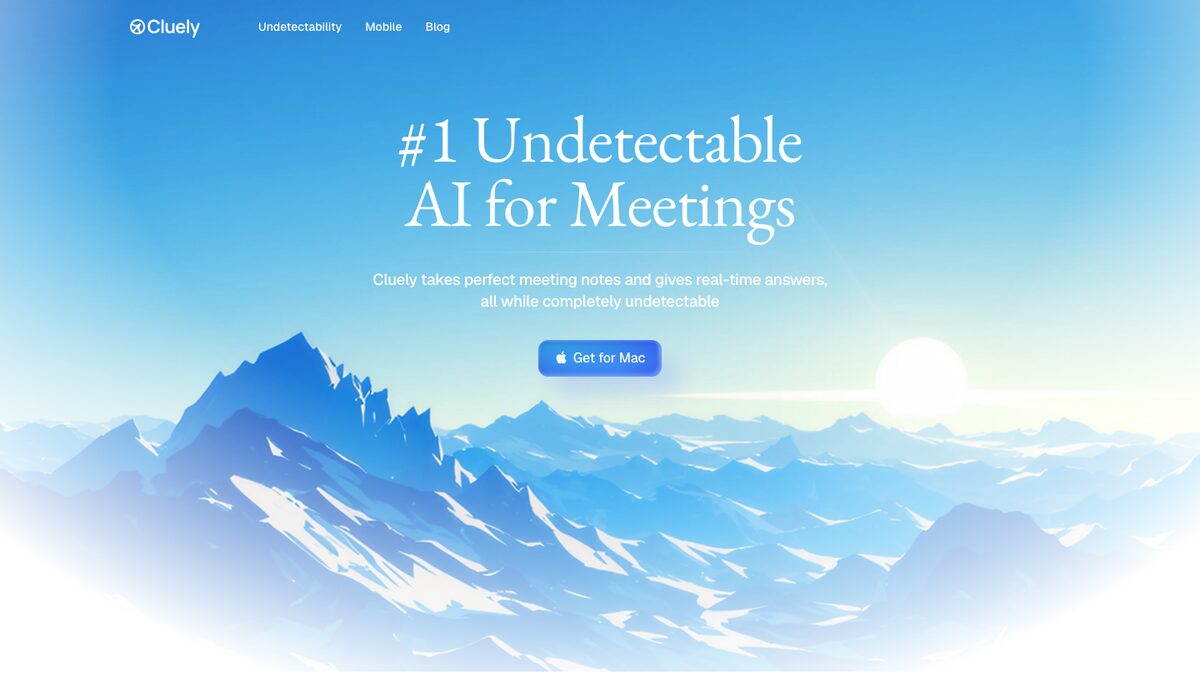
Today Cluely has desktop and mobile apps focused on real-time answers and meeting notes. But open the website and the biggest headline still reads "#1 Undetectable AI for Meetings." In other words, not being noticed by others remains its core selling point.
Also, in late 2025, Cluely had to move out of a residential property in San Francisco's SoMa district after violating zoning rules by having employees live and work there. In 2025 the company had 16 employees.
Thinking
1. It hit a real pain point: interviews are out of touch with reality
Interview Coder didn't take off because everyone wants to cheat. It took off because many programmers genuinely find LeetCode-style interviews unfair. In real jobs, everyone writes code with AI, yet interviews demand algorithms by hand. Lee's 600 hours of grinding and near-quitting were real pain.
A product that precisely pokes a large group's resentment gets natural word of mouth. But the same pain point can be solved legitimately — say, with mock interviews and practice tools — rather than helping people deceive employers in real interviews.
2. Controversy marketing cuts both ways
Cluely turned every piece of bad news into traffic: the suspension, the rescinded offers, the Black Mirror comparisons, the party shut down by police... Combined with a content factory of 60+ creators and 700 editors, it captured the whole internet's attention with almost no traditional ad spend.
But controversy brings attention, not trust. Users downloading out of curiosity doesn't mean they'll pay long term; enterprise buyers who see the word "cheat" hesitate harder. That's why Cluely later scrambled to rebrand as a "meeting assistant."
3. The limits of "ship first, figure it out later"
"Launch something that barely works and let users find the use cases" isn't a bad strategy in itself — many successful products started that way. The problem is that Cluely's marketing ran far ahead of its product: 5–90 second response lags, generic suggestions, and DMCA notices to silence a researcher after a security flaw surfaced.
Marketing decides whether users come; product decides whether they stay. When the buzz fades, only product quality can hold the company up.
4. Inflating numbers costs far more than the numbers themselves
The gap between $7M and $5.2M looks like just $1.8M. But the real cost is that the founder's word is no longer credible.
For a venture-backed company, ARR is the core basis of valuation. Inflating it damages reputation and can bring legal risk. Also watch for a common confusion: ARR (annual recurring revenue) and run rate are not the same thing — multiplying your best week by 52 and calling it annual revenue is misleading in itself.
5. After the pivot, how much differentiation is left?
Becoming an "AI meeting note-taker" means entering a crowded market where Otter, Fireflies, Granola and others have been building for years. Cluely's unique pitch is still being "undetectable" — which is exactly its risk: many jurisdictions require consent from all parties to record, and enterprise customers worry about compliance.
For a company built on controversy, the hardest part is finding real value beyond the controversy.
Action
Step 1: Find a pain point that has lots of people fuming Look for processes people widely complain about but institutions or big companies are slow to change: grind-style interviews, tedious expense reports, inefficient meetings... List where the complaints are loudest.
Step 2: Solve it legitimately For the same interview pain point, you could build AI mock interviews, problem walkthroughs or résumé improvement — helping people genuinely get better rather than deceiving others in real situations. Ask yourself: if the user's boss or interviewer knew they were using this tool, would that be a problem?
Step 3: Ship a paid MVP within a week Interview Coder proved a tool focused on one pain point can be built in a week and charge immediately. Don't spend months polishing; get real users to pay and validate demand first.
Step 4: Build content distribution at scale Borrow Cluely's content-factory idea: work with many small creators and test different content angles in bulk. Have attitude and opinions, but don't chase attention by lying or hurting people.
Step 5: Only publish numbers that can be verified When you talk about revenue, define it: ARR, MRR or run rate? Ideally attach a verifiable source (such as Stripe screenshots or a third-party revenue verification platform). Better to understate than overstate.
Step 6: Take security reports seriously When someone reports a vulnerability, thank them, fix it fast and disclose it publicly. Using legal threats to silence researchers only turns the issue into a bigger PR crisis.
Step 7: Convert attention into value early The attention window from controversy is short. While the buzz lasts, polish the product fast and find core users and real use cases willing to pay long term.
Not for you if:
- Your product's core pitch is helping users deceive others — it may blow up short term, but legal and ethical risk will follow you;
- You can't handle being criticized by the whole internet or don't want to be at the center of controversy;
- You depend on enterprise customers who are highly sensitive to compliance and reputation;
- You're used to "hype first, worry later" — inflated numbers will be discovered sooner or later, and the cost far outweighs the gain.