He Quit a $200K Job and Built a Cat Pomodoro App With ChatGPT: How Cat on Chair Hit $18K/Month
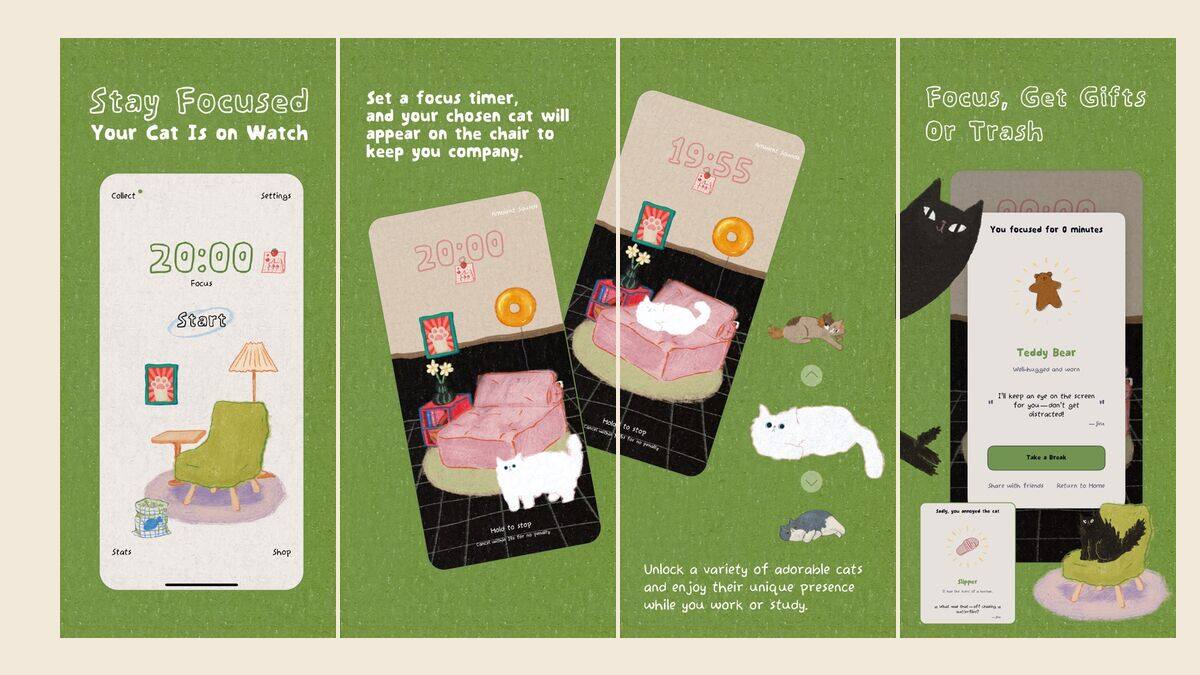
Product designer Ryan Yao left a $200K job and, with his illustrator girlfriend, built the Pomodoro app Cat on Chair: when you start focusing, a hand-drawn cat jumps onto a chair to keep you company; finish and it brings a gift, fail and it leaves a bit of trash, and gifts trade for fish that buy furniture for the cat's room. He says he didn't write a line of code, relying mainly on ChatGPT Pro. The app launched on August 27, 2025, recruited beta testers on Xiaohongshu, was featured in an Instagram creator's app roundup (2M+ views), then blew up again after a Taiwanese user shared it on Threads, peaking at #11 among all free apps in Taiwan. Per Starter Story (July 2026): 127K downloads and about $80K in revenue over 8-9 months, and $18K in the 30 days to April 2026, mostly from a $29.99 lifetime unlock.
Process
Pomodoro timers are probably one of the most crowded categories on the App Store. Forest and countless to-do and focus apps have filled the market long ago.
Product designer Ryan Yao picked it anyway. He quit a $200K-a-year job and, together with his illustrator girlfriend, built a Pomodoro app: Cat on Chair.
Only one thing sets it apart from other Pomodoro timers: when you start focusing, a hand-drawn cat jumps onto a chair to keep you company.
According to a July 2026 Starter Story interview, in its first 8–9 months Cat on Chair had:
- 127,000 downloads, about 24,000 a month;
- about $80,000 in total revenue;
- $18,000 in revenue in the 30 days to April 13, 2026;
- a peak of #11 among all free apps and #3 in Productivity on the Taiwan App Store.
The revenue figures are self-reported and not independently verified.
Phase 1 · Quitting a $200K job (early 2025)
Ryan had worked as a product designer at several tech startups, earning $200K a year. He wanted a product that was entirely his own, so he quit. He and his girlfriend reportedly live in Vancouver, Canada.
His problem was the same as many designers': he could design, but not code.
Phase 2 · Inspiration from a necklace (May 2025)
The idea came from a necklace his girlfriend made: a little cat sitting on a little chair.
Anyone with a cat knows that when you work, the cat likes to crawl up beside you. They wondered: could a focus timer feel like that — not a cold countdown, but a cat quietly keeping you company?
His girlfriend also suggested Animal Crossing-style decorating, so users could furnish the cat's room.
The product loop took shape:
- Start a focus session, and the cat you picked jumps onto the chair to keep you company;
- Finish the session, and the cat gives you a gift;
- Quit halfway, and the cat just leaves a bit of "trash" — no punishment;
- Gifts and trash trade for fish, which buy furniture and decor for the cat's room;
- Seasonal updates add new gifts, furniture and more cats to collect.
Phase 3 · Building the whole app with ChatGPT (May–August 2025)
Development began in May 2025. Ryan says he didn't write a single line of code himself; he relied mainly on ChatGPT Pro as his developer, turning design ideas into prompts, letting the AI write the code, and debugging over and over.
His girlfriend drew all the illustrations, which became the app's biggest differentiator. Ryan says: "Her style is truly unique and there's nothing quite like it in the market."
Cat on Chair launched on the App Store on August 27, 2025. It took several more months of iteration before the app became fairly stable around the end of 2025 and early 2026.
The free version is already complete: no ads, Pomodoro and count-up modes, and blocking for distracting apps and websites. Pro adds multi-device sync, an Apple Watch app, more cats and furniture, and later a "Focus Together" feature.
Phase 4 · Three waves of organic reach (from August 2025)
They haven't mentioned running ads. Growth came from three organic waves:
Wave 1: A Xiaohongshu beta His girlfriend already had a following on Xiaohongshu. They recruited beta testers there, inviting thousands of people and gathering lots of feedback.
Wave 2: An Instagram creator's app roundup An Instagram creator included Cat on Chair in an "apps I recommend" roundup post that passed 2 million views.
Wave 3: A Taiwanese user shares it on Threads A user in Taiwan shared the app on Threads, sparking another round of spread. Ryan says it doubled downloads and revenue overnight. Cat on Chair reached #11 among all free apps and #3 in Productivity in Taiwan.
To this day it has more ratings on the Taiwan App Store (473) than in the US (432); its Chinese name there is "椅子上有貓."
Another unexpected audience was the ADHD community: many users with attention difficulties love its non-judgmental, no-punishment design. In some regions the App Store name includes the keyword "ADHD Focus."
Phase 5 · Monetizing mainly through a lifetime purchase (2026)
Pricing is simple:
- Free version: no ads, core features available;
- Pro annual: $19.99/year;
- Pro lifetime: $29.99, with Family Sharing for up to 6 people.
Most revenue comes from the $29.99 lifetime purchase. For many users, paying once to "adopt" a cat that stays with them forever is easier to accept than renewing every year.
Costs are low: mainly the subscription tool RevenueCat at about $200–300 a month (scaling with revenue), plus a few small tool fees.
Thinking
1. In a crowded category, emotion separates you more than features
Pomodoro apps all do roughly the same things: timing, stats, blocking. Cat on Chair isn't selling "a better timer" — it's selling the feeling of a cat keeping you company. Not punishing failure, just leaving a bit of trash, contrasts sharply with Forest's "your tree dies," and that's also what drew the ADHD community.
2. A distinctive art style is the real moat in the AI era
Ryan could write the entire app with ChatGPT, which shows code is no longer scarce. What's hard to copy is his girlfriend's hand-drawn style: it makes the app instantly recognizable in screenshots and short videos, so creators want to recommend it and users want to share it.
3. A beautiful product spreads itself
None of the three growth waves were paid for: the Xiaohongshu beta, the Instagram roundup, the Taiwanese Threads post. What they share is that the product looks great in screenshots and is worth sharing. On visual social platforms, a cute cat interface is good content in itself.
4. Lifetime purchases suit emotional products
Utility apps usually use subscriptions, but most of Cat on Chair's revenue comes from a $29.99 lifetime purchase. For users it feels like adopting a cat once; for the developer it brings in cash faster early on. The trade-off is the constant need for new users, since existing ones won't pay again.
5. Read this case with a cool head
- The numbers are self-reported: $18K/month and ~$80K total come from an interview, without third-party verification;
- Monthly revenue fluctuates: about $80K over the first 8–9 months means an average of under $10K a month; $18K is a recent post-surge figure, and lifetime-purchase revenue is inherently uneven;
- The widely repeated "Apple Today feature" can't be verified, so we removed it;
- Prerequisites: he has senior product design experience and his girlfriend is a professional illustrator — skills most people don't have.
Action
Step 1: Find an "emotional gap" in a crowded category (1 week) Pick an app category you use that has lots of competitors (Pomodoro, budgeting, to-dos, water reminders...). Read the App Store's negative reviews and find where users feel pressure, guilt or boredom.
Step 2: Design a core interaction that feels like companionship Think of a character or scene that makes users feel accompanied rather than judged. When they fail, respond with something light and funny, not punishment.
Step 3: Find your art style If you can't draw, partner with an illustrator who has a distinctive style (revenue share or a flat fee). Settle the overall visual style before you start building.
Step 4: Turn the design into an app with AI (2–3 months) Use ChatGPT, Claude or Cursor and break each screen into small tasks. Build the core loop first (start focusing → companionship → result → reward), and add other features later.
Step 5: Beta-test in a small circle first On a platform where you or your partner already have followers (Xiaohongshu, Instagram, Threads), recruit a few hundred to a few thousand beta testers to gather feedback and polish the experience.
Step 6: Reach out to "app roundup" creators Find creators who regularly post "apps I recommend" roundups and introduce your app. Good-looking screenshots and short video clips greatly improve your odds of being featured.
Step 7: Price for "a generous free tier + lifetime purchase" Keep the free version ad-free with core features to build word of mouth; offer annual and lifetime paid options and test which sells better.
Not for you if:
- You have no design skills and can't find an illustrator with a distinctive style to partner with;
- Your product is a pure utility where users don't care about the emotional experience;
- You need steady, predictable monthly income and can't handle the swings of one-time purchases;
- You won't keep posting on social platforms and reaching out to creators.