A 'Boring' Job Board Making $28K a Month: A Non-Technical Psychology Grad Who Wins With $20 Videos and a Content System
Roman Lakhnyuk is non-technical, studied psychology and spent five college summers selling alarm systems door to door, eventually managing sales teams. He and a partner he met online wanted to start a business; when job hunting, the partner had built a scraper to find jobs posted directly on company websites. They turned that into the job board Career Hound — 'find jobs not on LinkedIn or Indeed' — hoping to make just $1,000 a month each. It has a hard paywall with no free plan: $7 a week, $20 a month or $50 a year. What really makes it money is Roman's marketing: he spends hours scrolling similar content across platforms to find 'timeless' topics and reusable video formats, then has older, more credible-looking everyday people film them, paying no more than $20 a video in 90% of cases. According to what he told Starter Story in September 2026: $28,000 in revenue last month, $12,000 MRR, 779 active subscriptions and 11.7 million social views in the past 30 days.
Process
If you had to name a website idea least likely to make money, a "job board" would probably rank near the top.
LinkedIn, Indeed, Glassdoor... this space has long been dominated by giants. Building another job board? It sounds almost like suicide.
But Canadian Roman Lakhnyuk did it anyway. His website is called Career Hound, featuring one main pitch: "Find jobs not on LinkedIn and Indeed."
According to his self-account on the startup interview show Starter Story in September 2026, this website generated $28,000 in revenue last month.
Roman is non-technical, and he is very frank about it: "What makes me stand out has absolutely nothing to do with the product."
His secret lies in marketing. More accurately, it lies in a content methodology that he has used for two years almost completely unchanged.
Note: These numbers come from the founder's own account and have not been audited by a third party.
Phase 1 · Psychology, Door-to-Door Sales, and the Advantage of "Non-Technical"
Roman studied psychology in college. He says he has always been very curious about human psychology.
During his studies, he spent five summers doing door-to-door sales, knocking on doors selling security alarm systems, and later even managed sales teams.
When he first started his business, he thought being "non-technical" was a disadvantage. But two years later, he realized this was exactly his secret weapon: "I've always been extremely curious about human psychology, and that is exactly what I studied in college." And his experience with door-to-door sales and managing teams gave him a huge advantage in managing content creators.
He also took a saying from his door-to-door sales days: "With every door I knock on, I'm one step closer to a sale." Later, this phrase became his marketing credo.
Phase 2 · A Scraper Turns into a Business
Roman always knew he wanted to start a business. He talked to many friends and later met someone online, and the two started brainstorming together.
Once, when Roman was looking for a job, that friend told him how he had originally found a job: he wrote a scraper specifically to grab jobs that were posted directly on company websites. Many companies post job openings on their own websites first and might not necessarily sync them to LinkedIn or Indeed.
The two decided to turn his friend's job-hunting method into a product, "just to test it out for ourselves first."
Their initial goal was very small: make $1,000 a month each.
"But from when we started to now, it has become a real business."
Phase 3 · A "Boring" Product and a Hard Paywall
Career Hound's target users are job seekers living in the United States: whether they already have a job and want to switch, or are unemployed and looking for one.
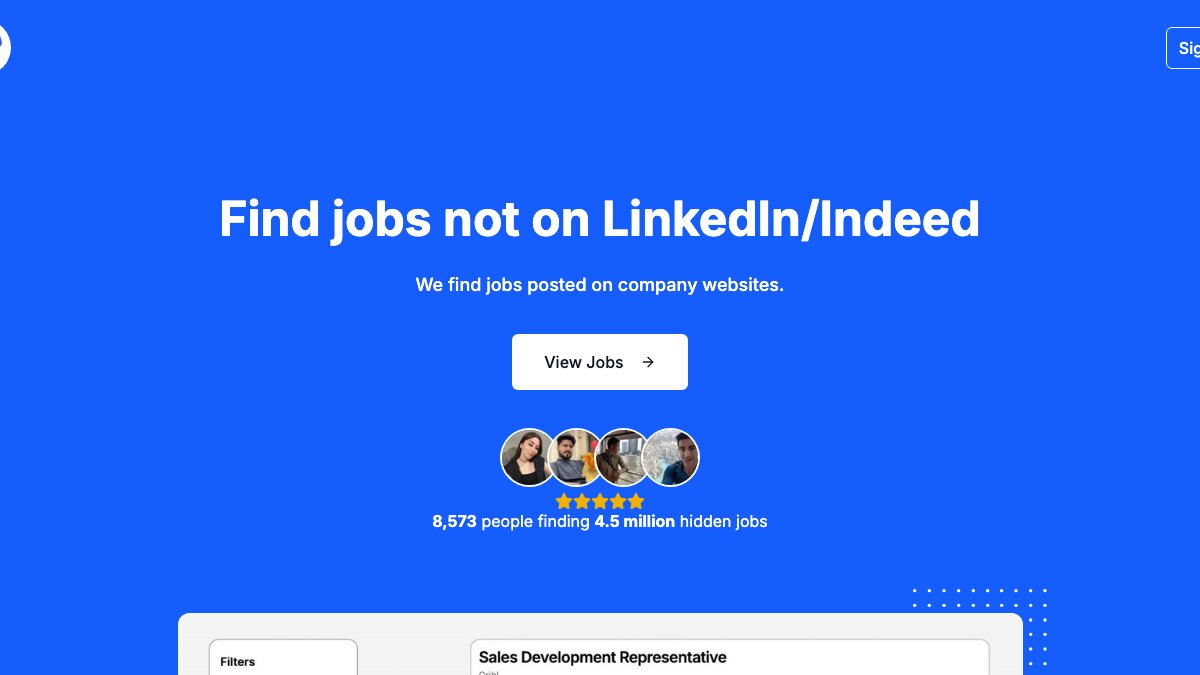
Its homepage is very simple: a sentence "Find jobs not on LinkedIn and Indeed," a line of small text below it saying "We find jobs posted on company websites," plus a "View Jobs" button. The website shows that over 8,500 people are using it to search for 4.5 million "hidden" jobs.
Roman strongly believes in a hard paywall: no free plan. Users either pay $7 a week, $20 a month, or $50 a year.
He is also very clear about the weakness of this business: churn rate is very high, around 31% (he didn't specify the tracking period). "Because we are selling a job-hunting product," naturally, once users find a job, they no longer need it. On average, each user contributes about $50 during their entire lifetime on the site.
Phase 4 · "Timeless" Content and "Content Thrifting"
Since the product itself isn't particularly special, how does Career Hound make money?
Roman says it relies on his ability to "evoke people's emotions and plant ideas in their heads." And this ability can be practiced: "You just have to do a massive amount of research on your niche, and then use the insights from that research to create content."
His entire strategy is built on one concept: there are two types of content, "timely" and "timeless."
- Timely content: trending right now, nobody will care about it a week later. If your distribution system is built on timely content, you will be stuck in the drudgery of constantly chasing trends;
- Timeless content: speaks to an ever-present problem and desire in a specific niche. It works today, and it will still work two years from now.
How do you find timeless content? Roman's method is called "content thrifting": spend hours scrolling through content in your niche on Instagram, Reddit, TikTok. Look at both videos and text, don't just focus on one format. While scrolling, collect everything that catches your attention, "because if it grabbed your attention, there must be something to it."
"If you want to break through in content, you need to spot things that others haven't. And to spot those things, you have to do more research than everyone else. If you scroll enough, you will inevitably notice patterns that others have missed." These recurring patterns are the timeless topics in your niche.
Phase 5 · One Format, Used for Two Years
Roman showed two examples on the show.
The first was a "timely" format: one that everyone is using right now, "people will just swipe past it once they see it enough because they know it's an ad."
The second was the "timeless" format he repeatedly uses: listing a bunch of companies currently hiring for "remote, apply from anywhere globally" positions.
"Everyone is looking for that kind of job that allows them to work remotely and hires worldwide, that's the dream." The video starts with a sentence directly addressing this group of people, then lists a few companies offering this "dream job," and finally ends with: "Want to find more jobs like this, go check out Roman's website."
He says the key to escaping the UGC and content marketing "hamster wheel" is finding formats that convert and can be reused. In the job-hunting niche, people always want to find companies hiring remotely and globally, "so I can use this list format over and over again."
This is also why he says he has "basically been using the exact same playbook for two years." Over the past 30 days, his content reached 11.7 million views across social platforms.
Phase 6 · Hire "Older" People to Film
Roman also makes an unconventional choice: he prefers to hire older creators.
"Every niche is different. In some niches, hiring young people is perfect. But if you're looking for career advice, why would you listen to a 19-year-old? When you see someone older, with some gray hair and a few wrinkles, subconsciously, that is associated with wisdom and credibility."
His method of finding creators is also very simple: you can use creator marketplaces, but most of his creators are people he reached out to individually via DM. He scrolls to find everyday people who post content purely out of interest and simply messages them: "Hey, want to pick up some paid content work?"
The price is extremely low: "In 90% of cases, I don't pay more than $20 per video."
Why can it be so cheap? Because he makes the creators' work incredibly simple: "Absolutely no research needed. They just open their computer, and there is a spreadsheet listing every format, with every step clearly written out." Every time he writes filming instructions, he asks himself: "Have I left anything that could be confusing? Or is it so simple that a dummy could do it?"
"Because of this, I can hand content over to 50-year-olds who have never filmed content in their lives." He manages these creators using WhatsApp.
The host, Gus, summarized: he has scrolled so much, researched so much, "it's almost not guessing anymore."
Phase 7 · $28,000 Revenue, $12,000 MRR
By September 2026, Roman publicly shared Career Hound's numbers:
| Metric | Data |
|---|---|
| Total revenue last month | $28,000 |
| MRR | $12,000 |
| Users | 8,000+ |
| Active subscriptions | 779 |
| Average user LTV | ~$50 |
| Churn rate | ~31% |
| Social views in past 30 days | 11.7 million |
Why is the monthly revenue ($28,000) so much higher than MRR ($12,000)? Roman explained this is because the user base is a mix of yearly, monthly, and weekly plans: annual fees are booked as revenue entirely in the month they are paid, but when calculating MRR, they have to be spread across 12 months.
His tech stack is very lean: Hetzner for servers, Postmark for email marketing, Clarity for website analytics, PostHog for marketing experiments, Shortimize for view tracking, plus Google Workspace and Cloudflare.
His advice for aspiring entrepreneurs is: go to creator marketplaces like Sideshift and see which companies are spending money on creators—if they are willing to spend, it means they are making money. Or use Sensor Tower to find apps getting lots of downloads. Then pick one you like, build a similar product, and use their content as a reference for marketing. "That way, if you don't get paid users, you know the problem isn't the product, it's your execution."
Next, it's about running marketing experiments every day. "You want to pursue failure results, because that's how you rule out what doesn't work and get one step closer to what does. Just like what we used to say in door-to-door sales: with every door I knock on, I'm one step closer to a sale. With every marketing experiment you run, you're one step closer to your first dollar."
Thinking
1. In a Proven Category, Marketing Determines the Winner
Job boards are nothing new, but the demand will always exist. Roman didn't invent anything new; instead, he won in a mature category entirely through marketing.
Choosing a category that has already proven people will pay for it minimizes the "is there a demand for the product" risk, allowing you to focus your energy entirely on how to let people know about you.
2. Finding "Timeless" Content is the Only Way to Escape the Drudgery of Chasing Trends
Chasing trends can bring temporary traffic, but it requires constant chasing. Roman found a format that lasted for two years: "a list of companies hiring remotely and globally." Because it strikes at the ever-present desire of job seekers.
A good content format is like a machine that can be run over and over again.
3. If You Research Enough, It's No Longer Guessing
"Content thrifting" sounds tedious: spending hours scrolling through similar content. But it's exactly this massive amount of research that allows him to spot patterns others can't see. The masters of content marketing are rarely the ones with the most inspiration, but the ones who do the most research.
4. Make the Creator's Job "Idiot-Proof"
$20 per video, allowing ordinary 50-year-olds to film it—this relies on extremely detailed filming instructions. When you lower the barrier for creators to the absolute minimum, you can produce content at scale for a very low cost.
5. Understand the Weakness of the Business
A 31% churn rate means users leave as soon as they find a job. This kind of product must constantly acquire new users; if marketing stops, revenue drops. In a high-churn business, marketing capability is the lifeline.
Action
Step 1: Find a "Proven" Category (1 week) Go to creator platforms like Sideshift to see which companies are spending money on creators, or use Sensor Tower to find highly downloaded apps. Pick one that interests you.
Step 2: Build a Similar Product, or Find a Technical Partner If you are non-technical, find a technical partner like Roman did; the product doesn't need to be complex, as long as it solves a clear problem.
Step 3: Set Up a Hard Paywall and Test Pricing You can reference Roman's pricing: weekly, monthly, and yearly tiers. Observe the conversion rate and churn rate.
Step 4: Spend 1-2 Hours a Day "Content Thrifting" Scroll through content in your niche on Instagram, Reddit, TikTok. Collect everything that catches your attention, and identify recurring patterns and "timeless" topics.
Step 5: Design 2-3 Reusable Video Formats Each format should have a clear hook, content structure, and a call-to-action at the end. Write it out as idiot-proof filming instructions.
Step 6: DM Everyday People to Be Creators Find people who post content purely out of interest. Choose the right age and appearance based on your target audience, and aim to keep the pay around $20 per video.
Step 7: Run Marketing Experiments Daily, Record Every Failure Use tools like PostHog and Shortimize to track performance. Treat every failure as "knocking on a door," bringing you one step closer to success.
Not for you, if:
- You are not willing to spend a lot of time every day researching content and scrolling through similar videos;
- You are not good at, nor do you want to learn, how to manage a group of creators;
- You cannot accept a high churn rate and hope users will stick around long-term;
- You have no technical skills and cannot find a reliable technical partner.