He Ran Up $30K in Credit Card Debt Making a Scratch-Off Date Book: After a Failed Kickstarter, a $50 Ad Took Off, Passing $100M in Cumulative Sales in a Little Over Three Years
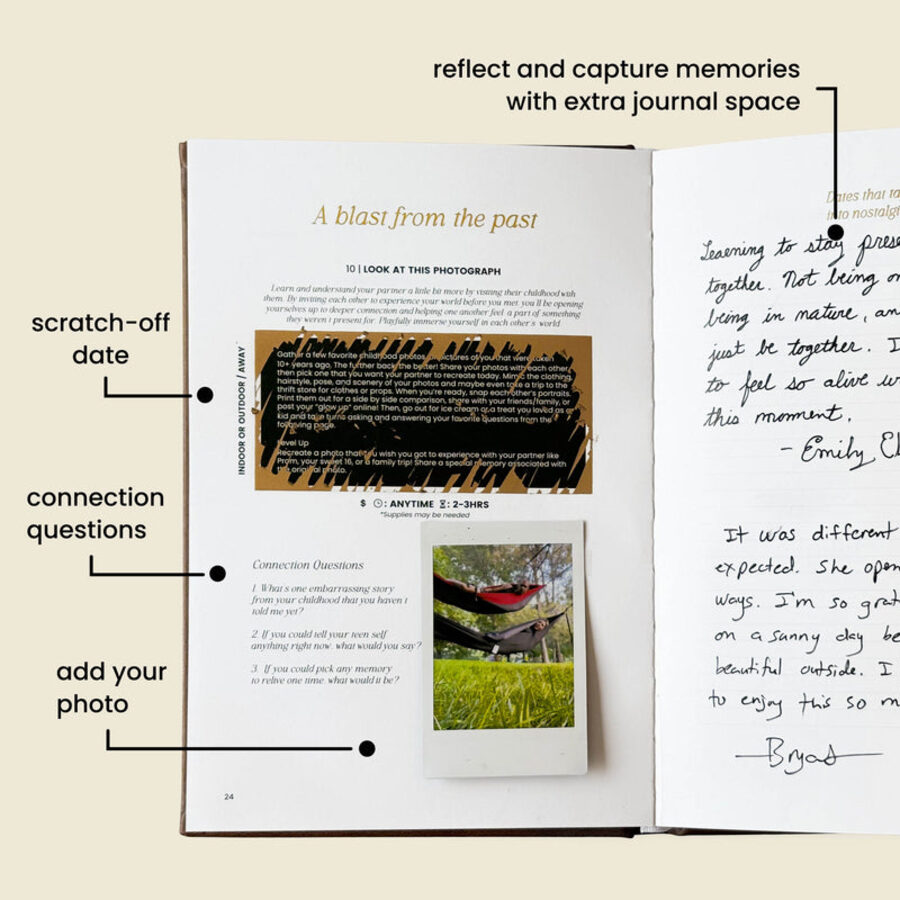
Bryant Ellis grew up in Oklahoma, one of six kids, homeschooled; he spent three years at a ministry school, worked as a creative director at a church in San Francisco, chased acting in Los Angeles for a year, then returned to the small California city of Redding for acting school. In April 2018, he started prototyping a scratch-off date book: each date idea is hidden under a lottery-style scratch-off coating, you scratch to find out what to do, then add a photo next to it. Over six-plus months of prototyping he maxed out credit cards, ran up about $30,000 in debt and nearly had his car repossessed. His Kickstarter raised only about $2,000 and failed; investors offered $20,000 for 40% and all veto power, and he said no. Then his boss at the time, Ben Day, paid $40,000 for 30% of the company. Bryant paid $50 to have two people act out a date and filmed an ad on his iPhone; four or five versions of the copy flopped until he cut it down to 'Best date idea ever,' and it finally sold. Per a ShipBob case study, the company made over $250,000 in its first quarter, $6 million in its first year and $80 million in sales in 2021, with about 100 employees; in 2022 Bryant said cumulative sales had passed $100 million. When e-commerce cooled in 2023, the company laid off about 35 people.
Process
To be clear up front: by 2021, The Adventure Challenge had about 100 employees, far beyond a "one-to-three-person team." Its startup money didn't come only from the founder either: co-founder Ben Day put in $40,000, and the company later used inventory financing. It's included because of how ordinary its start was: a young man in credit card debt, a scratch-off idea and a $50 ad.
Stage 1: A Young Man Whose Acting Dream Didn't Pan Out
Bryant Ellis grew up in Oklahoma, the second of six kids. His father was a pastor, and his mother homeschooled all of them. He was doing business early: he'd land a lawn-mowing job for $50, pay a friend $30 to do it and keep $20.
His original dream was to become an Air Force pararescue specialist. He passed the fitness test but fell three points short on the military entrance exam. Rather than wait months at home to retake it, he went to Redding, California, spent three years at Bethel's ministry school, worked two years as a creative director at a church in San Francisco, chased acting in Los Angeles for a year, and finally returned to Redding for a year at the Bethel Conservatory of the Arts (BCA). He later said that's where he met his future business partner, Ben Day.
After acting school, he started thinking about how to make some "passive income."
Stage 2: A Scratch-Off Date Book and $30,000 in Credit Card Debt
The idea came casually. He wanted to create a game that would give friends something more fun than board games when they hung out. The more he worked on it, the more a voice in his gut said: "This is going to be a multi-million dollar company." He told a few friends; they thought he was crazy.
On April 2, 2018, he started making prototypes. The product was a scratch-off adventure book: dozens of date ideas, each hidden under lottery-ticket-style scratch-off coating, so you only find out what to do when you scratch it; afterward you add an instant photo next to it, and the book becomes a scrapbook. Half the ideas came from his own dates, like a winter date on a giant king-size air mattress floating on the water; the other half were concepts he thought would be fun.
He had no idea how to make prototypes, "just a lot of stumbling in the dark," and it took six or seven months. Along the way, he maxed out his credit cards, paying rent with them and using credit cards to pay off credit cards, until he owed about $30,000. The repo company was looking for his car, so he hid it; his landlord was starting to kick him out.
He was too embarrassed to tell people what he was doing: "I didn't want to tell him I'm making a scratch off activity book because it just sounded so dumb."
Stage 3: A Failed Kickstarter, and Investors Weren't Sold
He launched a Kickstarter with a $10,000 goal. He made up the price on the spot: "How much of the books be? Maybe $25." He had no idea what a book cost to make.
After it launched, he prayed on his knees every day and refreshed the page every 10 minutes. The campaign failed, raising only about $2,000 (in another interview he said he sold maybe 20 books).
Looking back, he's grateful: "Had that Kickstarter gone viral I would have lost everything." His pricing was wrong: he was charging twenty-something dollars a book, the manufacturer was going to charge $18 to $20 a book, and he had no operations to handle a flood of orders.
Fundraising didn't go well either. A multimillionaire friend told him: "It needs to be an app. If it's not an app it's going to fail." When some investors finally agreed to talk, their terms were $20,000 for 40% of the company, plus all of his veto power, "because you don't have any business experience, we want to run the company." He nearly said yes.
Stage 4: Working for His Boss, Who Became His Partner
To stay afloat, Bryant messaged his friend Ben Day asking for a job. Ben ran a debt relief company in Redding, Fresh Start Debt Relief, with three or four salespeople. Bryant said: "Let me work for you for a year. I'm going to save up money and then I'm going to leave so I can make this book." So he made sales calls and worked on the book between calls.
When Ben's assistant heard about the investors' terms, she asked him: "Why don't you just ask Ben? He's your friend and he's got some money." So Bryant asked. Ben said yes on the spot, and they wrote up a contract right there: Ben paid $40,000 for 30% of the company.
Their personalities complemented each other. Bryant calls himself "ready, fire, aim," sometimes without the ready; Ben is "ready, ready, ready, aim five more times, fire," the kind of person who walks into a room and immediately spots 10 things he doesn't like. "Him alone probably doesn't get a lot done, me alone puts a lot of crap into the world," Bryant said. "So I think together it's a really good combination." They had plenty of fights and eventually even went to couples counseling together to learn how to handle conflict.
Stage 5: A $50 Ad
In September 2018, Bryant registered the company. Back then, many brands spent $10,000 to $20,000 on polished commercials that didn't work. Bryant's thinking was the opposite: "We just need an iPhone."
He paid $50 to hire two people to act out one of the dates from the book: making an apple pie together, with one of them blindfolded. He filmed it on his iPhone, edited it himself in iMovie, and handed it to Ben to test ad copy.
The first copy was long: "This is the best date idea ever, your significant other will love you if you get this..." Nobody bought. They tried another version; nobody bought. After four or five attempts, Bryant said: just write "Best date idea ever." That ad sold, and by his recollection it brought in the company's first million-plus dollars.
His takeaway: don't overcomplicate ads; "quickly showing people pain and solution, that's it. Date night's hard, this fixes it. Your girl wants to spend more time with you, this fixes it."
Stage 6: Ben Shuts Down His Company and Everyone Switches Over
Just as the ads started making money, Ben's debt relief company hit a wall. It wasn't making sales, and Ben even had to borrow money from The Adventure Challenge to pay his employees.
Bryant asked him: "What do you think about shutting down your company and then we do this full-time, and all of your employees become Adventure Challenge employees?" Ben put his headphones in, went for a walk and came back an hour later: "Let's do it."
That was October 2018. They tore down the office cubicles and put in hammocks, couches and beanbags. As of 2024, some of Ben's original employees still worked at The Adventure Challenge.
At first they shipped orders themselves, loading thousands of books into rented U-Haul trucks and making endless trips between a storage unit and the post office. According to the ShipBob case study, the company made over $250,000 in its first quarter and $6 million in its first year, and then handed warehousing and shipping to ShipBob.
Stage 7: The Pandemic, Viral Videos and $100 Million in Sales
Then came the 2020 pandemic. The company's COO said it actually helped: families and couples stuck at home got stir-crazy and went looking for new things to do, and sales surged.
Ads stayed at the core of growth. Bryant said about 80% of revenue came from ad videos on Facebook, Instagram, TikTok and Google. Their most viral video got more than 100 million views; he came up with the idea while scrolling on his phone on the toilet. The company's Instagram account eventually neared a million followers. They also appeared on TV, including QVC, and in 2022 on The Ellen Show, but Bryant said TV exposure was just "a little kick in the pants"; what sustained the business was consistently pushing out content.
The product line grew: editions for couples, families, friends, kids and solo, plus a bedroom edition designed with sex psychologists and relationship counselors. By 2022, about 15 people worked on product development, and every new idea was tested with focus groups of 100 or more people.
According to the ShipBob case study, the company had $80 million in sales in 2021, 1,233% growth over three years, about 100 employees, about a quarter of orders shipped outside the US, and had started selling through retailers such as Kohl's. In June 2022, Bryant said on a podcast that 2021 sales were about $77 million, cumulative sales had passed $100 million, and the company had about 115 employees. The same year, he was named to Forbes 30 Under 30. In 2023, the company ranked #719 on the Inc. 5000 list of fastest-growing companies.
To stock up before peak season, the company also used the inventory financing platform Kickfurther, which says it provided over $800,000 across five inventory deals for The Adventure Challenge, without the company giving up equity.
Stage 8: Handing Off the CEO Role, and the 2023 Downturn
Bryant was CEO for about three years and then burned out. Operations weren't his strength, he said; he was better at ideas and vision. So he handed the CEO role to Ben and became chairman, moved to San Diego to surf, and came back to Redding for about a week each month to meet with the team and brainstorm. He says he was financially free at 28.
The good times didn't last forever. In February 2024, Bryant said on a local podcast: "The first few years we were so profitable, millions of dollars profit." But e-commerce cooled across the board in 2023. The company roughly broke even and had to lay off about 35 people, going from about 110 employees to about 60. Many of his friends' e-commerce companies went out of business, he said; The Adventure Challenge at least stayed afloat.
He also turned his view of failure into a book, Hello, My Name Is Failure, made up of 35 "letters from failure."
Thinking
1. A product that's easy to understand is easier to sell than a complicated one. A scratch-off date book can be explained in one sentence: scratch a square and go on the date it describes. It turns the small hassle of "what should we do tonight" into a little game with built-in anticipation.
2. A failed crowdfunding campaign isn't necessarily bad. Bryant's Kickstarter was priced wrong and had no supply chain behind it. If it had taken off, he might have been unable to deliver and lost everything. The failure gave him time to get costs and operations right.
3. Be careful with early funding terms. $20,000 for 40% plus all veto power is tempting to a founder who can't pay rent. He turned it down and found a partner who understood him better, on better terms. Early equity and control are hard to get back once given away.
4. The key to ads is testing, not budget. A $50 iPhone ad went through four or five rounds of copy before landing on "Best date idea ever." Later they spent $200,000 on a commercial that worked and $100,000 on one that earned nothing. Expensive doesn't mean effective; testing finds the version that works.
5. Partners should complement each other, and learn how to fight. One impulsive, one a perfectionist: efficient together, but full of conflict. Bryant says learning to handle conflict was the most important lesson of the partnership: assume the other person meant well, then talk it through.
6. An ad-dependent business needs to be ready for a downturn. With 80% of revenue from paid ads, the business could scale fast during the pandemic, but when e-commerce cooled and ad costs rose, margins thinned quickly. The 2023 layoffs show that even fast-growing businesses need a buffer.
Action
1. Turn an everyday hassle into a product. Think about situations where people never know what to do: date night, family weekends, hanging out with friends, keeping kids busy. Can you turn the choice into a fun little game?
2. Know your costs before you prototype. Before crowdfunding or presales, get quotes for manufacturing, shipping and platform fees, and make sure your price covers costs with margin left over.
3. Shoot your first ad on a phone. You don't need to hire a crew. Have two friends act out how your product is used, film it on your phone and edit it yourself. Focus on quickly showing pain plus solution.
4. Test several versions of the copy on the same video. Before swapping footage, try different headlines and copy. Sometimes one shorter, more direct line completely changes your conversion rate.
5. When raising money, look hard at control. Don't just look at how much money you'd get; look at how much equity they want, whether they want veto power and whether they'd interfere with running the business. If the terms aren't right, keep looking for a better partner.
6. Keep cash and a fallback even while growing. If your business depends heavily on ads, watch ad costs and margins closely; consider inventory financing that doesn't cost equity to stock up before peak season, and leave room for slow seasons and industry downturns.