They Farm 1.5 Acres With No Tractor — and Sell $140,000 of Vegetables a Year at Roughly 45% Profit
Jean-Martin Fortier and Maude-Hélène Desroches turned 1.5 acres in Saint-Armand, Quebec into Les Jardins de la Grelinette, a micro-farm that grosses more than $140,000 a year at roughly a 45% net margin — without a tractor. Working mostly by hand with a broadfork and a walk-behind, using no-till methods and standardized permanent beds, the couple sells almost everything direct: a 140-family CSA plus two farmers' markets and a few restaurants. They started in 2004 with little capital on leased land, and Jean-Martin turned the method into a bestselling how-to book, The Market Gardener. The path is deliberately replicable — small, intensive, and sold direct.
Process
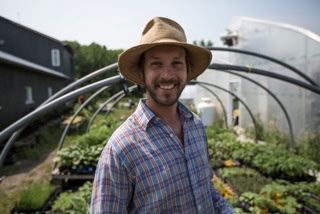
Jean-Martin Fortier and Maude-Hélène Desroches — a couple in Saint-Armand, Quebec — turned 1.5 acres into Les Jardins de la Grelinette, a micro-farm that grosses more than $140,000 a year at roughly a 45% net margin — without a tractor. They sell almost everything direct, to a 140-family CSA plus two farmers' markets, and they did it starting with little capital. Small wasn't a compromise — it was the whole strategy.
Stage 1 — From working others' farms to a leap of their own: starting on leased land in 2004
Jean-Martin and Maude-Hélène didn't come from farming money. After traveling and working on organic farms abroad, they came home to Quebec wanting to grow food for a living — not on a big industrial scale, but on a plot small enough to run by hand. In 2004 they founded Les Jardins de la Grelinette in Saint-Armand, starting with little capital on land they didn't even own at first. The bet was radical for its time: that 1.5 acres, worked intensively and intelligently, could support a family — no investors, no inherited estate, no giant tractor.
Stage 2 — The constraint that became the strategy: 1.5 acres, no tractor
Most farms try to get bigger; the Grelinette deliberately stayed small. Of about 10 acres, only 1.5 are kept in intensive production, divided into standardized permanent beds the same size everywhere so that tools, timing and planting all repeat. Instead of a tractor, they work with a broadfork (la grelinette), a two-wheel walk-behind tractor, and hand tools, using no-till methods that protect the soil and skip expensive machinery. Small scale wasn't a limitation to overcome — it was the whole point. Less land meant lower costs, less debt, and a system one couple could actually run and perfect, season after season.
Stage 3 — Sell direct, capture the whole margin: a 140-family CSA
Here's the part most growers miss: the Grelinette doesn't sell wholesale. Almost everything is sold direct — through a 140-family CSA (members pay up front for a weekly box all season), plus two farmers' markets near Montreal and a handful of restaurants. Selling direct means they keep the markup a distributor or grocery chain would otherwise take, which is exactly how a tiny farm clears a big margin. The result: more than $140,000 in annual sales at roughly a 45% net margin — on a plot smaller than many suburban backyards, often quoted at around $100,000 per acre in production.
Stage 4 — Turn the method into a second business: The Market Gardener
Fortier didn't keep the playbook secret. He wrote it down — The Market Gardener (originally Le jardinier-maraîcher, 2012/2014) — a practical, numbers-first manual that became an international bestseller and turned him into the figurehead of a whole "micro-farming" movement. The book, courses, and later projects became a second income stream layered on top of the farm itself, and proved the deepest point: a small farm run as a real, profitable business — and documented openly — is something thousands of others can copy. The constraint, the directness, and the transparency were the whole model.
"Growing better, not bigger." — Jean-Martin Fortier, founder of Les Jardins de la Grelinette and author of The Market Gardener
Source: The Market Gardener (book) · Les Jardins de la Grelinette · public interviews
Thinking
Insight 1: Small is a strategy, not a compromise
Most people assume more land means more money. The Grelinette proves the opposite can be true: 1.5 acres is small enough for one couple to truly master and optimize, season after season. Choose a scale you can actually run well, not the biggest one you can finance.
Insight 2: Skip the big machine — build a system instead
No tractor, no giant loan. Standardized permanent beds, no-till soil, a broadfork and a walk-behind turn the farm into a repeatable process, not a capital sink. The system — not the machinery — is what makes the work efficient and the books healthy.
Insight 3: Sell direct and you keep the whole margin
A distributor or supermarket eats most of a farm's markup. By selling through a CSA and farmers' markets, the Grelinette keeps that money — which is how 1.5 acres clears a 45% net margin. Own the customer relationship and you own the profit.
Insight 4: Yield per unit beats sheer size
The number that matters isn't acres farmed; it's dollars per acre — around $100,000 here. Optimizing density, succession and turnover on a small plot can out-earn spreading thin over a big one. Measure output per bed, not land owned.
Insight 5: Turn the method into a second income — and let transparency be the moat
Fortier wrote down exactly how the farm works and sold it as The Market Gardener. Far from giving away the edge, documenting the system openly built a second business — book, courses, a movement. A repeatable, transparent method is worth more shared than hidden.
Action
Step 1: Start small — even on leased land — at a scale you can run by hand
Don't wait to buy a farm. Begin with a small plot, rented if needed, sized so one or two people can manage it well. The Grelinette started on land it didn't own, on 1.5 acres.
Step 2: Build standardized permanent beds and skip the tractor
Lay out uniform, permanent beds and work them with a broadfork, a walk-behind, and hand tools using no-till methods. Standardization makes every task repeatable; skipping big machinery keeps you out of debt.
Step 3: Line up direct sales before you plant — a CSA and a market stall
Don't grow first and hope to sell. Pre-sell a CSA (customers pay up front) and book a farmers' market, so demand and cash come before the harvest and you keep the full margin.
Step 4: Track dollars per bed, then raise density and turnover
Measure output per bed, not just total yield. Push succession planting and faster turnover on your best beds to lift dollars per acre — that's where a small farm's real income lives.
Step 5: Once it works, write it down and teach it as a second income
When your system is repeatable, package it — a book, a course, a channel. Fortier turned his playbook into a bestseller; documenting openly built income and an audience on top of the farm.
Not for you if: you can't handle outdoor physical work and long seasonal hours; you want fast money (farming compounds season by season); or you won't do direct sales and face customers yourself.