A Couple Started Selling Political Bumper Stickers Online from Their Basement: From 'the Amazon of Stickers' to Custom Printing, 21 Years Without Outside Funding, Then Sold to a Label Group at About $30M in Annual Sales
After the 2000 US presidential election, John Fischer, who had worked in print sales and internet marketing, and his wife started selling a political bumper sticker online from their basement in Colorado. After several thousand sales, they realized they had 'an actual business.' StickerGiant first aimed to be 'the Amazon of stickers,' and in 2012 its store still stocked more than 20,000 ready-made bumper stickers; but more and more customers wanted their own stickers printed, and in 2010 the company became a custom sticker and label manufacturer. Nearly all its traffic came from web searches; it used open-book management so every employee saw the financials each week, and it rolled 171,466 stickers into a Guinness World Record sticker ball. Forbes reported $10.2 million in revenue and 39 employees in 2017; by 2021 it expected $32 million in sales with about 100 employees. John says he never raised money. In September 2021, it was acquired by private-equity-backed Resource Label Group on undisclosed terms. It was long past being a small team, but it started with a couple and a basement.
Process
To be clear up front: by the time StickerGiant was acquired, it had about 100 employees, far beyond a "one-to-three-person team." It's included here because of where it started: a couple, a basement and a bumper sticker, and 21 years without outside funding. This is the story of how one bumper sticker grew, step by step, into a printing plant.
Stage 1: One Political Bumper Sticker Turned into a Business
The 2000 US presidential election between George W. Bush and Al Gore came down to a recount dispute that dragged on for more than a month. Afterward, John Fischer in Colorado made a bumper sticker that read "He's Not My President" and put it up for sale online.
It sold several thousand copies. John later recalled: "I started StickerGiant 17/18 years ago in my basement with my wife, and we just started selling political bumper stickers online and one day we realized: 'we have an actual business.'"
He had the background for it. He studied commercial art and earned a commercial art degree, then worked for printing companies selling printing to ad agencies and doing retouching, "way back in the day before the Internet." When the internet arrived, he moved into internet marketing at an ad agency, where he "helped build some of the very first websites that did anything." Printing and the web: both sets of experience came into play.
So StickerGiant set itself an ambitious goal: to be "the Amazon of stickers."
Stage 2: "The Amazon of Stickers," in a Town Called Hygiene
The company eventually moved out of the basement to a small town in rural Boulder County called Hygiene. The company joked about the name itself: "yes, they've heard the jokes."
It sold all kinds of ready-made stickers online. By 2012, its description said it had more than 20,000 bumper stickers, political stickers and funny stickers in stock, shipped daily from its warehouse in Hygiene, and called itself "the largest sticker store on the internet." Its pitch was blunt: "Liberal or Conservative, Christian or Atheist, Leno or Letterman, Regular or Diet. We take you as you are. Just peel it, stick it, and tell the world about it."
It also learned early to market through communities. Since 2008, StickerGiant has provided free stickers for WordCamps (WordPress community conferences) around the world, "because they too use and love WordPress." Developers and geeks love covering their laptops in stickers, and they're exactly the kind of customers who order online.
Stage 3: Customers Didn't Want Ready-Made Stickers; They Wanted Their Own
During the years of selling ready-made stickers, more and more customers asked the same question: can you print stickers of my own design?
In the company's words: "Over the years, customers started asking StickerGiant to have their own custom stickers printed. In 2010, the company transitioned to manufacturer and printer of custom stickers with the goal of providing premium quality stickers, fast turnaround and excellent customer service."
This was the most important turn in the whole story. Selling ready-made stickers made it an online store; printing custom stickers made it a factory. Ready-made stickers sell one at a time; custom stickers come order by order: craft breweries need beer labels, bands need merch, companies want logo stickers, food brands need packaging labels.
The shift didn't happen overnight; in 2012 the store and custom printing still existed side by side. Over time, StickerGiant became a manufacturer focused on custom stickers and product labels, running HP Indigo digital presses. In 2019, a team member said these machines cost "nearly a million dollars," and press operators first serve an apprenticeship before the company pays to send them to Alpharetta, Georgia, for three levels of training.
Its traffic depended almost entirely on search. In 2020, its marketing director said: "All our traffic comes from web searches and we've always been e-commerce driven." That also meant risk: a 2020 interview was titled "How a Panda & Penguin nearly put this Giant out of Business." Panda and Penguin were Google search algorithm updates in 2011 and 2012 that hit many search-dependent websites. But the interview page has no transcript, so this article can't verify the details.
Stage 4: Teaching Every Employee to Read the Books
In 2012, John's business partner and friend Bill Flagg introduced him to open-book management. The method comes from books such as Jack Stack's The Great Game of Business, and rests on three rules: teach every employee the numbers that measure the company's success; expect and enable everyone to use that knowledge to improve performance; and give everyone a stake in the company's success (and the risk of failure). Bill had also gone to Zingerman's deli in Ann Arbor, Michigan, to learn the system.
In 2014, StickerGiant described its approach on its blog:
- The full staff of 16 met once a week for a "Huddle" to share the financial dashboard and tell the stories behind the numbers;
- 20% of the time went to what happened, 80% to how to improve the next week's results;
- Each line of the financials was "owned" by an employee who handled that area in their daily role;
- The team planned and forecast together, and if it beat the plan, a share of the gain was split equally among employees;
- There were also "mini-games": the team picked a process to improve, calculated the value of improving it, and if it succeeded, employees shared in the benefit.
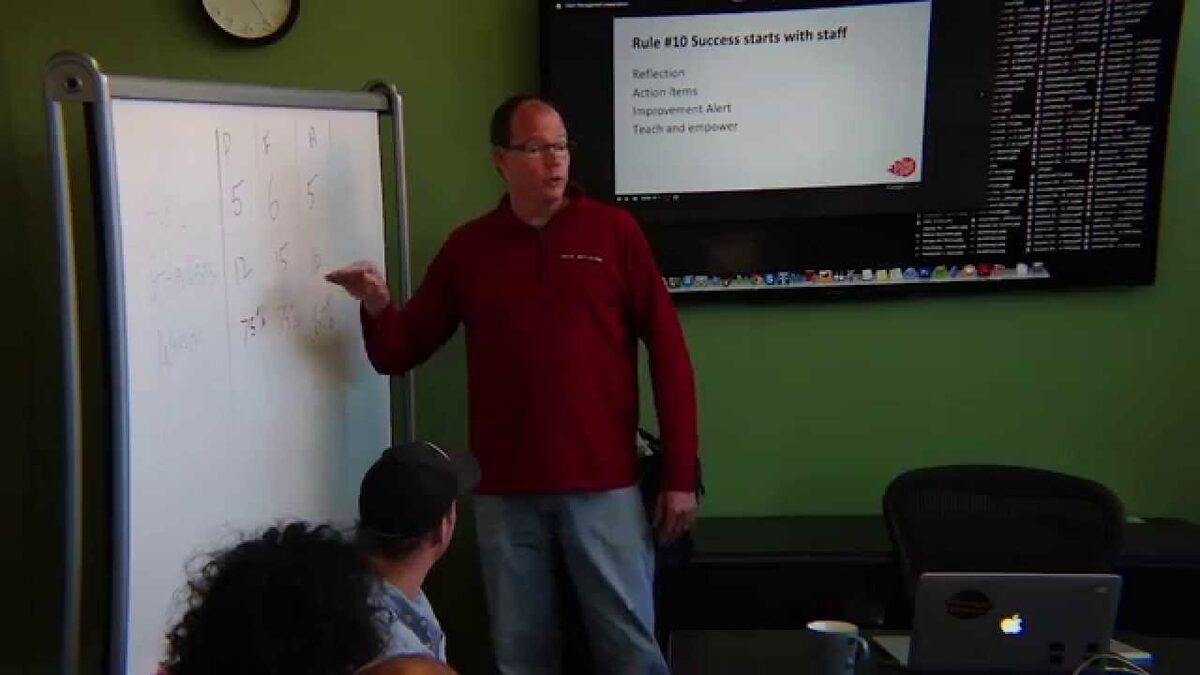
The practice stuck. By 2019, the company had more than 60 people and still spent 30 minutes every Tuesday reporting key metrics and revenue to the whole company. One manager said getting 60-plus people together for 30 minutes at a manufacturer is "a trick," and that owners of other manufacturing companies who visited asked only one question: do you pay everybody to be there? The answer: yes.
Stage 5: A 231.6-Pound Sticker Ball
StickerGiant also came up with a marketing idea: working with National Day Calendar, it created National Sticker Day on January 13 each year, with the first one on January 13, 2016. The date is the birthday of Ray Stanton Avery, who invented the first commercially available self-adhesive label and founded the label giant Avery Dennison.
To celebrate the first National Sticker Day, employees started rolling a sticker ball they named Saul. Work began on November 3, 2015, and at first it was far too slow, about 10 pounds in a week. Then employees took Saul home on weekends with boxes of stickers, and teams of three competed to add the most weight. Once the ball passed 100 pounds, whichever side it rested on overnight would flatten slightly, so everyone took turns rolling it several times a day to keep it round.
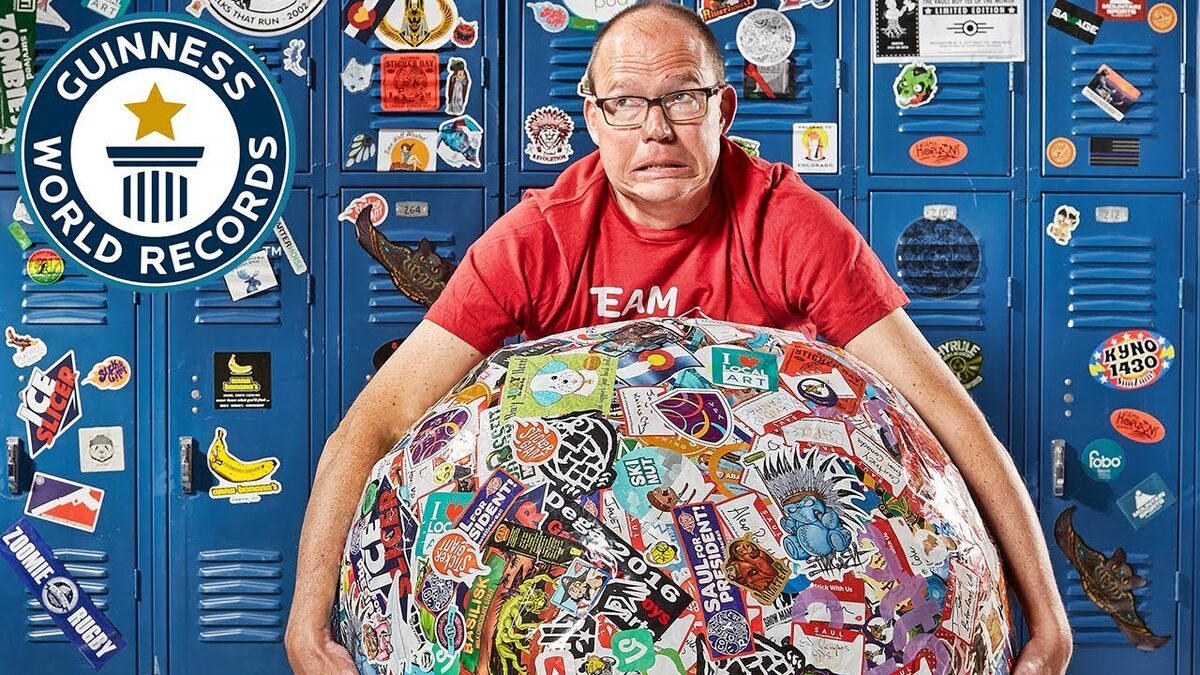
On January 13, 2016, at Wibby Brewing in Longmont, with about 100 people watching and the mayor of Longmont among the witnesses, Saul officially weighed in at 231.6 pounds with 171,466 stickers, setting the Guinness World Record for the largest sticker ball. It later appeared in the 2018 edition of Guinness World Records.
A ball of stickers put a sticker company on Denver TV news and made it a Longmont attraction. The same year, the company moved from Hygiene to a larger facility in Longmont.
Stage 6: A Forbes Small Giant, Then an Acquisition
Forbes' May 16, 2017 issue named 25 "Small Giants," honoring companies that favor greatness over growth. StickerGiant made the list with $10.2 million in revenue and 39 employees. In the feature, John called the company "a customer-acquisition machine": machine operators met weekly with a goal of landing 400 new customers a week.
That same year, Beth A. Smith joined as COO. The company ran on the EOS management system, with John as "Visionary" and Smith as "Integrator" running day-to-day operations. In a 2019 talk, John said: "I never did the I'm gonna raise money thing." The company had about $25 million in sales in what he described as a $52 billion global market.
From 2018 to 2020, StickerGiant made the Inc. 5000 list of fastest-growing companies three years running. During the 2020 pandemic, hand sanitizer and disinfectant products needed huge numbers of labels, and the company's focus shifted from an even split between stickers and labels to mostly labels. It kept its advertising budget, grew from about 79 employees at the start of the year to 99, and was named Colorado Manufacturer of the Year.
In April 2021, Smith became CEO. According to BizWest, annual sales grew from $12 million in 2017, when Smith joined, to an expected $32 million in 2021.
On September 17, 2021, Resource Label Group, headquartered in Franklin, Tennessee, announced a definitive agreement to acquire StickerGiant, its 20th acquisition, on undisclosed terms. Resource Label Group is backed by private equity. The press release called StickerGiant "one of the first online sticker companies" and said most orders are produced within 24 to 48 hours. John said he was thrilled to have StickerGiant join Resource Label "to continue the growth of the company." Smith noted the step came during the month the company was celebrating its 21st year.
Thinking
1. A small business can start from a news moment, but it can't stop there. "He's Not My President" caught the mood of the 2000 election and sold several thousand copies. But news moments pass. StickerGiant survived because John saw in those few thousand stickers a bigger business: selling stickers online.
2. The best pivot is toward what customers keep asking for. StickerGiant didn't decide out of nowhere to do custom printing; customers kept asking, "Can you print my own stickers?" Ready-made stickers mean stocking inventory and chasing designs; custom printing means producing after the order comes in, and every customer has their own reason to come back.
3. Arriving early and having the right background are real advantages. Selling stickers online in 2000, with experience in both printing and internet marketing, John had a rare combination at the time. Nearly all its traffic came from search, the result of that early head start, but it also shows how heavily it depended on Google: a single algorithm update could do serious damage.
4. Even manufacturers can win attention with marketing. Stickers are an unglamorous business, but National Sticker Day and Saul the sticker ball got StickerGiant onto TV and into Guinness World Records. These ideas were cheap, yet they tied the brand to the sticker category itself.
5. Open books get employees thinking like owners. When every employee understands revenue, costs and profit and shares in gains above plan, they have a reason to improve their own area. StickerGiant kept its weekly all-hands look at the numbers as it grew from a dozen-plus people to around a hundred.
6. You can grow big without funding, but you have to accept slow. From 2000 to 2017, it took StickerGiant 17 years to reach $10 million in revenue. Bootstrapping means growth rolls forward on profits, but the founder stays in control and can decide when and how to exit.
Action
1. Test with one small, specific product. A bumper sticker, a sticker design, a small item: put it online and see whether people buy. If you sell a few thousand, you have the start of a business.
2. Pay attention to the questions customers keep asking. If many customers ask "Can you customize this?" or "Do you have other designs?", that may be your next direction. Write the questions down and see which needs come up most.
3. Invest in search early, but don't rely on one channel. Build a good website so customers can find you through search. But also build other channels, such as community sponsorships, repeat customers and an email list, so one algorithm update can't swing your business.
4. Find a marketing idea that travels. Think about whether your category has a day to celebrate, a record to attempt or a story to tell. StickerGiant used a sticker ball and a holiday to make an unglamorous business fun.
5. Share the numbers with your team from the start. Even with a few people, spend a little time each week looking at revenue, costs and profit together, so everyone knows which number they can move. When you beat the target, share the results.
6. Grow on profits. If you don't plan to raise money, keep each investment within what your profits can bear. Validate demand with small equipment and a small space first, and invest in bigger machines and facilities once orders are steady.