Pets Painted Like Old Masters, 3 Million Portraits Made: How a Hunger Games Songwriter Built the AI Portrait Business Fable Inside a 17th-Century Fortress
Damian Ardestani was born in Tehran in 1985 and makes music as XOV; his song 'Animal' was picked by Lorde for The Hunger Games: Mockingjay – Part 1 soundtrack, and his recordings have passed 100 million streams. He also co-founded the humanitarian group I AM YOU, coordinating over 1,000 volunteers in refugee crises. His creative house Surrealium works out of a 17th-century sea fortress in the Stockholm archipelago, making jewelry, couture and art. Its product Fable uses proprietary AI to turn uploaded photos of pets, people or families into Renaissance, Baroque, Rococo and other old-master styles: preview free, then pay for a download (from $29) or order fine-art prints (from $89) and canvases. The site says 3M+ portraits have been created for customers in 88 countries, with a 4.5 Trustpilot rating. The widely repeated '$100K a month' figure has no public source; the company hasn't disclosed revenue.
Process
Deep in the Stockholm archipelago stands a 17th-century sea fortress: Vaxholm Fortress. Centuries ago, soldiers kept watch over the Baltic here for enemy ships.
Today, a 1600s guard post inside the fortress has been turned into a studio, with a jewelry workshop, a 3D lab and a tech lab. Its owner is a musician who once wrote a song for a Hunger Games film soundtrack.
One of the businesses he runs from here paints your cat or dog as a Renaissance aristocrat.
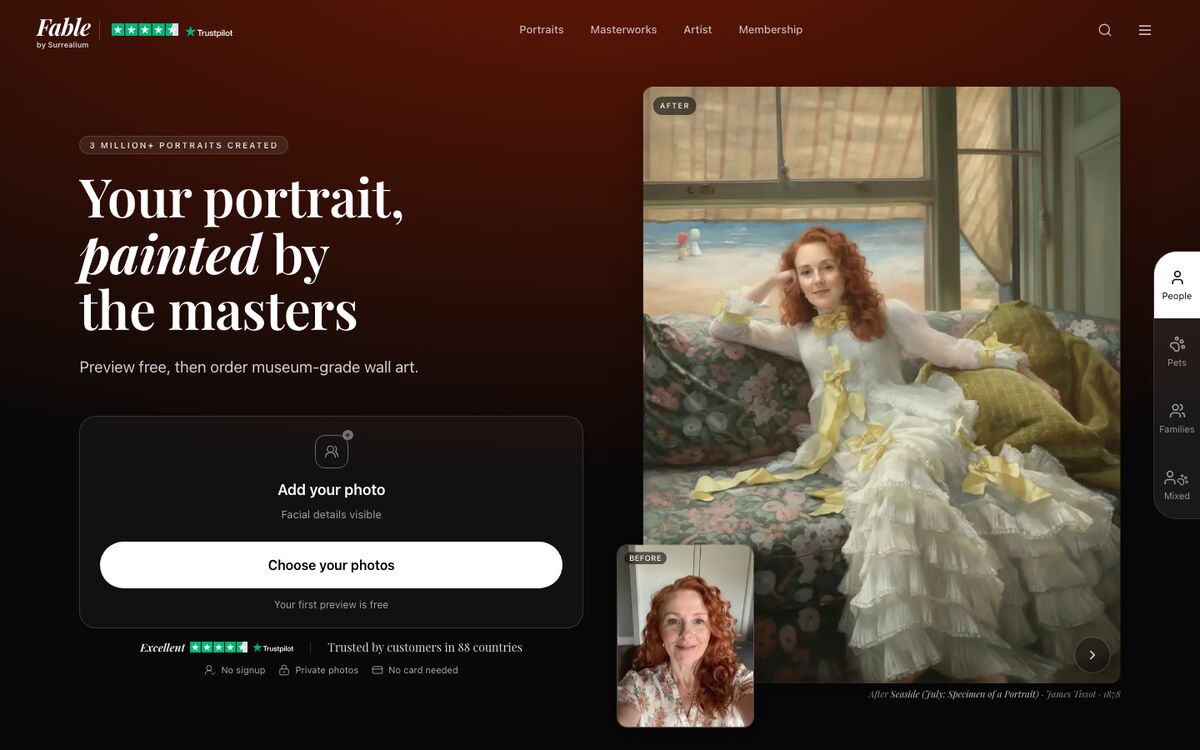
The service is called Fable. You upload a photo of your pet, and about a minute later it becomes a Baroque-style painting: the dog in a gold-braided military jacket, the cat in a pearl necklace, with classical court drapery behind. The site says Fable has created more than 3 million such portraits for customers in 88 countries.
First, one thing to be clear about: the claim circulating online that Fable makes "$100K a month" has no public source we could find, and the company has never disclosed revenue. So this piece won't talk about how much it earns — only how it works, because the approach itself is well worth studying.
Phase 1 · A musician from Tehran to Stockholm (1985–2015)
The person behind Fable is Damian Ardestani, born in Tehran, Iran, in 1985, who later settled in Sweden.
He is first of all a musician, performing as XOV. His songs are mostly about "suffering, longing, hope and despair." Lorde selected his song "Animal" for the soundtrack of The Hunger Games: Mockingjay – Part 1; another track, "Lucifer," went platinum. His recordings have passed 100 million streams.
But that's not all he is. He also makes jewelry, couture and collectibles, working at the intersection of fashion, art and music.
Phase 2 · A volunteer in refugee camps (from 2015)
In 2015, Europe's refugee crisis erupted. Ardestani co-founded the humanitarian organization I AM YOU, coordinating more than a thousand volunteers in some of the hardest humanitarian crises. The BBC once called a place he worked "the worst refugee camp on Earth."
Later he co-founded the "Creators Society" with Human Rights Watch, focused on art and human rights. In 2024 he wrote poetry from survivors' testimonies for designer Louise Xin's fashion show on modern slavery at the European Parliament.
These experiences shaped his work deeply and gave his personal brand a rare depth: he isn't "someone who makes AI tools" — he's an artist with a story.
Phase 3 · A "surreal laboratory" inside a fortress (after 2015)
Also in 2015, Ardestani founded the creative house Surrealium. The name combines "Surrealism" and "Laboratorium" — a laboratory for all things surreal.
The studio eventually settled into Vaxholm Fortress, occupying more than 300 square meters: an art library, workshops for jewelry and garments, a 3D lab for sculptural molds and jewelry prototypes, and a tech lab.
Surrealium's core work is jewelry (rings, cuffs, chains), couture and limited-edition art, with an emphasis on handcraft and precision. That tech lab later gave birth to Fable.
Phase 4 · Pet portraits, a business that already existed
Painting pets is nothing new.
In 2020, a British man named Phil, under the pen name "Hercule Van Wolfwinkle," posted a drawing of his dog on Facebook and jokingly offered commissions at £299 each. He called his work "rubbish," yet orders flooded in — at the peak he was doing about 150 portraits a week — and he raised more than £5,000 for a local homelessness charity.
That story shows two things:
- People will spend a lot on portraits of their pets — even deliberately silly ones;
- Hand-painting doesn't scale — one person can do a hundred-odd a week at most, delivery takes a long time, and prices can't come down.
AI changes the second point. If you can generate a sufficiently beautiful "old master" painting in a minute, the economics of the business are completely different.
Phase 5 · Fable: see the result first, then decide whether to pay
Fable's flow has just three steps:
- Upload a photo: pick a clear photo of your pet, ideally a close-up in natural light with eyes, ears and nose in focus;
- Free preview: about a minute later you see the generated portrait. No signup, no credit card. Not happy? Try a different style or photo;
- Order: if you like it, buy a high-resolution digital file, or order prints and canvases.
Styles span the Renaissance, Baroque, Neoclassicism, Romanticism, Rococo, Impressionism, ukiyo-e and more, or you can let "the atelier" choose for you.
One clarification: the original version of this case said Fable "blends classical oil-painting craft," but Fable's own help center is explicit: all artwork is generated by its proprietary AI engine, not painted by human artists.
Pricing has two parts:
- Digital works on credits: $29 buys 1 generation and 1 high-res download; $39 buys 5 generations and 2 downloads; $99 buys 10 generations and 10 downloads plus more styles; $199 buys 60 generations and unlimited downloads. All paid packs include commercial-use rights;
- Physical: fine-art paper prints from $89, canvases from $299 on the pet page, shipped worldwide.
The key design is "see before you buy." With traditional custom portraits, you pay first, wait days or weeks, and only then find out whether it looks right. Fable flips the order: you see the finished piece and confirm you love it before paying anything. It removes the biggest purchase barrier for custom goods — "what if I don't like it?"
Phase 6 · From pets to family portraits: after 3 million (to date)
Fable started with pets and gradually expanded to people, families, people-with-pets and home portraits. The company says a dedicated human-portrait engine launched in 2026.
Scale has grown fast. Earlier public material mentioned "60,000+" portraits; today the homepage says "3 million+."
User feedback is broadly good. Fable has 408 reviews on Trustpilot with a 4.5 rating, 84% of them five stars. Praise centers on "crystal-clear" quality, an easy-to-use site and fast rendering. But the complaints are telling:
- Prices feel high: many find digital downloads and prints "heavily overpriced";
- Credits run out fast: some report unexpected extra costs that quickly drained their credits;
- The AI doesn't listen: when asked for edits, it sometimes "just does its own thing."
The company replies to about 65% of negative reviews, usually within days.
Thinking
1. Pets are family, and emotional spending isn't price-sensitive
For many people, pets are family members. Painting one as a Renaissance noble is fun, meaningful, and something to hang in the living room or give a friend. A British painter charging £299 a piece couldn't keep up with demand — proof of how strong the willingness to pay is for this kind of emotional purchase.
The deeper the emotion, the more people will pay for "one of a kind."
2. "See before you buy" solves custom goods' core problem
The biggest problem with custom goods is that buyers don't know the result before paying. Fable uses AI to drive the cost of "generation" to nearly zero, so everyone can see the finished piece for free and pay only if satisfied.
That changes the whole conversion logic: instead of ad copy persuading users to "trust that we paint well," the product proves itself.
3. An artist's brand is rare differentiation in the AI era
Plenty of sites do "AI pet portraits," and the technical bar isn't high. What sets Fable apart is a real, substantial story behind it: a musician who wrote for The Hunger Games, a refugee-camp volunteer, a studio inside a 17th-century fortress.
In an age when anyone can generate images with AI, "who makes it" and "where it's made" are themselves sources of brand premium.
4. Costs are near zero, but pricing shapes reputation
Generating an image with AI costs almost nothing; Fable's revenue comes from high-res downloads and physical prints. Credits look flexible but also produce clear negative feedback: users feel they're being "nickel-and-dimed."
Every AI product faces this: low costs don't mean you can price however you like. Opaque pricing directly hurts trust and repeat purchases.
5. Risks and limits
- Commoditized competition: the technical bar for AI portraits keeps falling, so competitors will multiply;
- Expectation gaps: if users assume a human painted it, an AI piece may disappoint — so honesty is essential;
- Opaque revenue: the company hasn't disclosed revenue, and the circulating "$100K a month" can't be verified, so we can't judge the business's real scale;
- Not an ordinary side hustle: Fable rests on an established art studio and the founder's years of personal brand-building, so anyone copying it needs their own differentiation.
Action
Step 1: Find an emotionally rich custom occasion (1 week) Pets, weddings, newborns, graduations, memorials for loved ones... List the moments when people will pay for "one of a kind."
Step 2: Build a free preview with AI Use open-source models or an off-the-shelf image-generation API to build an upload-and-preview flow. Aim for a result within a minute, with no signup or card required.
Step 3: Pick a distinctive style direction Don't offer "every style." Start with one or two of the most distinctive (classical oil painting, ukiyo-e, vintage posters) and polish them until results are consistently beautiful.
Step 4: Design clear pricing Offer both digital downloads and physical prints. Keep pricing simple and transparent so users never feel "out of credits" or repeatedly charged.
Step 5: Plug into print-on-demand (POD) Find a print-on-demand provider that handles fine-art paper, canvas and frames for zero inventory and automatic fulfillment.
Step 6: Tell your story clearly Who are you, why are you doing this, and where? A real personal story is what separates you from other AI wrapper sites.
Step 7: Label "AI-generated" honestly and take bad reviews seriously State clearly on the page that the work is AI-generated to avoid expectation gaps. Respond to negative reviews and keep improving output quality and pricing based on feedback.
Not for you if:
- You lack aesthetic judgment and can't tell which styles look good or which images are worth selling;
- You just want an "AI wrapper site" with no brand story or differentiation;
- You don't want to deal with after-sales for physical goods (print defects, shipping damage, returns);
- You plan to sell AI work as "hand-painted" — that badly damages trust and may carry legal risk.