She Got the Idea in a Bathtub — Turned It Into $20M/Year Dissolvable Tea Drops
Sashee Chandran's father was born on a Sri Lankan tea estate, her mother from China. In 2015 she quit her eBay job, took out $125K in home equity, and invented a dissolvable tea pellet — no bag, no strainer. Now in 3,000+ retailers, $20M/year revenue, with Chrissy Teigen and Michelle Obama as fans.
Process
Sashee Chandran's story didn't start with a business plan. It started one evening with a bath bomb dissolving in hot water — and the thought: What if tea worked the same way? One idea. Ten years later.
Stage 1: Tea Estate Blood and Cultural Roots (1990s—2013) — Father Born on a Sri Lankan Tea Estate
Sashee Chandran's father was born on a tea estate in Sri Lanka. Her mother is Chinese. Growing up in Los Angeles, tea wasn't a casual habit in her house — it was a family ritual. Everyone gathered around, brewed tea slowly, drank it together. Tea meant home.
After college, she landed a job in Silicon Valley — at eBay, working in digital marketing through a two-year rotation program covering email, consumer insights, social, and internet marketing. A solid career on a solid track.
But one thing kept bothering her: she couldn't find a good way to drink tea at her desk.
Loose-leaf required a kettle, a strainer, and patience she didn't have at a workdesk. Tea bags were worse — bleached paper bags packed with microplastics and dust, delivering flat, lifeless tea. She was stuck between two bad options. She couldn't understand why nothing had changed since the tea bag was invented in the early 1900s.
Stage 2: Inventing a New Format (2014) — The Bath Bomb Gave Her the Answer
Sashee knew she wasn't looking for a better tea bag. The problem with tea bags wasn't the material — it was the format itself. A bag always puts a barrier between the tea and the water. What she wanted was a different logic: make the tea become part of the water, not seep through a layer of packaging into it.
The question was: how?
One evening she was soaking in the bathtub, holding a bath bomb. She watched it slowly dissolve — color and fizz spreading through the water — and the connection fired.
A bath bomb is compressed powder. Dense enough to hold its shape. But when it hits water, it dissolves completely, dispersing into the liquid. If you ground tea leaves finely enough and compressed them the same way, the pellet would hold its form until dropped in hot water — then it would disperse. Not melt. Disperse — the way sugar disappears into water, rather than the way tea bags always hold the tea at arm's length.
The logic held.
She went back to the kitchen and started testing. For months, after eBay workdays, she ran experiments in her apartment kitchen: which tea varieties ground finely enough to bind under compression, which blends held their shape when pressed into molds, which shapes felt most satisfying to hold — hearts, stars, flowers. She kept all of them, because they were delightful, and delight was the whole point.

She had no food industry background. She didn't know what a co-packer was, had never dealt with UPC codes, and didn't know commercial kitchen permits existed. Every gap she hit, she wrote into a public blog — not to build an audience, but to force herself to think it through. The formula worked. She filed a patent for the format: a compressed dissolvable tea pellet.
Stage 3: Quit eBay, Bet the House (2015) — The Bank Said No
In 2015, Sashee brought her product to local farmers markets to test it. People picked up a tea drop, looked at it curiously, then dropped it in hot water — and almost everyone said "Wow." Sales started accumulating.
She decided to go full-time.
She went to a bank for a small business loan. Rejected — only $30,000 in sales, insufficient business history.
She didn't stop. Instead she tapped a home equity line of credit plus personal savings, pulling together roughly $125,000–$150,000 as her launch capital. She called it "my MBA education" — trade shows, commercial kitchens, supplier negotiations, cash flow management, learning it all by doing it at cost.

In the early months she worked 13 to 17 hours a day, doing everything herself: blending, pressing, packaging, labeling, photography, social media, packing and shipping. Every SKU, every order, every email — all her.
Stage 4: 70 Rejections Before the Seed Round, Then 3,000 Retailers (2016—2021)
The product had earned word-of-mouth. But money was running thin. Sashee started pitching investors.
What followed was a marathon. She entered pitch competitions first. Women Founders Network — top 10, won $20K. Tory Burch Foundation competition — first place, won $100K. PepsiCo WomanMade Challenge — first place, $50K. Competition prizes kept the business alive one round at a time.
Then came the VC circuit. She pitched 70 to 80 investors. Most said no. She had no Silicon Valley connections, no warm intros to fund managers. She refined her pitch deck after every rejection, practiced in front of anyone who'd listen, extracted feedback from every "no," and came back sharper.
By late 2017, she was near burnout — managing sourcing, production scaling, packaging design, retail negotiations, and vendor relationships simultaneously, alone.
In June 2018, the $1.9M seed round closed — led by AccelFoods, with Halogen Ventures and Cue Ball Capital participating. Halogen's Jesse Draper had spotted Sashee while judging a pitch competition.
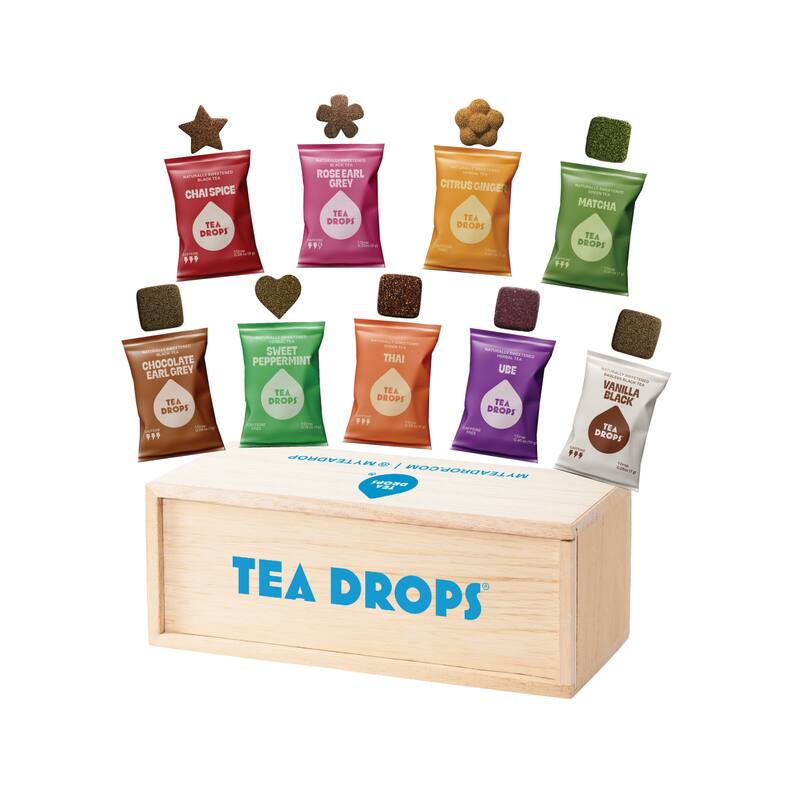
With capital behind her, Tea Drops pushed into retail: Whole Foods, Nordstrom, Neiman Marcus, Costco, Anthropologie — eventually reaching more than 3,000 retail locations nationwide. A $5M Series A followed, led by BrandProject, bringing total funding to $8.4M.
Stage 5: $20M Revenue, Chrissy Teigen, Michelle Obama (2021—Now)
The product did the marketing itself.
Chrissy Teigen tweeted: "I can't stop telling everyone I interact with about this tea." — unpaid, unprompted, organic.
Michelle Obama became a customer. Oprah Magazine ran a feature. Coverage compounded.
In 2021, Tea Drops crossed eight figures in annual revenue — $20M — and had built a community of over 200,000 tea drinkers. Sashee landed on Inc.'s 2021 Female Founders 100 list.
From one idea in a bathtub to 3,000 retail shelves across America — six years.
"Too many people overvalue what they are not and undervalue what they are." — Sashee Chandran
Source: Tea Drops Official · Voyage LA Interview · Medium/Rho deep dive
Thinking
Insight 1: Analog Innovation — Why "Bath Bomb for Tea" Made the Product Go Viral With Zero Budget
The smartest thing about Tea Drops isn't the product technology — it's the analogy frame. "Tea compressed into little drops like a bath bomb — drop it in hot water and it dissolves." Anyone hears that once and immediately understands. No demo needed, no explanation required.
That's why Chrissy Teigen didn't need to be paid to tweet about it. She wasn't sharing a product — she was sharing a story that demanded to be retold. Great consumer product innovation makes the format itself the marketing. When you can describe your product in one sentence using a comparison ("X version of Y," "like A but does B"), you've already acquired something most marketing budgets can't buy: frictionless word-of-mouth.
Insight 2: Bank Rejection Was Actually an Advantage
The bank turned Sashee down in 2015 because she only had $30,000 in sales. Most founders at this point either give up or scramble for other investors. Sashee chose a more aggressive path: she put her own home on the line.
This decision had cascading effects:
- She kept 100% of her equity (no dilution in the critical early phase);
- She was forced to be genuinely accountable for every dollar (no VC cushion to burn through carelessly);
- Three years of careful bootstrapping meant she had real product-market fit data by the time she went to investors — something money alone can't manufacture.
For founders without investor networks, the path of pitch competition prizes ($170K) + home equity ($125K) + personal savings is harder to replicate — but also more stable — than chasing VC before you've proven anything.
Insight 3: Pitch Competitions Are the Leverage Point for Founders Without Networks
Sashee had no Silicon Valley connections, no investor friends, no alumni network. How did she get in front of VC? Pitch competitions.
Tory Burch Foundation, Women Founders Network, PepsiCo WomanMade Challenge — these competitions designed for women and minority founders don't just give out prize money. They structurally put you in front of investors in an environment where investors are already attentive. Jesse Draper of Halogen Ventures noticed Sashee while judging one of her competitions.
This path is replicable: if you lack the warm intros to enter VC sight lines, find the 2–3 competitions that match your identity segment (woman / minority / food industry / specific region) and treat them as your organized cold-start network. Every competition is a structured chance to be noticed.
Insight 4: The Patent's Strategic Value Is Greater Than You Think
Most consumer product founders don't bother with patents — too complex, too expensive, too slow. Sashee filed as soon as her format was defined.
The patent's value isn't primarily about courtroom litigation. It:
- Raises the barrier for large incumbents (Lipton, Bigelow) to directly copy — they'd need to design around or negotiate;
- Signals to investors "this is a real product innovation, not a rebrand";
- Gives the brand a permanent, ownable narrative: "the inventor of dissolvable tea drops."
Not every founder needs a patent. But if your innovation is a physical product form rather than a service or experience, it's one of the highest-leverage protective investments you can make early.
Action
Step 1: Find Your Product's "Analogy Sentence" and Test It Before Spending on Marketing
Before launching, write this sentence: "This is the [familiar thing] version of [your product], except [core difference]." For Tea Drops: "It's like a bath bomb for tea — drop it in hot water and it dissolves. No bag, no strainer."
Then say this sentence to 20 people with different backgrounds and watch their faces. Do they nod or frown? Do they say "Oh!" or "What do you mean?" The quality of your analogy determines the efficiency of word-of-mouth. Don't spend on advertising until the analogy passes the test.
Step 2: Use Competition Prize Money Instead of Early VC
If you qualify for any of these identities — woman founder, minority founder, food/CPG sector, specific region — find and enter 3 matching startup competitions.
Practical starting points:
- Tory Burch Foundation Fellows: for women founders
- Women Founders Network annual pitch competition: for women
- SBIR grants: small business innovation research funding (US)
- Search "[your identity] startup pitch competition [year]"
Treat each competition as: $X prize money + one structured chance to get in front of an investor + free product-market fit feedback from judges.
Step 3: Validate at Farmers Markets or Etsy Before Pitching Whole Foods
Tea Drops had already validated real purchase behavior at farmers markets before approaching Whole Foods. This sequence matters: first answer "will someone hand me cash in a face-to-face setting," then pursue retail placement.
Path into major retail:
- Get into 10–20 independent specialty retailers first (natural food stores, boutiques) — these don't require a broker;
- Collect 3–6 months of actual sell-through data;
- Use this data to approach regional buyers at chains (Whole Foods regional — not national HQ);
- Regional performance is what earns national placement conversations.
Step 4: When You Feel Near Burnout, Hire One Person — Don't Just Do More
By 2017 Sashee was nearly breaking — production, sourcing, retail negotiations, packaging design, marketing, shipping, all on one person. If you reach this point, burnout isn't a willpower problem. It's a systems problem: one person doing three people's work.
The solution isn't "push through." It's to identify the single task you're least good at that drains you most (usually admin, finance, or logistics), and either outsource it or hire someone part-time. Your first hire isn't growth — it's survival. It's buying back the hours that only you can fill.
Step 5: Patent Selectively, But Patent Early When It Applies
Not every product warrants a patent, but consider filing when:
- Your innovation is a physical format or manufacturing process (not just a concept or service);
- You're in a category where large incumbents could replicate you with capital;
- The patent story becomes part of your brand narrative ("we invented this").
Practical path: find an IP attorney who specializes in food/CPG (initial consultations are usually free), describe your product format, ask about patentability. If viable, start with a Provisional Patent Application (PPA) — $320 in government fees, 12 months of "patent pending" protection, and full time to test sales before deciding whether to convert to a full application.