A Fashion Blogger Revived Her Needlepoint Hobby in the Pandemic, Hand-Painting Canvases at Her Kitchen Table — From $7,000 to $4.4M a Year
Krista LeRay was a well-paid fashion blogger. During the pandemic she revived her college needlepoint hobby, hand-painting 4x4 cotton canvases at her kitchen table — six hours each. She spent $7,000 on supplies, launched a Shopify shop in September 2020, and sold $25,000 worth in the first two hours. She reinvented a traditional, pricey, stuffy craft as cheap, trendy, pop-culture designs, and acquired customers at near-zero cost through her existing influencer audience. She passed $416K and went full-time in 2022, and hit $4.4M with a 36% margin and 60% repeat customers in 2024.
Process
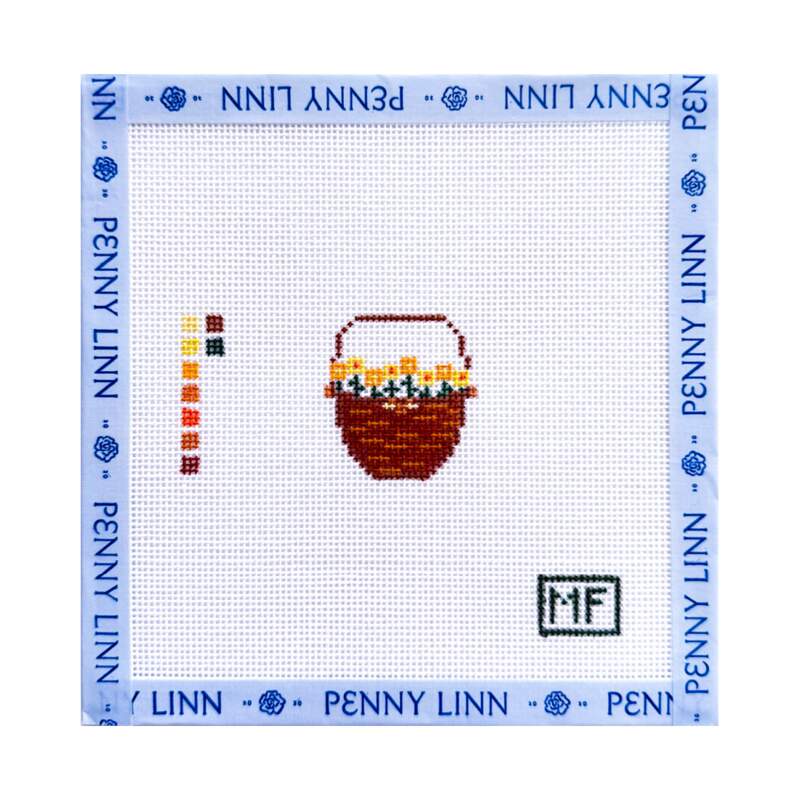
Krista LeRay used to be a well-paid fashion blogger. In 2024, the needlepoint brand she founded, Penny Linn Designs, did $4.4 million in revenue at a 36% net margin. But the business began with tiny hand-painted canvases — six hours each — at her own kitchen table during the pandemic.
Stage 1 — The start (2020): a blogger hand-painting needlepoint canvases at her kitchen table
Before the pandemic, Krista was a full-time fashion/lifestyle blogger, and a well-paid one — "blogging was my retirement plan," she says. Back then a one-minute Instagram story could earn her a couple hundred dollars.
But when COVID hit in 2020, posting outfits and beauty felt "insensitive." She turned instead to an old college hobby: needlepoint. She began hand-painting 4×4-inch cotton needlepoint canvases at her kitchen table — a full six hours each, often working late into the night.
As it happened, during the pandemic crowds of needlepoint hobbyists were searching online for canvas sellers, and Krista was among the very first to do it. Her blog followers saw her canvases and started asking to buy them. So she spent $7,000 of her blogging earnings on supplies and launched the Penny Linn Designs Shopify site in September 2020.
The result stunned everyone: in just two hours, she sold $25,000 — a full 500 canvases.
Stage 2 — The first thing she got right: turn an "old relic" into a young person's trendy toy
Why did it explode right out of the gate? Because Krista completely reinvented an old category.
Traditional needlepoint shops sold tapestries costing well over a thousand dollars — stuffy patterns, made for seasoned experts. Krista did the opposite: cheap ($30–$100+), trendy, packed with pop-culture references — "Ew, David" from Schitt's Creek, "Your email did not find me well," chinoiserie vases, sun hats, coastal-preppy motifs.
She was aiming at exactly the people traditional shops ignored: young beginners who wanted fun, approachable projects. "I just wanted more accessible projects," she says. The demand was always there; she simply changed the aesthetic and the price, reopening an over-elevated old category to ordinary people.
Stage 3 — The second thing she got right: zero-cost acquisition via her own audience + a high-repeat flywheel
The second thing: she spent almost nothing on advertising.
Krista was already an influencer, with a built-in audience and built-in taste. "I know how to connect with our customers online, partly because I am our customer," she says. She announced and showed off new canvases on her blog, Instagram, and later TikTok, at near-zero acquisition cost — the single most under-rated, hardest-to-replicate asset for anyone starting from scratch.
And needlepoint just happens to be an addictive, lifelong, high-repeat hobby — finish one canvas and you want the next, "which is why people stitch into their 90s." A 60% repeat rate means every customer she acquires monetizes for years. Built-in traffic plus extreme repeat purchase forms a low-cost, self-rolling growth flywheel.
Stage 4 — From one person hand-painting to $4.4M: scaling and transformation
Krista didn't get stuck "painting each canvas herself for six hours." She expanded the designs from her own hand-painting to a roster of multiple designers, while she moved into brand, curation, and operations — decoupling both capacity and variety from her personal hours.
In 2022, revenue passed $416,000, and she formally quit being a blogger to go full-time (that's also the year she had her first son and grew less comfortable posting her personal life online — which conveniently pushed the transition along).
By 2024, Penny Linn did $4.4M in revenue, a 36% net margin, and 60% repeat customers, with a team of 10 full-time + 24 part-time, plus a 5,000-square-foot retail store in Rowayton, Connecticut. A kitchen-table hand-painting side hustle had grown, in five years, into a seven-figure needlepoint brand.
"I give myself 24 hours to be upset. Then, the next morning… that's behind us." — Krista LeRay (paraphrased from public interviews)
Source: CNBC Make It · NBC New York · Penny Linn
Thinking
Insight 1: A built-in audience is the most underrated "startup capital"
Krista's real startup capital was never the $7,000 — it was the audience that trusted her, built over years of blogging, plus an eye for what young women find beautiful. Selling $25,000 in two hours wasn't luck; it was a one-time cash-out of trust she already had.
This is the part of the case most worth seeing clearly, and the part inspirational stories most often bury: "started with $7,000" sounds replicable by anyone, but her true moat was the audience — and an audience takes years to build. The biggest takeaway for an ordinary person isn't "go sell needlepoint"; it's: before you sell anything, build a group of people who trust you. The audience itself is capital that transfers to any product. Admit this honestly, or you'll misread the case.
Insight 2: Don't create demand — repackage a neglected old one
Needlepoint has existed for centuries; Krista didn't invent it. What she spotted was a market the traditional players had ruined: expensive, stuffy, and walling out beginners. She used trendy designs, low prices, and pop-culture references to reopen that same demand and catch the young people who'd been ignored.
The biggest opportunity is often not "invent brand-new demand" but "give an old category a new aesthetic, a new price, and a new audience." Fishing, gardening, classical instruments, sewing — nearly every traditional hobby category has a "Penny Linn waiting to happen." The demand is old; the audience is new — and the gap between them is your business.
Insight 3: Upgrade "the founder makes it by hand" into "a platform"
Each canvas took her six hours. If she'd kept painting them herself, the ceiling of the business would be one person's working hours — no amount of effort gets you far past that. Krista's key leap was decisively shifting from her own hand-painting to a roster of designers, turning herself from "producer" into "brand and platform."
Any business that starts on a craft or the founder's own hands must cross this line to scale: decouple output from your personal time. The sooner you turn "only I can make this" into "a system others can supply into," the higher your ceiling. Being trapped inside your own two hands is the root reason countless makers never grow.
Insight 4: Pick a "high-repeat" category, and acquire customers only once
Needlepoint is an addictive, lifelong hobby; 60% of customers come back. That means every customer Krista acquires monetizes for years — acquisition cost amortizes to almost nothing, and the business gets easier as it grows.
Factor "repeat purchase" in at the very moment you choose the product. Selling a one-off product (buy once, gone) versus a repeat hobby/consumable are radically different economic models: the former forces you to keep paying to find new customers; the latter acquires once and earns for years. If you can pick a category where "customers naturally come back," you've already won half the game.
Insight 5: Emotional resilience is a founder's invisible moat
"I give myself 24 hours to be upset, then move on." It sounds like a platitude, but it's a decisive variable in whether a business survives. Krista even doubted early on whether this was worth it (an IG story made money faster, after all) — but she pushed through the hesitation and the setbacks.
Most people don't lose on ability; they lose by stopping after the first big setback. Give your emotions a fixed "stop-loss window," then force yourself back to the table — that capacity to keep going shapes the final outcome more than any single flash of brilliance.
Action
Step 1: Build the audience first, sell the product second
Don't wait until you have a product to start gathering followers. Consistently put out content in a field you genuinely know, and build a group of people who trust you (even just a few thousand). When you later have something to sell, those people are your "sold out in two hours." An audience is startup capital that transfers to any product — there's no shortcut here, but it's the true starting point of the Penny Linn story, far more important than the $7,000.
Step 2: Find an "old, expensive, hard-to-enter" category and make it young
Look at hobbies or categories the traditional players have made stuffy and inaccessible — needlepoint, fishing, gardening, classical instruments, baking, crafts. Use lower prices, a trendier aesthetic, and a friendlier on-ramp to catch the young beginners who've been ignored. Remember: the demand can be old, but the audience must be new.
Step 3: Once validated, immediately upgrade "you make it" into "a platform"
If the product runs on your own two hands (painting, writing, making), use it to validate demand — but don't get trapped in the hours. Bring in more creators, designers, or suppliers as fast as you can, and move yourself from "producer" to "curation and brand." Stop letting capacity equal your personal time — that's the watershed between "a craft side hustle" and "a company."
Step 4: Prefer categories with repeat purchase
Sell things people "buy again and again" — hobby consumables, addictive projects, categories with ongoing demand. Acquire once, monetize repeatedly — far easier than endlessly chasing new customers. Make repeat rate one of your core product-selection criteria: for the same effort, a repeat category makes every dollar of acquisition cost pay back several times over.
Step 5: Set a "stop-loss timer" for your emotions
Building anything will bring moments that hit hard. Do what Krista does: give yourself a fixed grief budget (say, 24 hours) to break down, complain, and doubt — then force yourself back to the table when time's up. Being able to keep going beats being able to peak — many people lack not the peak, but the breath to outlast the trough.
Not for you if: you have no audience and won't spend the time to build a group of people who trust you first (the real starting point here is the audience, not the $7,000); or you want a one-off sale and won't commit to a repeat-purchase category; or you refuse to move from "doing it yourself" to "building a platform" and insist on doing everything by hand — then the ceiling of this business is your own two hands.