Ex-Murakami Studio Employee Made $10M+/Year With Dog Clothes — 3 Failures Before Sandy Liang & Disney Collabs
Jisu Kim left Takashi Murakami's Kaikai Kiki studio and used her savings to start Little Beast in 2018. Two failed pivots later, she switched to dog onesies made in Korean baby-clothes factories — sold out on Instagram launch. Sandy Liang collab, Disney × Nordstrom deal, $10M+/year, zero VC.
Process
Jisu Kim didn't come from fashion or pet retail. She studied arts administration at Sotheby's Institute of Art in New York, then worked as a studio administrator at Kaikai Kiki — the studio of Japanese contemporary art icon Takashi Murakami. She had a Border Collie Lab named Molly, an eye sharpened by years in the art world, and zero experience in manufacturing or e-commerce. From 2018 to $10M+ in annual revenue, the path ran through three failures, one supply-chain insight nobody else had made, and two collaborations that changed the brand's trajectory entirely.
Stage 1: First attempt (Winter 2018) — launched collars, lost money on every unit
The original frustration was simple: dog collars and leashes were ugly. Jisu and Lys Bui — a Kaikai Kiki colleague who would later become Little Beast's creative director — pooled their savings, designed a small collection, and launched. People bought them.
Then came the accounting: they were losing money on every sale. Neither founder had modeled cost structure — materials, packaging, shipping, returns — before going live. Margin was negative. Failure number one.
The lesson wasn't about product. It was about the order of operations: unit economics have to be solved before aesthetics.
Stage 2: The curation pivot (2019) — online boutique, another dead end
Undeterred, they changed approach. From an 800-square-foot New York City apartment, they built an online curated pet boutique — sourcing the world's most design-forward pet products onto a single platform. It was a reasonable idea. It was also unsustainable: customer acquisition costs were high, suppliers owned the pricing power, and every sale they drove built equity for someone else's brand. Failure number two.
Two failures in, savings depleted, Jisu kept her day job and kept thinking.
Stage 3: The supply-chain insight (2020) — dying baby factories meet booming pet market
The pandemic shifted the landscape: pet spending surged as people stayed home. At the same time, Jisu had noticed something specific: South Korea had a network of small, family-owned garment factories that had originally specialized in baby clothing. South Korea's declining birth rate had gutted their order books. They needed new clients urgently.
The structural insight: baby clothing and small-dog clothing share nearly identical pattern logic — small bodies, short limbs, proportions that need soft, stretch-tolerant construction. These factories didn't need to retool. They needed to adjust sizing data. This wasn't a fashion insight; it was supply-chain arbitrage — using the idle capacity of a shrinking industry to serve an exploding one.
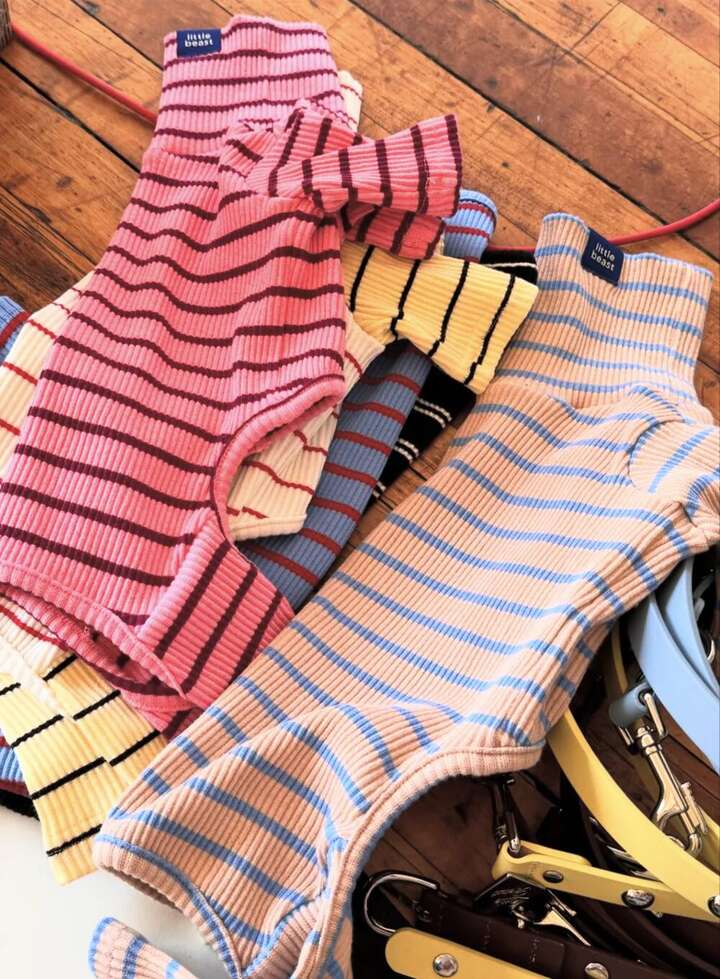
Jisu reached out to Korean factories, negotiated terms, and designed the first Little Beast collection: dog onesies, knit sweaters, and rain jackets. Fall/Winter 2020 went live on Instagram.
It sold out immediately. Jisu quit her day job that same day.

Stage 4: Building the brand (2020–2022) — uniform pricing, word-of-mouth flywheel
With a product that worked, the next question was defensibility. Little Beast made a pricing decision that cut directly against industry convention: uniform pricing across all dog sizes. A Chihuahua and a Labrador pay the same price for the same sweater. Traditional pet brands charge size premiums — more fabric, higher cost. Jisu framed size-based pricing as discriminatory. Why should large-dog owners pay more?
This created genuine organic traction in large-breed communities — owners who had always felt penalized by the category. Word spread without paid acquisition.
Jisu and her husband Ryeon Kim (online marketing) steadily built out Instagram (@littlebeast.co, now 120K followers). Five percent of every order was pledged to animal welfare causes, adding substance to the brand's personality.

Stage 5: Breaking through (2023) — Sandy Liang + Disney × Nordstrom
In 2023, two collaborations changed the scale of the brand entirely.
First: Sandy Liang. One of New York's most beloved independent fashion designers, known for soft-palette knitwear and a joyful, unapologetically feminine aesthetic. When she approached Little Beast, both brands' visual DNA aligned closely. The resulting collection, priced at $88–$149, was covered as a fashion story — not a pet story. That distinction matters: once fashion media treats you as a fashion brand, your ceiling changes.
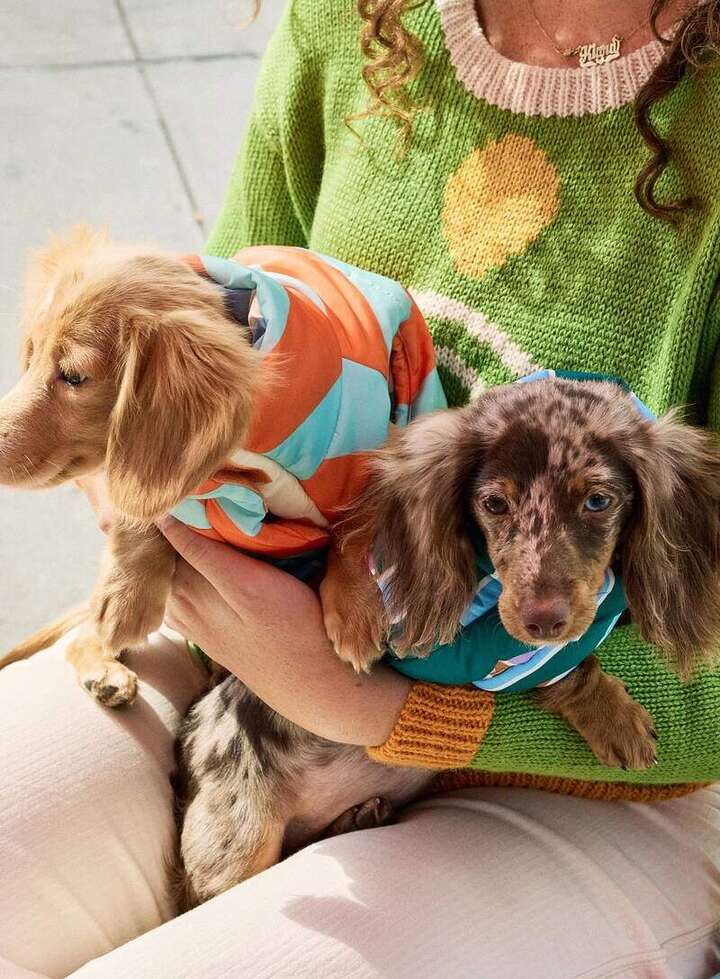
Second: Disney × Nordstrom exclusive. The same year, Little Beast landed an exclusive partnership placing the brand inside America's largest department store alongside one of the world's most recognized entertainment IPs. This move unlocked gift-market and family-market demand that the DTC channel couldn't reach.
After both collaborations, annual revenue crossed $10M+ (8 figures) — confirmed publicly by Jisu on LinkedIn. Zero venture capital, ever. Three failures, one supply-chain insight: she turned a shrinking South Korean baby clothing industry into America's most talked-about pet fashion brand.
Source: Fashionista (December 2023) · Kinship Interview · WWD · Little Beast
Thinking
Moat 1: The Art-World Aesthetic Barrier
Jisu and Lys both have serious art-world credentials — Sotheby's Institute, Murakami's Kaikai Kiki. This isn't a marketing angle; it's a genuine competitive advantage. They have the visual vocabulary, the taste-making instinct, and the social currency to speak as equals to high-fashion collaborators. Sandy Liang didn't choose Little Beast over dozens of other pet brands by accident — she chose them because Little Beast occupies the same aesthetic frequency. Most pet brands can't access this. Taste is the moat that capital cannot simply purchase.
Moat 2: The Supply Chain Discovery
Converting South Korean baby clothing factories into pet apparel suppliers required three simultaneous conditions: cultural proximity (Korean background, direct knowledge of South Korea's manufacturing landscape), category insight (recognizing the pattern-overlap between baby clothing and small dog clothing), and timing (pandemic surge in pet spending + factories desperate for new clients). Remove any one condition and the opportunity disappears. This is why it's defensible: the specific combination of background, knowledge, and timing that produced this insight belongs to Jisu, not to anyone who reads this case after the fact. The factory relationships, quality track record, and lead-time advantages compound over time.
Moat 3: The Product Is the Content
Every dog wearing a Little Beast onesie in a park, in an Instagram post, in a TikTok video is a free advertisement. Dog content is inherently high-virality — universally appealing, emotionally resonant, conflict-free. Little Beast's design language — bold colorways, clean silhouettes, human-owner matching potential — is built explicitly around being photographed. When your product is the content, marketing cost approaches zero. This isn't a strategy you layer on afterward; it has to be baked into the product design from day one.
Moat 4: The Pricing Stance as Brand Identity
"Same price for every size" isn't just a pricing decision — it's a public value statement. It gave media and consumers a clear narrative hook and generated genuine loyalty among large-breed owners who had always resented size premiums. This kind of brand identity is cheaper and more durable than paid advertising. Critically, it's also commercially viable: the primary cost drivers in garment manufacturing are design complexity and fabric quality, not fabric volume — with standardized designs and a strong factory relationship, large-size marginal costs are lower than intuition suggests.
Action
Step 1: Find Your Supply Chain Before You Have Money
Jisu's breakthrough was a supply chain insight, not a product idea. Before you build anything physical, research manufacturers in declining industries — falling birth rates, sector downturns, export market shifts, overcapacity. These factories have weakened negotiating positions, lower MOQ requirements, and strong motivation to work with new brands. Your first unfair advantage may be hiding in a manufacturing cluster where your cultural background or industry knowledge gives you information that competitors lack.
Step 2: Use the First Batch to Validate, Not to Profit
Little Beast's first batch wasn't meant to turn a profit — it was meant to test the Instagram response. Apply the same logic: the right criteria for reordering are not "did it sell?" but "did customers share it unprompted?" and "did any media accounts pick it up organically?" If neither happened, fix the product before scaling inventory.
Step 3: Pick One Counterintuitive Public Stance
"Same price every size" gave Little Beast a clear, distinctive voice in a crowded market. Identify one practice in your category that the industry has normalized but that's genuinely bad for customers. Taking a public stand against it — and actually living by that stand — costs nothing and earns media coverage, word-of-mouth, and brand loyalty that paid advertising cannot replicate.
Step 4: Collab for Aesthetic Fit, Not Follower Count
Sandy Liang wasn't the highest-follower designer Little Beast could have approached. She was the highest-alignment one. The purpose of a brand collaboration is to enter the other brand's community and media context — not to borrow their audience count. The marker of a right-fit collab is when both brands' fans see the announcement and think "these two brands should have always been together." Optimize for that reaction.
Step 5: Make a Specific, Measurable Charitable Commitment
"5% of every order" is a concrete, auditable commitment. It's not a slogan — it's a number. At a 5% revenue contribution, it doesn't devastate margins (5% of revenue, not 5% of net profit, which is a much smaller absolute amount). But it creates genuine brand loyalty among values-aligned customers and is extremely difficult for competitors to authentically replicate. Pick a cause you actually care about, commit to a specific percentage, publish results quarterly, and do it indefinitely.