From $30 to $999 on a Single Flip: How a Couple Turned Flea-Market Junk Into a $133K-a-Year Business
Rob and Melissa Stephenson resell flea-market and curbside finds on eBay — no storefront, no inventory, no funding. Rob started flipping at 16, tagging along to yard sales; a prosthetic leg he bought for $30 sold for $999 in under an hour, an old security booth went $5,000 → $25,000, and 60 returned mattresses bought at $60 each resold for an average of $605. When his employer cut health insurance in 2016, the side hustle became full-time and they did $133,000 in sales that year, working ~14–20 hours a week. His rule: 'the money is made in the buy.' Startup cost was basically $0 — you can start with one free item off the curb.
Process
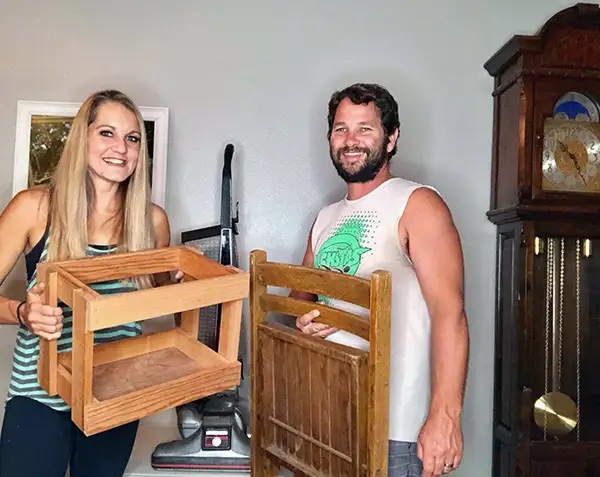
Rob and Melissa Stephenson — a couple in Orlando, Florida — resell flea-market and curbside finds on eBay. With no storefront, no inventory, and no funding, they did $133,000 in sales in their best year and pulled $62,000 in profit from just 90 flips in another — all in about 14–20 hours a week. The startup cost? Basically $0.
Stage 1 — A 16-year-old at the yard sales: two decades of flipping as a side hobby
Rob started flipping at 16 in Orlando, tagging along with his mom to yard sales and Salvation Army auctions. In his 20s he was buying NordicTrack ski machines for $15–20 and reselling them for hundreds — "I started realizing I could actually make some pretty good money on the side." In 2007 he met Melissa (an equestrian performer at a dinner show); they married, had kids, and for years flipping stayed a side hobby while Rob worked full-time photographing houses for an insurance company. It was the thing he did on weekends — a hobby that quietly came in handy whenever money was tight.
Stage 2 — Forced full-time: a cut paycheck, a pregnancy, and a $133K year
The turning point came in 2016, when Rob's employer cut its health insurance and Melissa — pregnant with their third child — couldn't work. The side hobby suddenly had to pay the bills. So they went all-in on flipping full-time — and did $133,000 in sales that first full year. It wasn't luck; it was twenty years of practice finally pointed at a single goal. In the years after, sales settled into a steady rhythm — about $64K, $85K, then $79K — with $62,075 in profit on that last year, from just 90 items.
Stage 3 — "The money is made in the buy": hunting 10x items others walk past
Rob's whole edge is buying things wildly under value. A prosthetic leg he bought for $30 sold for $999 in under an hour — a 3,333% return. An old parking-lot security booth: bought for $5,000, sold for $25,000. A Harley-Davidson sign: $250 → $9,000. Sixty returned Sleep Number mattresses at $60 each, resold for an average of $605. His rule is simple: chase items with a 10x return or at least $300 of profit — and "the money is made in the buy." His research is just as simple: at a flea market he checks the model on his phone against eBay's sold listings before he ever pays. He sources from yard sales, thrift stores, local apps (OfferUp, Facebook Marketplace), and even the curb.
Stage 4 — One free chair → $11,000, and a second income teaching it
The clearest proof of the method: in one challenge, Rob took a free chair off the sidewalk, sold it for $50, rolled that into two exercise bikes that sold for $499 each, and kept reinvesting — four months later that free chair had become $11,000 in cash. Today the couple runs it all themselves — no team, no funding — spending 14–20 hours a week (a couple hours hunting, a couple scanning apps, the rest cleaning, fixing, photographing, and shipping). They've also turned the method into a $497 online course with 600+ students, which brings in roughly $150,000 a year on top of the flipping itself.
"Flipping probably won't make you a millionaire, but it can be a great way to make some money on the side — and the money is made in the buy." — Rob Stephenson (paraphrased from public interviews)
Source: The Hustle · Flea Market Flipper · public interviews
Thinking
Insight 1: The money is made in the buy — your profit is locked in the moment you buy, not when you sell
Rob's entire edge is paying far below resale value. Decide what something can sell for before you pay for it; if the spread isn't there, walk away. When you buy right, the profit is already yours — selling is just collecting it.
Insight 2: Reselling is arbitrage on information and effort — the hassle others avoid is your margin
A prosthetic leg, a security booth, sixty returned mattresses — these are things most people find too weird, too big, or too much trouble. That friction is exactly why they're cheap, and exactly where your profit lives. You're paid to do what others won't.
Insight 3: Near-zero startup cost, near-zero risk — one free item is enough to begin
A chair off the curb became $11,000. You don't need capital, inventory, or a storefront — you need one item and the willingness to list it. If a flip flops, you've lost almost nothing; the downside is tiny, the upside is 10x.
Insight 4: Chase the big, boring, fixable stuff — it pays far more for the same work
Listing and shipping a $700 pole saw takes about the same effort as a $20 trinket. So go where the dollars are: commercial gear, machinery, oversized items — the things with 10x returns or $300+ margins. Same hours, much bigger checks.
Insight 5: Turn the method into a second income — once you're good, teaching it compounds
After years of flipping, the Stephensons packaged what they knew into a $497 course with 600+ students — roughly $150K a year on top of reselling. A repeatable skill is worth more taught than done alone; your experience itself becomes a product.
Action
Step 1: Start with one item you already own — or one free off the curb — and just sell it
Don't overthink it. List one thing today on eBay or Facebook Marketplace and go through the whole loop once: photograph, price, ship. The first sale teaches more than any guide.
Step 2: Before you buy, check eBay "sold" listings on your phone — only buy 10x or $300+ items
The buy is everything. Look up the real sold price before you pay, and only buy when the margin is huge. If it won't 10x or clear $300, leave it.
Step 3: Go for the big, fixable, "too much hassle" items others skip
Don't compete on cheap trinkets. Hunt commercial machinery, oversized gear, and broken-but-fixable items — fewer buyers chasing them, far fatter margins.
Step 4: Learn to photograph, title, and ship big items — that's where the profit hides
Good photos and an accurate, keyword-rich title do most of the selling. Learn to crate and freight large items — most resellers won't, which is exactly why those flips pay so well.
Step 5: Roll each win into the next, and once you've got a system, teach it
Reinvest your profit into bigger flips (one free chair → $11,000), and once your method is repeatable, package it — a course, a channel — as a second income stream.
Not for you if: you won't get your hands dirty cleaning, fixing, and shipping; you want fully passive income (this is a hands-on hunt-and-flip); or you have no patience to wait for the right buyer.