She Dropped Out of UBC at 23 to Buy a Laundromat — Recouped Her Investment in 18 Months
At 23, Maureen Ngo dropped out of UBC and bought a laundromat in East Vancouver for under CAD $100K. Eighteen months later, she'd recouped her entire investment. Boring is beautiful.
Process
The Beginning: A UBC Senior's Counterintuitive Choice
In 2023, while most of her peers were cramming for finals and polishing resumes for campus recruiting season, 23-year-old Maureen Ngo made a decision that confused everyone around her: she dropped out of UBC (University of British Columbia) in her senior year, took her savings, and bought a worn-down laundromat in East Vancouver — East Van Laundry.
Not a tech startup. Not content creation. Nothing anyone her age would call "cool." A laundromat — the kind of place you rush through while doing laundry, drop in a few coins, and never think about again.
While her classmates debated which FAANG offer to accept or which grad school had the best ranking, Maureen was studying washing machine specifications, utility bills, and commercial lease clauses. Her father couldn't understand it — four years of university, only to buy a laundromat? Even her friends gently asked, "Are you sure about this?"
Maureen had never been more sure. Her choice wasn't "settling." It was a calculated decision.
Phase 1: The Intellectual Foundation — Codie Sanchez and the "Boring Business" Philosophy
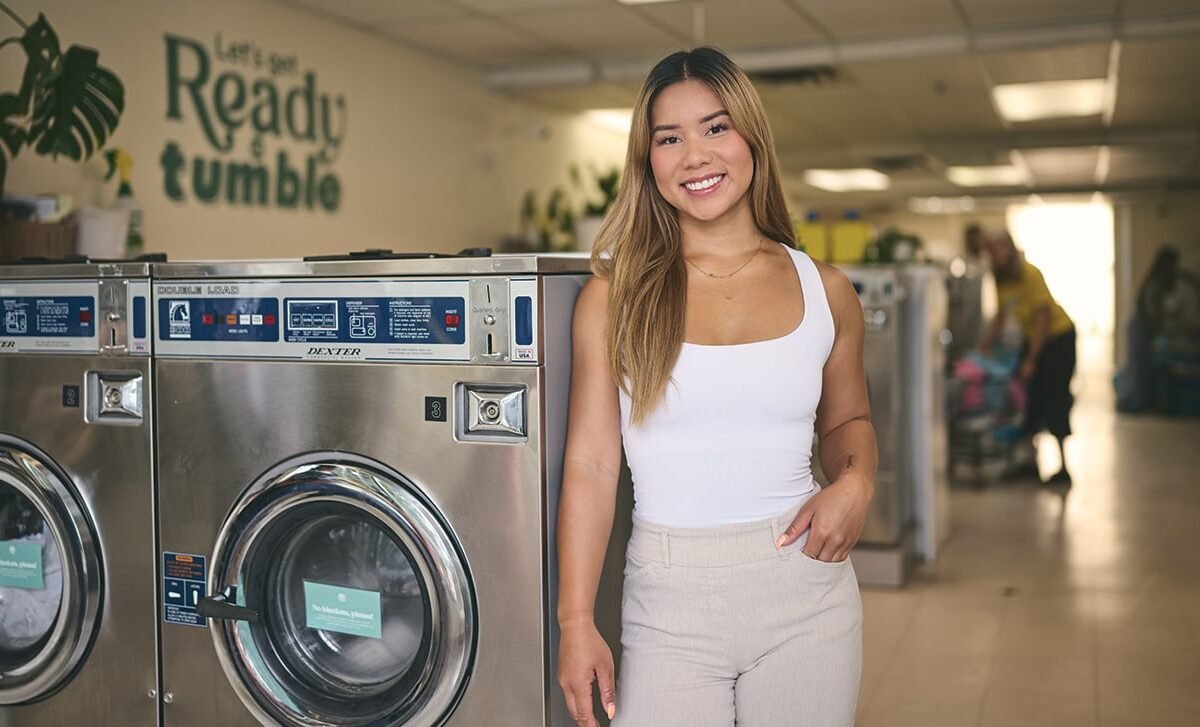
Maureen's business worldview didn't come from a textbook. It came from an investor named Codie Sanchez, the most prominent evangelist for "boring businesses." Codie's thesis is devastatingly simple: laundromats, vending machines, car washes, self-storage facilities — these unglamorous industries are the best investments for ordinary people.
Why? Because "cool" startups have three fatal flaws: ① Bloody competition — everyone wants to build a cool app, so every lane is packed with cash-burning rivals; ② Sky-high failure rates — 90% of startups don't survive three years; ③ Unpredictable cash flow — you might raise $1M this month and be down to $100K the next.
"Boring businesses" are the exact opposite: Demand never goes away — people need clean clothes in a boom and in a recession. Competition is minimal — no Ivy League grads are fighting you for a laundromat. Cash flow is predictable — how much each washer earns per day can be modeled almost to the cent. In Maureen's eyes, "boring" wasn't a flaw in this business. "Boring" was the moat.
One line from Codie Sanchez rewired her thinking: "Stop asking if it's cool. Ask if it makes money. Cool won't pay your bills. Boring will."
Phase 2: Preparation — 8 Months of Research + 20 Handwritten Letters
But "boring" didn't mean careless. Maureen understood that the wrong acquisition could wipe out every dollar she had saved. So she took an almost obsessive approach — eight full months of research.
Here's what those eight months looked like: ① She listened to every single laundry business podcast on Spotify — equipment selection, maintenance cycles, pricing strategy — until the knowledge became second nature; ② She analyzed East Vancouver's demographics — the neighborhood had a high renter ratio (renters don't own washers, making them core laundromat customers), stable median household income (enough spending power without owning equipment); ③ She modeled the total lifecycle cost of commercial laundry equipment — the purchase price was only the beginning, the real costs were in utilities, repairs, depreciation, and insurance; ④ She physically visited over a dozen Vancouver laundromats, observing foot traffic patterns, machine utilization rates, and customer profiles.
Only after all this preparation did she make her most decisive move — she handwrote over 20 letters.
No email. No LinkedIn DMs. No Facebook group posts. She went to a stationery store, bought proper paper and envelopes, and wrote each letter by hand with a fountain pen, personally dropping them into the mailboxes of laundromat owners across Vancouver. Each letter introduced herself, demonstrated genuine understanding and respect for the industry, and respectfully asked whether they'd consider selling.
This might look "vintage," but it was actually a precise signal filtering mechanism. Mass emails typically get below 2% response rates — because they signal "I'm casually asking." A handwritten letter transmits something entirely different: I invested time. I invested effort. I'm serious about this. An owner who responds to a handwritten letter is a fundamentally different seller from one who responds to mass email. The former is more likely to be genuinely selling, more likely to care about legacy than the highest bidder, more likely to do business with a sincere young person.
Phase 3: The Deal — Acquiring an Asset for Under CAD $100K
Those 20 letters led her to the right deal. The acquisition price for East Van Laundry: under CAD $100,000 (~$70,000 USD).
In Vancouver's real estate market, that's almost absurdly low — a condo down payment could cost more. But Maureen wasn't buying a shiny storefront. She was buying a cash-generating machine that happened to look old: solid location, loyal customer base, equipment that was aging but well-maintained. Crucially, it had been operating for over a decade — meaning the revenue was real and verifiable, not some "projection" in a pitch deck.
Maureen closed the deal entirely with her own savings. No bank loan. No money from parents. No investors. This looks conservative — leverage other people's money and you could buy a bigger business, right? But her logic was crystal clear: zero debt means zero pressure. If the business didn't make money in the first few months, she wouldn't be forced into short-sighted decisions by loan payments. She was betting on her ability to make this business better, not betting on paying off debt before going bankrupt.
On closing day, she was 23. Most 23-year-olds are interns at big companies. She became an owner of a real, physical, cash-generating asset.
Phase 4: Taking Over — From Counter Worker to Asset Owner
After the acquisition, Maureen did nothing flashy. No app launch. No TikTok marketing campaign. No loyalty program. Her first move was cleaning the store — scrubbing floors, painting walls, replacing light bulbs. Then optimizing shifts — mapping foot traffic peaks, staffing up during rush hours, cutting shifts during lulls to maximize labor efficiency. Then improving the customer experience — adding seating, offering Wi-Fi, keeping the restroom spotless.
These sound like basic property management. And they are. That's the point. Within 18 months of these "boring" improvements, the result was staggering: she recouped her entire investment.
How? Not through "growth." A laundromat's customer base has a natural ceiling — you can only serve people within a 1-2 km radius. What she did was compress costs and increase per-machine revenue: renegotiating utility contracts cut fixed costs by 15%, optimizing equipment utilization raised daily revenue per machine, and improved customer experience boosted retention rates. Eventually, she built a small team to handle daily operations — which freed her from "the person who has to be at the store every day" to "the person who owns the asset whether she's there or not."
This transformation is everything. Because when a person shifts from "worker" to "asset owner," their time is no longer bound by physical space. They can go find the next acquisition.
Phase 5: The Bigger Picture — The Silver Wave and 76% Retiring Business Owners
Maureen's story deserves careful study not just for her personal success, but for the historic structural opportunity it reveals.
Canada is undergoing what's called the "Silver Wave" — the baby boomer generation, born after WWII and now aged 60-80, owns the vast majority of this country's small businesses: laundromats, dry cleaners, convenience stores, auto repair shops, small restaurants. And these people are old. Official Canadian data shows that 76% of small business owners plan to exit within the next decade. They're retiring, falling ill, or discovering their children don't want to take over.
What does this mean? Supply is surging while demand is critically undersupplied. Every year, hundreds of thousands of stable, profitable small businesses will come to market looking for buyers — and the pool of young people willing to take them over is vanishingly small. This is a classic buyer's market: abundant choices, room to negotiate, willingness to accept seller financing. Maureen's CAD $100K acquisition price will become increasingly common as the silver wave accelerates.
Her story isn't a one-off. It's a signal of the times. For any young person willing to let go of the "I must do something cool" obsession, the next decade may offer the lowest entrepreneurial entry barriers in history — no need to invent anything, just the courage to catch the baton being passed by a generation that's running out of time.
Maureen put it plainly: "This business is in no way exciting — that's exactly why I chose it." That's not modesty. That's a 23-year-old, in an era when everyone is chasing "cool," making the most rational decision possible with cold, clear math.
Source: Tech Digital Minds; originally reported by The Globe and Mail
Thinking
Maureen Ngo's story is easily reduced to "another kid dropped out of college to start a business." But that reading misses the point entirely. She wasn't "chasing a dream" — she was running the numbers. Here are the three layers actually worth unpacking:
Layer 1: "Boring" is a contrarian moat. While society chases AI, Web3, and content entrepreneurship, Maureen chose a sector that is "in no way exciting" — a laundromat. Not because she lacked options (she was a UBC student), but because she understood something fundamental: the sexier the market, the bloodier the competition; the more boring the market, the easier the steady returns. Laundromat customers don't switch providers because a new app launched. The customer stickiness and cash flow predictability that "boring" generates are metrics SaaS companies would kill for. Codie Sanchez's "boring business" philosophy is, at its core, an investment thesis: buying a business that's already profitable carries far higher expected value than burning capital betting on one that might become profitable.
Layer 2: Acquisition >>> Startup. Maureen didn't "start a business" — she acquired one. These are two fundamentally different games. A startup founder has to go from 0 to 1: validate demand, build a product, acquire customers — with an extremely high failure rate. An acquirer buys something already validated: existing demand, an existing customer base, already-flowing cash. In the context of Canada's "silver wave" — 76% of small business owners planning to exit within the decade — the logic becomes even sharper: supply (businesses for sale) is surging while demand (young buyers willing to take over) is critically undersupplied. This is a buyer's market, not a seller's.
Layer 3: Twenty handwritten letters aren't romantic — they're signal filtering. Maureen could have sent mass emails, LinkedIn DMs, or Facebook group posts. She chose handwritten letters. This isn't just heartwarming — it's a low-cost, high-precision signal filtering mechanism. The owner who responds to a handwritten letter is a fundamentally different person from the owner who responds to a mass email. The former is more serious, more likely genuinely considering selling, and more likely to care about legacy than the highest bidder. With 20 letters, Maureen filtered out hundreds of unsuitable sellers and precisely located the one willing to hand his business to a 23-year-old.
This isn't a story about "being brave and chasing dreams." It's about choosing a contrarian track through rational analysis, substituting acquisition for startup risk, and replacing low-efficiency effort with high-signal action.
Action
If you want to replicate Maureen's path, here's a four-step actionable framework:
1. Find your "boring" sector. Open Google Maps and look at your city's street corners. Laundromats, self-serve car washes, self-storage facilities, vending machine routes — these are Codie Sanchez's "boring businesses." Selection criteria: ① Demand is permanent (people need it regardless of the economy); ② Operations are simple (no creative or technical moat required); ③ Cash comes first, profit comes after (collect money before delivering service); ④ Existing owners skew older and don't understand digital. Identify 3 candidate sectors and spend 10+ hours listening to industry podcasts for each. Maureen spent 8 months studying laundry — you should spend at least 1 month.
2. Acquire. Don't start up.
The risk of starting from scratch dwarfs the risk of acquiring. Look for businesses that have been operating for 5+ years, have stable customer bases, and have owners approaching retirement. Canada's silver wave is not unique — the US, Japan, and Europe are going through the same structural shift. Search terms: [city] + business for sale + [sector]. Camp on BizBuySell, Sunbelt, and local business broker sites. If your city lacks these platforms, even simpler: handwrite letters to owners. Start with 20. Your letter should demonstrate industry knowledge and genuine intent — not "I want to make money," but "I want to continue and build upon what you've created."
3. Use seller financing to lower the entry barrier. Maureen used her own savings, but it's not the only path. Many retiring small business owners accept seller financing — you pay a portion upfront, and the rest is paid from the business's profits over time. This has tax advantages for the seller and lowers the capital barrier for you. Proactively raise this option during negotiation. A laundromat listed at CAD $100K might only need $30K down, with the rest covered by the laundromat's own cash flow.
4. After taking over, optimize the boring stuff first. Don't rush to "innovate." Maureen's first moves were cleaning the storefront and optimizing staff schedules — not launching an app or doing TikTok marketing. The core of a stable cash-flow business isn't growth — it's not screwing up. For the first 6 months, do only three things: ① Learn the quirks and maintenance cycles of every piece of equipment; ② Talk to every regular customer (they are live user research); ③ Build a simple monthly table: Revenue − Fixed Costs − Variable Costs = Your Real Profit. When you can recite those numbers with your eyes closed, then think about growth.