Bought a Freeze Dryer During Lockdown: Couple Built a $5M Candy Brand on TikTok
Mel & Zeus Macias bought a freeze dryer during the 2020 lockdown and started posting before/after candy transformation videos on TikTok. The content went viral. Within 3 years they hit $1M revenue; now generating ~$5M/year with 8M+ YouTube subscribers and a Forbes 30 Under 30 recognition.
Process
The Beginning: Two People Who Had Nothing to Do with Candy
April 2020. Utah, USA. Mel (Melinna Macias) and Zeus (Jesus Macias) were stuck at home — like several billion other people on earth.
Before the pandemic, neither had touched the candy industry. Mel had spent her career in retail management at fashion brands like Kate Spade and Guess — she understood store operations, visual merchandising, and consumer psychology, but had never stepped inside a food factory. Zeus held an MBA from Universidad Iberoamericana in Mexico — he understood business models, supply chains, and financial statements, but had never handled a candy formula.
Between their combined resumes and the words "freeze-dried candy," there was a galaxy of irrelevance.
But the pandemic had made all plans obsolete. Couldn't go out. Couldn't go to work. Couldn't even know what next week would look like. In this aimless anxiety, they did something almost absurdly casual: they bought a home freeze dryer for a few hundred dollars.
The reason was simple — they were bored out of their minds and wanted something to play with.
Phase 1: The First Video Exploded — Discovering the "Freeze-Dried + Short Video" Chemistry
A freeze dryer works on straightforward physics: freeze food at extreme low temperatures, then create a vacuum so ice sublimates directly into vapor, removing almost all moisture. But applied to candy, this process produces a kind of magic — a regular gummy goes in, and what comes out is 3-4 times larger, transforms from chewy to shatteringly crispy, becomes more vividly colored, and produces an explosive popping sensation when bitten. Most importantly: this physical transformation is incredibly photogenic on camera.
Mel and Zeus weren't food scientists. They were just two people with an absurd amount of free time. They started doing what any curious person with a freeze dryer would do — throw random candies in and see what happens. Gummy bears. Fruit chews. Sour strips. Marshmallows. Every experiment yielded different results: some candies emerged as perfect, puffy masterpieces; others exploded into fragments or congealed into sticky disasters.
They made one decisive move: film both the successes and the failures, edit them into "Before vs. After" comparison clips, and post them on TikTok.
The first video didn't "gradually gain traction." It exploded. TikTok's algorithm pushed this short clip to millions of users within hours. Why? Because freeze-dried candy videos possess every element short-form content demands: ① Visual shock — a small soft gummy goes in, a massive crunchy sphere four times the size comes out; ② ASMR payoff — the bone-dry crunch on bite triggers an almost physical brain-tingle; ③ Curiosity engine — viewers are hardwired to wonder "what happens when you freeze-dry this candy?", which drives extreme completion and share rates.
Phase 2: The Content Flywheel — They Don't Buy Traffic, They Make Traffic
After that first viral hit, Mel and Zeus didn't treat it as luck. They immediately grasped something deeper: the freeze-drying process is biologically engineered for short-form video.
Every candy type is a new experiment. Every experiment is a new video. Every video has a chance to go viral. This forms a perfect content engine with zero creative bottleneck — as long as new candies exist, new content exists.
They built a ruthlessly efficient content flywheel:
- Experiment: Source or create candies, throw them in the freeze dryer, document what happens
- Film: Focus on two core elements — the dramatic visual Before/After transformation, and the ASMR crunch sound on bite
- Publish: TikTok, YouTube Shorts, Instagram Reels — simultaneously, maximizing reach
- Sell: The viewer's brain, having watched that crunch, is now biologically compelled to taste it — they click the bio link and order from trendytreats.com or Amazon
The genius of this model: the content IS the acquisition funnel. Zero ad spend required. Traditional consumer brands allocate 20-40% of revenue to marketing — ads, keyword buys, influencer sponsorships. Trendy Treats' content team is just Mel and Zeus themselves. Their "ads" are free viral videos. Their "spokesperson" is the algorithm.
The numbers prove the model's terrifying efficiency: a single viral video can hit 18+ million views; their YouTube channel has accumulated over 8 billion total views, with 100+ million monthly views; YouTube subscribers exceed 8 million. These aren't vanity metrics — every view is a brand impression, every impression is a person moving from "never heard of Trendy Treats" to "I need to taste freeze-dried candy."
Phase 3: From Freeze-Drying Others' Candy to Inventing Their Own — The Birth of GLOBOS
After establishing themselves as the internet's freeze-dried candy destination, Mel and Zeus faced a critical question: what's the moat?
Freeze-dried gummy bears sell great. But if you can buy a freeze dryer, so can anyone else. If you can film videos, so can anyone else. If Trendy Treats is merely "a shop that freeze-dries existing candy brands and resells them," then the business is replicable by any TikTok creator who buys a freeze dryer — and copycats were already appearing.
Their answer: invent their own candy. Not freeze-dry an existing product — design an entirely original candy formula built from the ground up for the freeze-drying process.
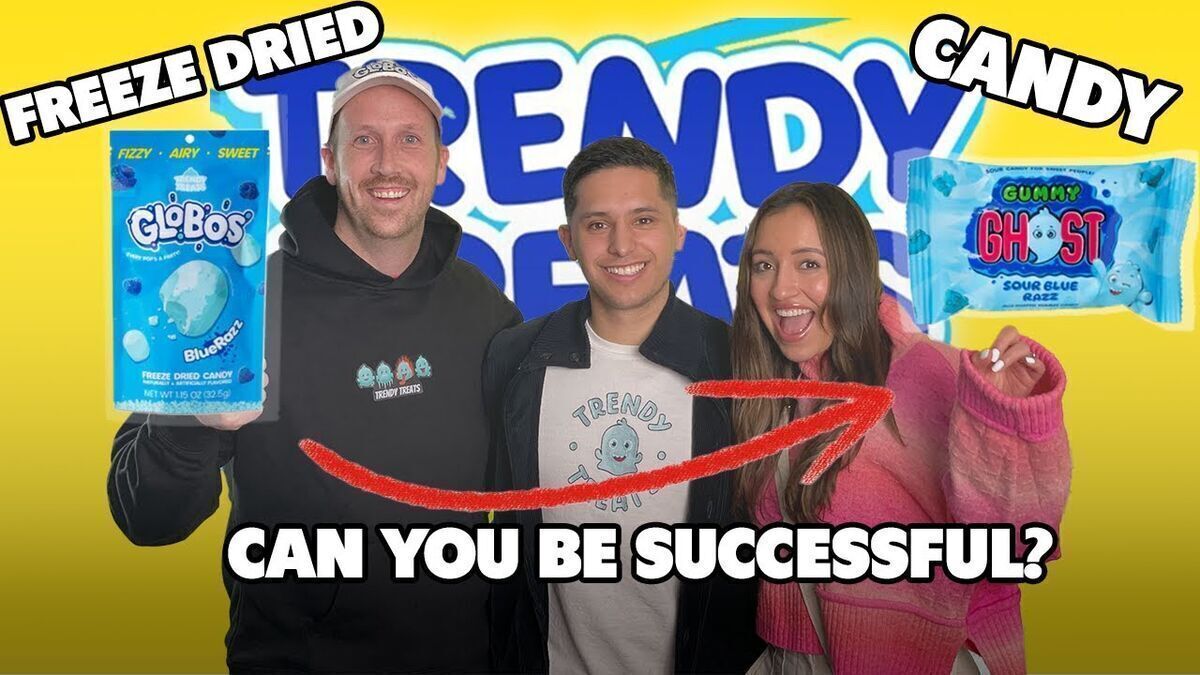
That product is GLOBOS — positioned as "The World's First Original Freeze-Dried Candy." GLOBOS isn't a freeze-dried version of anything that existed before. Its formulation was engineered for freeze-drying from day zero: when bitten, each piece shatters into hundreds of micro-bubbles that simultaneously release sweet and sour signals across the palate, then dissolve almost instantly, leaving a faint fruity whisper behind. "Every pop's a party" isn't a marketing tagline — it's a physical description of the product experience.
GLOBOS now sells on Amazon, Walmart.com, and candy retailers across the US and Canada. It's Trendy Treats' flagship SKU. The leap from "freeze-drying other brands' candy for processing fees" to "selling your own original product" is the leap from contract manufacturer to brand owner. The former earns thin margins on labor. The latter earns brand premium.
Phase 4: From Kitchen to $5M Empire — The Pain and Reward of Scaling
Getting from $0 to $1M in revenue requires creativity and luck. Getting from $1M to $5M requires systems.
When orders went from dozens per day to hundreds, then thousands, Mel and Zeus hit the bottleneck every content-driven brand eventually faces: the kitchen couldn't keep up. A single home freeze dryer processes a few pounds of candy per batch. One viral video can generate demand for hundreds of times more. Their choice: throttle the content (insane) or scale production.
They scaled. From a second freeze dryer to a fifth, a tenth, until they had a small factory. From two people doing everything to hiring the first employee, the fifth, the fiftieth — today the team numbers 11-50 people. From selling only on their own website to establishing distribution on Amazon, Walmart.com, and brick-and-mortar candy retailers nationwide — products now ship across the US, Canada, and international markets.
A woman who used to manage retail operations at Kate Spade and a man with an MBA took a few-hundred-dollar home appliance and built it into a brand generating approximately $5 million in annual revenue. Mel Macias was named to Forbes 30 Under 30 in the Food & Drink category — not for inventing revolutionary technology, but for proving something more broadly applicable: in the content-driven commerce era, the ability to manufacture attention is scarcer than the ability to manufacture product.
Phase 5: The Bottom Layer — Why Them and Not Someone Else?
Looking back, one question deserves real scrutiny: Mel and Zeus weren't the only people who bought a freeze dryer in 2020. Why did they build the $5M brand?
Three reasons.
First, they had an instinctive nose for "content-native" products. Freeze-dried candy exploded on TikTok not because they got lucky with one video, but because the physical transformation of candy in a freeze dryer carries innate short-form DNA: dramatic visual contrast, satisfying ASMR audio, curiosity-driven engagement, high retention rates. They saw the natural fit between this product category and this medium, rather than the conventional sequence of "make a product first, then figure out content."
Second, they turned "the experiment process" into an infinite content engine. How many types of candy exist? Gummy bears, fruit chews, sour strips, chocolate, taffy, bubble gum — multiply by different brands, different formulations, different freeze-dry parameter combinations. That equals infinite content material. They never have to "come up with ideas" — every new candy IS a new idea, every experiment's result IS a new story. This solves the single most painful problem every content creator faces: creative burnout.
Third, and most importantly — they made the leap from contract processor to brand. The launch of GLOBOS marks the transition of Trendy Treats from "a freeze-drying service" to "an original candy brand." The ceiling on the former is a TikTok influencer's side business. The ceiling on the latter is a national consumer brand sitting on a Walmart shelf. Ninety percent of content-driven sellers never make this jump — they're content to freeze-dry other people's products and pocket the margin, and will never take the step of creating their own product line.
Their mission is simple: "Make the world a sweeter place." One freeze dryer at a time.
Source: Trendy Treats · YouTube @TrendyTreats · Forbes 30 Under 30
Thinking
Why the "freeze-dry + content" model is so structurally powerful
1. Low-barrier physical product + naturally visual process = zero ad spend customer acquisition
A commercial freeze dryer costs $5,000–$15,000 — unusually low for a consumer product startup. More importantly: the transformation process is the content. You don't need a separate photographer, copywriter, or ad budget. The machine running is the marketing material. This collapses physical product creation and content creation into the same act instead of two separate cost centers.
2. Content flywheel: every new product = a new video = a new traffic source
Traditional consumer brands face a structural problem: launching new products requires advertising spend to create awareness. Trendy Treats flips this entirely — every new candy they test is automatically a new video ("what happens when you freeze-dry X?"). The marginal cost of content creation is near zero, but every video is a new acquisition funnel. Their content library compounds over time without depending on any single viral hit to sustain revenue.
3. ASMR + visual transformation = highest completion rate content in its category
Freeze-dry videos consistently go viral because they nail the two metrics short-form algorithms prioritize most: completion rate (people watch all the way through the transformation) and engagement rate (people comment "I want to try this"). This isn't luck — it's the product's inherent properties aligning perfectly with how short-form content spreads.
What's replicable vs. what isn't
Fully replicable: the underlying logic of content-driven e-commerce — pick a product category where the making process is visually dramatic and ASMR-friendly, then use that process as the content.
Not directly replicable: freeze-dried candy as a specific niche now has heavy competition. But the same logic applies to any food or craft category where "the process is the magic."
The transferable product-selection framework
Ask yourself: if I filmed the making of this product as a 30-second video, would people watch it to the end? If yes, it has content flywheel potential. Candidates: hand-pulled sugar candy, artisan chocolate pours, unusual ice cream forms, specialty dough expansion, handmade popping candy…
Action
Step 1: Niche selection — find a food category with a "visually dramatic process"
Evaluation criteria (all must pass):
- Making process has a visible change that fits within 30 seconds
- End product looks dramatically different from the raw input ("before vs. after" contrast is strong)
- Can be produced at home or small-workshop scale
- Equipment startup cost < $20,000
Beyond freeze-drying: hand-pulled candy (sugar syrup threads), colored macarons, bubble tea sealing, Japanese wagashi, artisan hot sauce, laminated pastry…
Step 2: Equipment purchase + small batch testing
Freeze dryer size reference:
- Home-grade (Harvest Right etc.): $3,000–$5,000, good for testing phase
- Small commercial: $8,000–$15,000, for early scaling
- Don't buy the largest size first — validate content and sales before committing
First batch recommendation: run 5–10 different experiments, film them all, test which video gets the strongest response, then decide which product to lead with.
Step 3: Content strategy — position as a "candy lab," not a candy brand
Don't position as a "candy brand." Position as a "candy laboratory" — then every experiment is content, every failure is content, and customers are your audience, not just buyers.
Post cadence: 2–3 short videos/week (TikTok/Instagram Reels), 1 long video/week (YouTube)
Content formula (rotate these three):
- "We put X in the freeze dryer and…" (suspense-driven)
- "A customer asked us to freeze-dry X" (interactive — drives comment requests)
- "How many units we sold last week" (transparency-driven — builds trust)
Step 4: E-commerce setup — own site first, platforms second
Priority order:
- Shopify standalone store (Trendy Treats' path): own the customer data, higher margins
- Amazon: secondary channel for platform traffic
- TikTok Shop: activate once audience base is established
Content and commerce must be directly linked: put purchase links in every video description. Don't make viewers search.
Step 5: From freeze-drying others' candy to inventing your own
This is Trendy Treats' most important strategic move. Once you've built an audience, stop being just a "service provider" (making other brands' candy more interesting) and become a "creator" — develop your own original formula product. That's where the real moat is. GLOBOS proves: audiences pay a premium for something you invented because they feel like co-creators of the brand.