Lawyer and Banker Spent $60K of Their Own Money Buying a Barbershop to Validate Squire
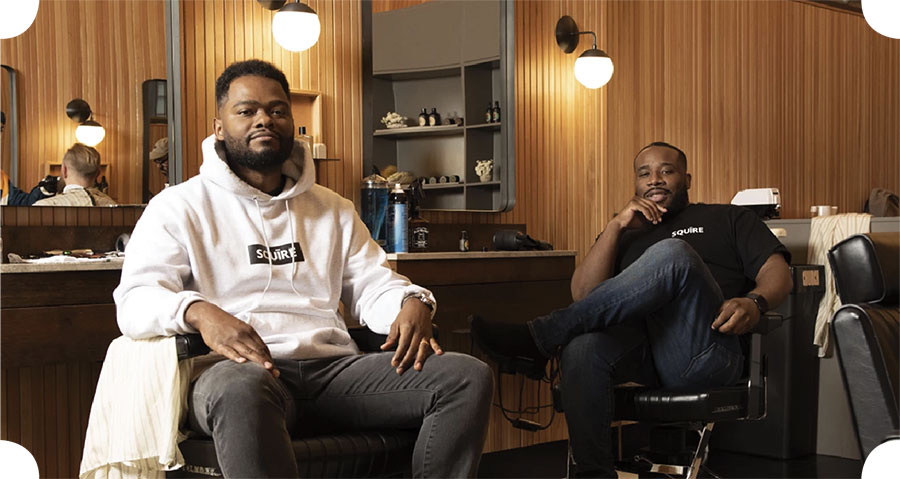
Songe LaRon (a lawyer) and Dave Salvant (a banker) had zero experience when their barber-booking app flopped. So they spent $20K of their own money buying out a Manhattan barbershop and running it for a year — that's how they found the real product: Squire, barbershop management software.
Process
In 2015, Songe LaRon was a Yale Law-educated corporate lawyer, and Dave Salvant had worked as a private banker at JPMorgan and AXA. Close friends, neither had any tech or startup background.
The inspiration traced back to LaRon's childhood — he'd been going to barbershops with his father since age six or seven. Twenty years later, he noticed software had touched nearly every part of modern life except this one: getting a haircut still meant cash payments and long waits. He and Salvant set out to build an "Uber for barbers" — a booking app connecting customers with barbers.
The problem surfaced immediately: they couldn't get barbershops to adopt the app. To validate demand anyway, they did something crude but effective — they hauled a physical barber chair to coworking spaces, bringing barbers directly to customers to prove people wanted the experience.
It still wasn't enough. Downloads were sparse, usage was worse, and shop owners complained the app didn't help their actual business.
In 2016, they made a more drastic move. Between them, they had $60,000 in savings. They spent $20,000 of it buying out the lease on a struggling barbershop in Manhattan's Chelsea Market. Without a barber's license, they couldn't cut hair themselves, but they ran everything else — front desk, inventory, customer service, daily operations — for a full year.
That year undercover as barbershop operators revealed the real problem: shop owners didn't need booking — most shops were already fully booked. What they needed was comprehensive management software: point-of-sale, inventory, staff scheduling, customer retention — all still running on pen, paper, and outdated cash registers.
That same year, armed with this new direction, they applied to and joined Y Combinator's Summer 2016 batch. The product pivoted entirely from a booking app into "QuickBooks for barbershops" — an integrated system for booking, payments, and loyalty marketing. They renamed it Squire.
Early growth came inch by inch: in early 2016, weekly sales had just crossed $5,000, growing 46% week-over-week. A regular customer at the Chelsea Market shop — Blake Chandlee, a former Facebook VP — took notice and later became an early investor.
Over the next three years, Squire grew steadily: 400% growth in 2018, expansion to 28 cities across the US, Canada, and UK, and over $100 million in cumulative transactions processed on the platform — all before raising a single dollar of institutional capital.
"This is a marathon, not something you can rush." — Songe LaRon
It wasn't until 2020 that Squire closed its first real institutional round — an $8 million Series A led by Trinity Ventures, followed by a $34 million Series B. Funding accelerated from there: over $140 million raised in total, a $750 million valuation by 2021, more than 3,000 barbershops and salons served, and over $1 billion in payments processed. But the part worth studying is that one year spent running a real barbershop with their own money — trading cash for a genuine understanding of the customer's problem.
Source: Y Combinator Blog · UAlbany Magazine · Forbes
Thinking
Insight 1: The fastest way to validate demand isn't a survey — it's running the business yourself.
LaRon and Salvant didn't send out customer surveys. They spent their own money buying a barbershop and stood behind the front desk for a year. That's more real than any "we interviewed 100 barbers" research, because they experienced the actual inventory, scheduling, and cash-register problems shop owners face daily — not what shop owners think they need when asked in an interview.
Insight 2: When your first assumption is proven wrong, have the courage to zero out and start over.
The original "Uber for barbers" idea got built into a working app — and nobody used it. The real turning point wasn't grinding harder on that direction; it was admitting the assumption was wrong, writing off the sunk cost, and spending a year embedded in a real shop to find the actual problem. The most expensive part of a startup isn't the money you spend — it's the time you keep burning refusing to admit the direction is wrong.
Insight 3: Judge whether a product matters by behavior, not by answers.
Ask a barbershop owner "do you need a booking feature?" and you'll likely get a polite "yes." But actually running the shop revealed that most shops were already fully booked — they didn't need booking at all. That insight only becomes visible from behind the counter. What customers say they want and how they actually allocate their resources are often two different things.
Insight 4: Set an affordable personal "experiment budget" for validation instead of burning money indefinitely.
Between them, they had $60,000 in savings and committed a third of it ($20,000) to this undercover-operator experiment. That's a bet an ordinary person can actually afford — no VC required, no house mortgaged. Just carve out a slice of savings as a "validation budget," run the experiment, and let the results speak.
Action
Step 1: Before writing any code, go "undercover" in the industry you want to serve.
If you're building for an industry, find a way to genuinely spend time inside it first — buy or lease a small real business in that space, take a frontline job for a few months, or shadow a practitioner's full workday. What you're watching for isn't "what they say they need" — it's what tools they actually use and where they actually get stuck.
Step 2: Validate demand the crude, manual way before you build anything.
Do what they did with the barber chair — use the crudest possible method (a person, a phone, a spreadsheet) to run a real version of the service and see if anyone actually shows up and pays. Software can always come later; the reality of demand can't be guessed.
Step 3: Write down every manual workaround your target customer uses — that's what your product needs to replace.
While embedded in the business, log every pen-and-paper ledger, verbal shift schedule, and cash-only payment you observe. Those manual workarounds are exactly what your software should attack — often not the feature you originally set out to build.
Step 4: Set a hard budget and time limit for your validation phase.
Carve out an amount you can afford to lose (a third of savings, say) and set a clear validation window (a year, for example). When it's up, force yourself to a clear conclusion — continue, pivot, or quit. Don't let "maybe it'll turn around tomorrow" drag on indefinitely.
Step 5: Only look for outside capital after you've validated a real business model.
Don't go straight to VCs or quit your job to chase a hunch. Use your own money to prove a minimum viable version of the business, get real paying customers and data — then, whether you keep bootstrapping or raise money, you're negotiating from a completely different position.
This isn't for you if: you can't stomach the opportunity cost of a year that might produce no visible output; the industry you want to serve has licensing or credential barriers that make "going undercover" on the front line impossible (heavily regulated fields like medicine or law need a different validation approach); or you have no savings at all to put toward this kind of experimental investment.