One Man, $20K, AI Tools: Matthew Gallagher Built a $401M GLP-1 Startup (Medvi)
Matthew Gallagher spent $20K and 2 months building GLP-1 telehealth brand Medvi with AI tools. AI writes code, makes ads, handles customer service; medical compliance outsourced. 2025 revenue: $401M, 16.2% net margin, one employee: his brother.
Process
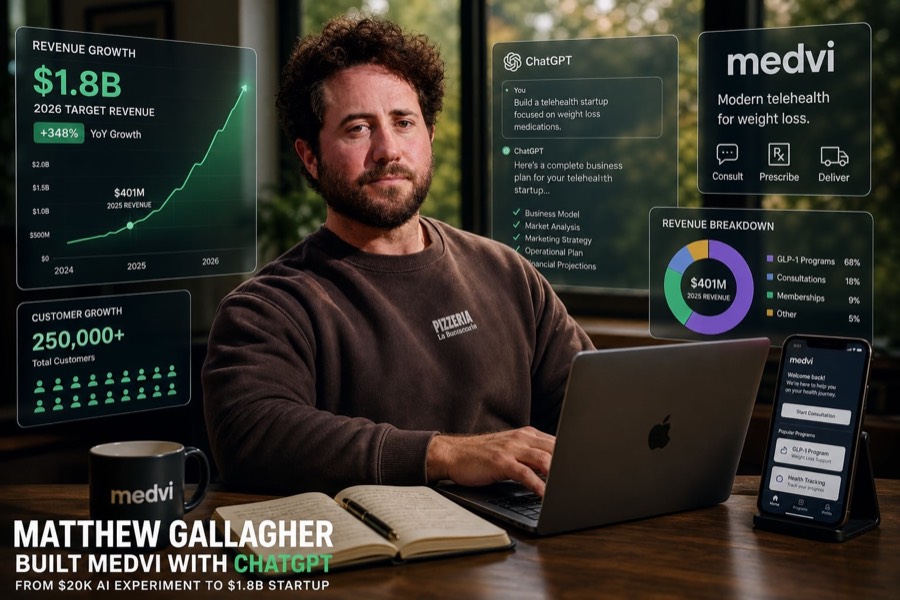
Matthew Gallagher, 41, Los Angeles. His starting point was about as low as it gets in America: he spent parts of his childhood in motels and sleeping in cars, moving constantly before finally settling in Cincinnati at age 12. An uncle gave him a laptop. He taught himself to code, built websites for local businesses, flipped candles and samurai swords on eBay. At 18, he sold a small web hosting business for $6,000 — his first real taste of building something and cashing it out.
Lesson One: 60 Employees, Never Profitable
College didn't stick. In 2010 he moved to LA to try acting, then drifted back to tech. In 2016 he founded Watch Gang, a watch subscription company with 60 employees. It ran for years and never turned a profit. He lived through the full weight of traditional headcount: payroll scales up faster than revenue, and profitable margins are brutally hard to achieve. That experience burned into him a conviction he'd carry forward: if you can avoid hiring, avoid it.
The Opportunity: AI Middleman in Healthcare
After ChatGPT launched in 2022, Gallagher started studying AI seriously. In 2024, he met a co-founder of CareValidate — a company that had built a full remote healthcare infrastructure stack: online doctors, pharmacy, prescription, delivery, and regulatory compliance all pre-assembled. OpenLoop Health offered a similar service.
He saw a structure clearly: he didn't need to build the medical backend himself. It was already built. He just needed to handle branding, marketing, and customer acquisition — exactly what AI does best.
He chose GLP-1 drugs as his entry point (semaglutide-class weight loss medications, the same category as Ozempic and Wegovy). Americans desperately want affordable weight loss prescriptions without driving to a clinic. The demand was massive. The existing options were expensive and slow.
$20K, 2 Months: Medvi Launches
In 2024, Gallagher spent $20,000 and two months building telehealth brand Medvi with more than a dozen AI tools:
- ChatGPT / Claude / Grok — code and copywriting
- Midjourney / Runway — ad creatives
- ElevenLabs — voice cloning for ads
- AI customer service — automated user intake
- CareValidate + OpenLoop Health — doctors, pharmacy, logistics, compliance: fully outsourced
September 2024: launch. Month one: 300 customers. Month two: 1,000 more.
The early days weren't clean. The AI customer service bot once recommended a lasagna recipe to a patient. It also told users it was a hair loss product company 😅. When customers requested a human, calls went directly to Gallagher's personal phone. At one point, he took over 1,000 customer service calls himself.
The Numbers Take Off
He survived the chaos. Then the growth became hard to believe.
2025 full-year revenue: $401 million. Net margin: 16.2%. Net profit: ~$65 million. Current daily revenue: approximately $3 million. 2026 projected revenue: $1.8 billion. Total customer count: over 250,000.
Comparison: Hims & Hers, a public company doing similar telehealth work, employs 2,442 people and runs a 5.5% net margin.
Medvi's total headcount: Gallagher and his brother Elliot. Two people.
He recently mentioned wanting to hire. His reason: "At this point, I kind of want to hire people because I'm lonely."
Sam Altman once predicted the "billion-dollar one-person company" would emerge. It did — not as an AI product company, but as an AI-powered middleman selling weight loss drugs.
⚠️ Note: In February 2026, the FDA sent Medvi a warning letter citing false or misleading claims about compounded semaglutide and tirzepatide on its website. The company also faces a class action lawsuit. The regulatory landscape for compounded GLP-1 drugs remains contested.
Source: NewsNation · New York Times / Techmeme · imfounder.com
Thinking
The core insight of this case isn't "weight loss drugs make money." It's that AI's real leverage isn't in building AI products — it's in flattening the headcount structure of a traditional business.
- Middleman model rediscovered: doctors, pharmacy, logistics, compliance are heavy assets, outsource them all; brand, marketing, customer service are light assets, AI handles them — this layering is the key
- AI tool stack lets one person do team-scale work: code (Claude/ChatGPT) + ad creative (Midjourney/Runway) + voice (ElevenLabs) + support (AI bot) = a complete business operating system
- $20K marginal cost makes the experiment nearly free: worst case is a $20K tuition; best case is $400M
- Watch Gang was the counter-example: 60 employees didn't create competitive advantage, just cost overhead; re-run it with AI tools and the result is completely different
Action
- Find a high-demand, high-friction market segment: GLP-1, mental health, dermatology — remote healthcare infrastructure is mature and pluggable
- Layer the business: heavy assets (compliance/logistics/production) → find existing partners; light assets (brand/traffic/support) → automate with AI
- Replace headcount with AI tool combos: code → Claude/ChatGPT, ad images → Midjourney, video ads → Runway, customer support → AI bot, voiceovers → ElevenLabs
- Minimize startup capital, validate fast: can $20K get you the first customers? If yes, scale. If not, pivot
- Design compliance in from day one: GLP-1 compounded drugs carry FDA regulatory risk; in any health-related business, compliance is architecture, not an afterthought